Office on Smoking and Health, National Center for Chronic Disease Prevention and Health Promotion, CDC.
Center for Tobacco Products, Food and Drug Administration, Silver Spring, Maryland.
MMWR Surveill Summ. 2019 Nov 6;68(12):1-22. doi: 10.15585/mmwr.ss6812a1.
PROBLEM/CONDITION: Tobacco use is the leading cause of preventable disease, disability, and death in the United States. Most tobacco product use begins during adolescence. In recent years, tobacco products have evolved to include various smoked, smokeless, and electronic products.
The National Youth Tobacco Survey (NYTS) is an annual, cross-sectional, school-based, self-administered survey of U.S. middle school (grades 6-8) and high school (grades 9-12) students. A three-stage cluster sampling procedure is used to generate a nationally representative sample of U.S. students attending public and private schools. NYTS is the only nationally representative survey of U.S. middle and high school students that focuses exclusively on tobacco use patterns and associated factors. NYTS is designed to provide national data on tobacco product use and has been conducted periodically during 1999-2009 and annually since 2011. Data from NYTS are used to support the design, implementation, and evaluation of comprehensive tobacco use prevention and control programs and to inform tobacco regulatory activities. Since its inception in 1999 through 2018, NYTS had been conducted via paper and pencil questionnaires. In 2019, NYTS for the first time was administered in schools using electronic data collection methods. CDC's Office on Smoking and Health, in collaboration with the U.S. Food and Drug Administration's (FDA's) Center for Tobacco Products, analyzed data from the 2019 NYTS to assess tobacco product use patterns and associated factors among U.S. middle and high school students. Overall, 19,018 questionnaires were completed and weighted to represent approximately 27.0 million students. On the basis of self-reported grade level, this included 8,837 middle school questionnaires (11.9 million students) and 10,097 high school questionnaires (15.0 million students); 84 questionnaires with missing information on grade level were excluded from school-level analyses.
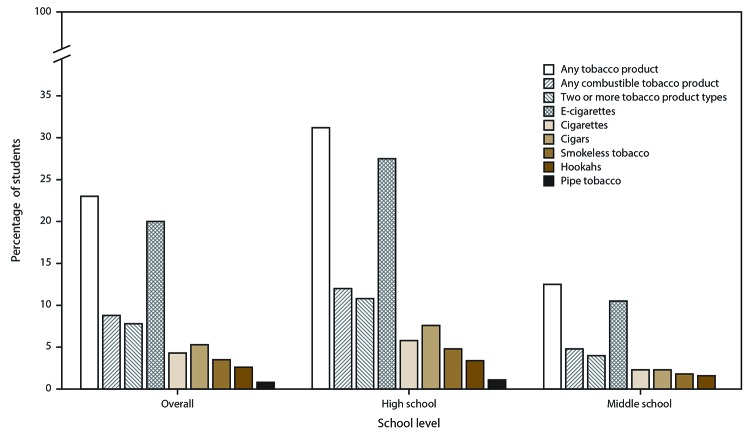
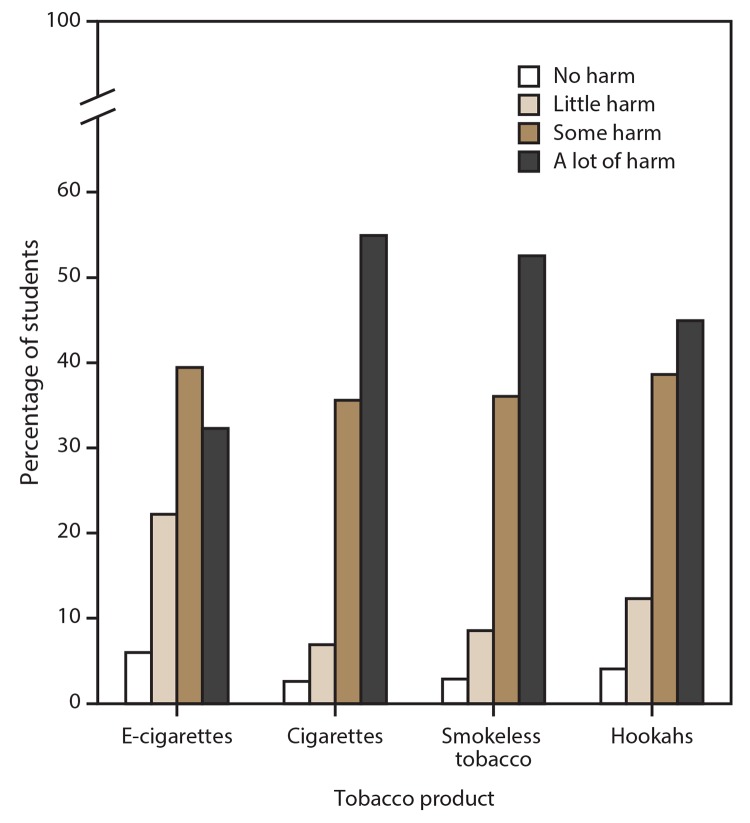
In 2019, an estimated 53.3% of high school students (8.0 million) and 24.3% of middle school students (2.9 million) reported having ever tried a tobacco product. Current (past 30-day) use of a tobacco product (i.e., electronic cigarettes [e-cigarettes], cigarettes, cigars, smokeless tobacco, hookahs, pipe tobacco, and bidis [small brown cigarettes wrapped in a leaf]) was reported by 31.2% of high school students (4.7 million) and 12.5% of middle school students (1.5 million). E-cigarettes were the most commonly cited tobacco product currently used by 27.5% of high school students (4.1 million) and 10.5% of middle school students (1.2 million), followed in order by cigars, cigarettes, smokeless tobacco, hookahs, and pipe tobacco. Tobacco product use also varied by sex and race/ethnicity. Among current users of each tobacco product, the prevalence of frequent tobacco product use (on ≥20 days of the preceding 30 days) ranged from 16.8% of cigar smokers to 34.1% of smokeless tobacco product users. Among current users of each individual tobacco product, e-cigarettes were the most commonly used flavored tobacco product (68.8% of current e-cigarette users). Among students who reported ever having tried e-cigarettes, the three most commonly selected reasons for use were "I was curious about them" (55.3%), "friend or family member used them" (30.8%), and "they are available in flavors, such as mint, candy, fruit, or chocolate" (22.4%). Among never users of each individual tobacco product, curiosity and susceptibility (a construct that can help to identify future tobacco product experimentation or use) was highest for e-cigarettes (39.1% and 45.0%, respectively) and cigarettes (37.0% and 45.9%, respectively). Overall, 86.3% of students who reported contact with an assessed potential source of tobacco product advertisements or promotions (going to a convenience store, supermarket, or gas station; using the Internet; watching television or streaming services or going to the movies; or reading newspapers or magazines) reported exposure to marketing for any tobacco product; 69.3% reported exposure to e-cigarette marketing and 81.7% reported exposure to marketing for cigarettes or other tobacco products. Among all students, perceiving no harm or little harm from intermittent tobacco product use (use on some days but not every day) was 28.2% for e-cigarettes, 16.4% for hookahs, 11.5% for smokeless tobacco products, and 9.5% for cigarettes. Among current users of any tobacco product, 24.7% reported experiencing cravings to use tobacco products during the past 30 days and 13.7% reported wanting to use a tobacco product within 30 minutes of waking. Moreover, 57.8% of current tobacco product users reported they were seriously thinking about quitting the use of all tobacco products and 57.5% reported they had stopped using all tobacco products for ≥1 day because they were trying to quit.
In 2019, approximately one in four youths (23.0%) had used a tobacco product during the past 30 days. By school level, this represented approximately three in 10 high school students (31.2%) and approximately one in eight middle school students (12.5%). Since 2014, e-cigarettes have been the most commonly used tobacco product among youths. Importantly, more than half of current youth tobacco product users reported seriously thinking about quitting all tobacco products in 2019. However, established factors of use and initiation, including the availability of flavors, exposure to tobacco product marketing, curiosity and susceptibility, and misperceptions about harm from tobacco product use, remained prevalent in 2019 and continue to promote tobacco product use among youths.
The continued monitoring of all forms of youth tobacco product use and associated factors through surveillance efforts including NYTS is important to the development of public health policy and action at national, state, and community levels. Everyone, including public health professionals, health care providers, policymakers, educators, parents, and others who influence youths, can help protect youths from the harms of all tobacco products. In addition, the comprehensive and sustained implementation of evidence-based tobacco control strategies, combined with FDA's regulation of tobacco products, is important for reducing all forms of tobacco product use among U.S. youths.
问题/状况:吸烟是美国可预防疾病、残疾和死亡的主要原因。大多数烟草制品的使用始于青少年时期。近年来,烟草制品已发展为各种吸食、无烟和电子产品。
2019 年。
全国青年烟草调查(NYTS)是一项针对美国中学(6-8 年级)和高中(9-12 年级)学生的年度、横断面、以学校为基础的自我管理调查。采用三级整群抽样程序生成具有代表性的美国公立和私立学校学生样本。NYTS 是唯一一项专门针对美国中、高中生吸烟模式和相关因素的全国性调查。NYTS 旨在提供全国范围内关于烟草制品使用的数据,并定期在 1999-2009 年和 2011 年以来每年进行。NYTS 数据用于支持全面烟草使用预防和控制计划的设计、实施和评估,并为烟草监管活动提供信息。自 1999 年成立以来,NYTS 通过纸笔问卷进行。2019 年,NYTS 首次在学校使用电子数据收集方法进行。疾病控制与预防中心(CDC)的吸烟与健康办公室与美国食品和药物管理局(FDA)的烟草产品中心合作,分析了 2019 年 NYTS 的数据,以评估美国中、高中生的烟草制品使用模式和相关因素。总体而言,完成了 19018 份问卷,并进行了加权处理,以代表大约 2700 万名学生。根据自我报告的年级,这包括 8837 份中学问卷(1.19 亿名学生)和 10097 份高中问卷(1.50 亿名学生);84 份问卷因年级信息缺失而被排除在学校层面的分析之外。
2019 年,估计有 53.3%的高中生(8000 万人)和 24.3%的中学生(2900 万人)报告曾经尝试过一种烟草制品。目前(过去 30 天)使用任何烟草制品(即电子烟、香烟、雪茄、无烟烟草、水烟、烟斗烟草和比迪烟[小棕色卷烟,用叶子包裹])的比例为 31.2%的高中生(4700 万人)和 12.5%的中学生(1500 万人)。电子烟是最常被当前使用的烟草制品,27.5%的高中生(4100 万人)和 10.5%的中学生(1200 万人)使用电子烟,其次是雪茄、香烟、无烟烟草、水烟和烟斗烟草。烟草制品的使用也因性别和种族/民族而异。在每种烟草制品的当前使用者中,频繁使用烟草制品(过去 30 天中≥20 天使用)的比例范围从雪茄吸烟者的 16.8%到无烟烟草制品使用者的 34.1%。在每种单一烟草制品的当前使用者中,电子烟是最常使用的调味烟草制品(68.8%的当前电子烟使用者)。在报告曾经尝试过电子烟的学生中,尝试电子烟的三个最常见原因是“我对它们很好奇”(55.3%)、“朋友或家人使用它们”(30.8%)和“它们有薄荷、糖果、水果或巧克力等口味”(22.4%)。在每种单一烟草制品的从未使用者中,对电子烟(分别为 39.1%和 45.0%)和香烟(分别为 37.0%和 45.9%)的好奇心和易感性(一种有助于确定未来是否会尝试使用烟草制品的结构)最高。总体而言,86.3%的学生报告接触过评估的烟草制品广告或促销的潜在来源(去便利店、超市或加油站;使用互联网;看电视或流媒体服务或去看电影;或阅读报纸或杂志),他们接触到了任何烟草制品的营销;69.3%的人接触到电子烟营销,81.7%的人接触到香烟或其他烟草制品的营销。在所有学生中,28.2%的人认为偶尔使用烟草制品(有时使用但不是每天使用)没有危害或危害很小,16.4%的人认为水烟没有危害,11.5%的人认为无烟烟草制品没有危害,9.5%的人认为香烟没有危害。在所有当前烟草制品使用者中,24.7%的人报告在过去 30 天内有吸烟的冲动,13.7%的人报告在醒来后 30 分钟内有使用烟草制品的欲望。此外,57.8%的当前烟草制品使用者报告他们正在认真考虑戒掉所有烟草制品,57.5%的报告他们已经停止使用所有烟草制品≥1 天,因为他们试图戒烟。
2019 年,大约四分之一的年轻人(23.0%)在过去 30 天内使用过一种烟草制品。按学校水平计算,这代表大约十分之三的高中生(31.2%)和大约八分之一的中学生(12.5%)。自 2014 年以来,电子烟一直是年轻人中最常使用的烟草制品。重要的是,2019 年超过一半的当前青少年烟草制品使用者报告他们正在认真考虑戒掉所有烟草制品。然而,使用和开始使用的既定因素,包括口味的可用性、烟草制品营销的暴露、好奇心和易感性以及对烟草制品使用危害的误解,在 2019 年仍然普遍存在,并继续促进年轻人使用烟草制品。
通过包括 NYTS 在内的监测努力,持续监测所有形式的青年烟草制品使用和相关因素,对于制定国家、州和社区各级的公共卫生政策和行动非常重要。每个人,包括公共卫生专业人员、卫生保健提供者、政策制定者、教育工作者、家长和其他影响年轻人的人,都可以帮助保护年轻人免受所有烟草制品的危害。此外,全面和持续地实施循证烟草控制策略,结合 FDA 对烟草制品的监管,对于减少美国年轻人使用所有形式的烟草制品非常重要。