St Peter Wendy L, Guo Haifeng, Kabadi Shaum, Gilbertson David T, Peng Yi, Pendergraft Trudy, Li Suying
Chronic Disease Research Group, Minneapolis Medical Research Foundation, 701 Park Avenue, Suite S4.100, Minneapolis, MN, 55455, USA.
College of Pharmacy, University of Minnesota, Minneapolis, MN, USA.
BMC Nephrol. 2018 Mar 15;19(1):67. doi: 10.1186/s12882-018-0861-1.
Anemia is common in non-dialysis-dependent chronic kidney disease (NDD-CKD) patients, but detailed information on prevalence and treatment is lacking.
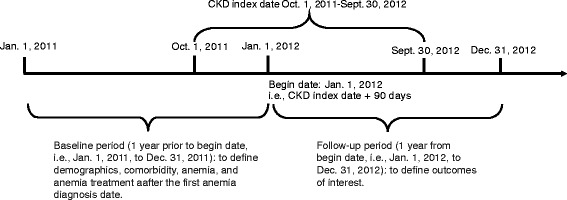
We evaluated anemia prevalence and treatment using two datasets: the Medicare 20% random sample (ages 66-85 years), and the Truven Health MarketScan database (ages 18-63 years). We selected stage 3-5 NDD-CKD patients with and without anemia from both databases during 2011-2013. We evaluated anemia prevalence and treatment (erythropoietin stimulating agents [ESAs], intravenous [IV] iron, red blood cell [RBC] transfusions) following anemia diagnosis during a 1-year baseline period, and healthcare utilization during a 1-year follow-up period. We used Poisson regression models to compare healthcare utilization in patients with and without anemia, adjusting for demographics, baseline comorbid conditions, inflammatory conditions, and CKD stage.
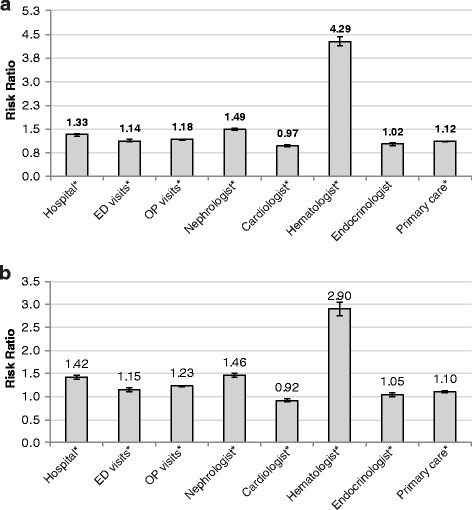
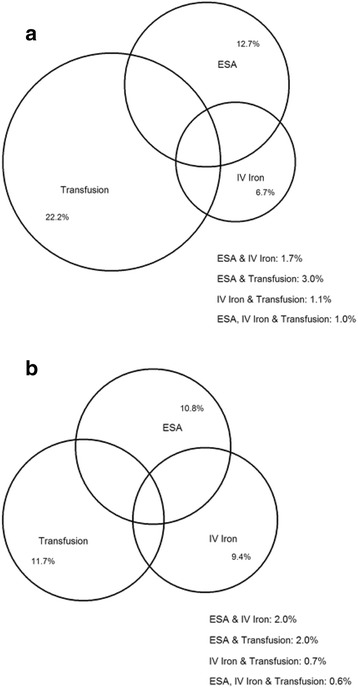
We identified 218,079 older and 56,188 younger stage 3-5 NDD-CKD patients. Anemia prevalence increased with age in both datasets; was higher in women, black patients (Medicare only), and patients with comorbid conditions; and rose sharply with increasing CKD stage. Of 15,716 younger anemic patients, 11.7%, 10.8%, and 9.4% were treated with RBC transfusion, ESAs, and IV iron, respectively. Corresponding proportions of 109,251 older anemic patients were 22.2%, 12.7%, and 6.7%. Regardless of age, anemic patients were more likely than non-anemic patients to use healthcare resources, including hospitalizations and emergency department, hematologist, nephrologist, and outpatient visits. Anemic NDD-CKD patients were more likely to be treated with RBC transfusion than with ESAs or IV iron.
More research is necessary to determine best approaches to anemia management in CKD.
贫血在非透析依赖性慢性肾脏病(NDD-CKD)患者中很常见,但缺乏关于患病率和治疗的详细信息。
我们使用两个数据集评估贫血患病率和治疗情况:医疗保险20%随机样本(年龄66 - 85岁)和Truven Health MarketScan数据库(年龄18 - 63岁)。我们在2011 - 2013年期间从两个数据库中选取了患有和未患贫血的3 - 5期NDD-CKD患者。我们评估了在1年基线期贫血诊断后的贫血患病率和治疗情况(促红细胞生成素刺激剂[ESA]、静脉注射[IV]铁、红细胞[RBC]输血),以及1年随访期内的医疗资源利用情况。我们使用泊松回归模型比较患贫血和未患贫血患者的医疗资源利用情况,并对人口统计学、基线合并症、炎症状态和CKD分期进行调整。
我们识别出218,079名老年和56,188名年轻的3 - 5期NDD-CKD患者。在两个数据集中,贫血患病率均随年龄增长而升高;在女性、黑人患者(仅医疗保险数据集)和有合并症的患者中更高;并且随着CKD分期增加而急剧上升。在15,716名年轻贫血患者中,分别有11.7%、10.8%和9.4%接受了RBC输血、ESA和IV铁治疗。109,251名老年贫血患者的相应比例分别为22.2%、12.7%和6.7%。无论年龄如何,贫血患者比非贫血患者更有可能使用医疗资源,包括住院、急诊科、血液科医生、肾内科医生和门诊就诊。贫血的NDD-CKD患者接受RBC输血治疗的可能性高于接受ESA或IV铁治疗。
需要更多研究来确定CKD贫血管理的最佳方法。