Harvard T.H. Chan School of Public Health Harvard University, Boston, MA
Harvard T.H. Chan School of Public Health Harvard University, Boston, MA.
J Am Heart Assoc. 2018 Mar 15;7(6):e008245. doi: 10.1161/JAHA.117.008245.
The cardiovascular effects of low-level environmental radiation exposures are poorly understood. Although particulate matter (PM) has been linked to cardiovascular morbidity and mortality, and elevated blood pressure (BP), the properties promoting its toxicity remain uncertain. Addressing a knowledge gap, we evaluated whether BP increased with higher exposures to radioactive components of ambient PM, herein referred to as particle radioactivity (PR).
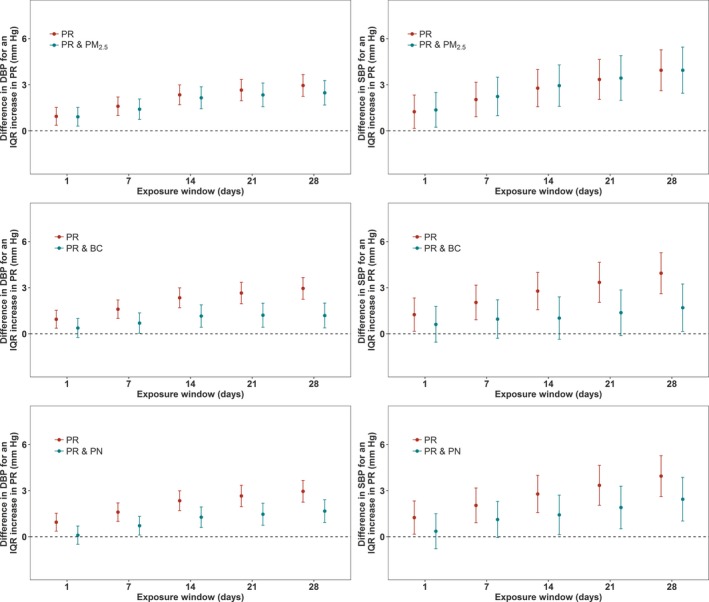
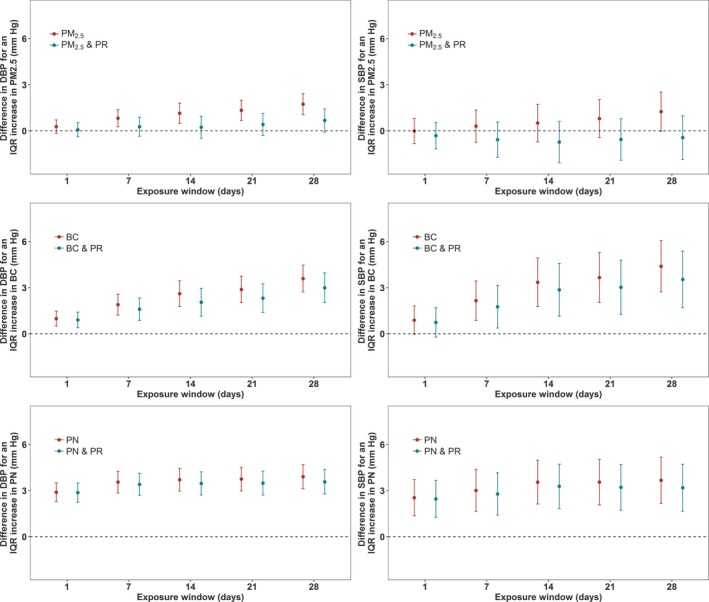
We performed a repeated-measures analysis of 852 men to examine associations between PR exposure and BP using mixed-effects regression models. As a surrogate for PR, we used gross β activity, measured by the US Environmental Protection Agency's radiation monitoring network. Higher PR exposure was associated with increases in both diastolic BP and systolic BP, for exposures from 1 to 28 days. An interquartile range increase in 28-day PR exposure was associated with a 2.95-mm Hg increase in diastolic BP (95% confidence interval, 2.25-3.66; <0.001) and a 3.94-mm Hg increase in systolic BP (95% confidence interval, 2.62-5.27; <0.001). For models including both PR and PM ≤2.5 µm, the PR-BP associations remained stable and significant. For models including PR and black carbon or PR and particle number, the PR-BP associations were attenuated; however, they remained significant for many exposure durations.
This is the first study to demonstrate the potential adverse effects of PR on both systolic and diastolic BPs. These were independent and similar in magnitude to those of PM ≤2.5 µm, black carbon, and particle number. Understanding the effects of particle-bound radionuclide exposures on BP may have important implications for environmental and public health policy.
低水平环境辐射暴露对心血管的影响尚未被充分了解。尽管颗粒物(PM)与心血管发病率和死亡率以及血压升高有关,但促进其毒性的特性仍不确定。为了解决这一知识空白,我们评估了环境 PM 中放射性成分(即颗粒放射性,PR)的更高暴露是否会导致血压升高。
我们对 852 名男性进行了重复测量分析,使用混合效应回归模型检查 PR 暴露与 BP 之间的关联。我们使用美国环境保护署辐射监测网络测量的总 β 活度作为 PR 的替代物。更高的 PR 暴露与舒张期和收缩期血压均升高相关,暴露时间从 1 天到 28 天不等。28 天 PR 暴露的四分位间距增加与舒张期 BP 升高 2.95mmHg 相关(95%置信区间,2.25-3.66;<0.001),收缩期 BP 升高 3.94mmHg 相关(95%置信区间,2.62-5.27;<0.001)。对于同时包含 PR 和 PM≤2.5 µm 的模型,PR-BP 关联仍然稳定且显著。对于包含 PR 和黑碳或 PR 和粒子数的模型,PR-BP 关联减弱;然而,对于许多暴露持续时间,它们仍然具有统计学意义。
这是第一项证明 PR 对收缩压和舒张压均有潜在不良影响的研究。这些影响与 PM≤2.5 µm、黑碳和粒子数的影响独立且程度相似。了解颗粒结合放射性核素暴露对 BP 的影响可能对环境和公共卫生政策具有重要意义。