Ni Zhong, Wang Xiting, Zhang Tianchen, Li Linlin, Li Jianxue
Institute of Life Sciences, Jiangsu University, Zhenjiang, Jiangsu 212013, P.R. China.
Institute of Reproduction and Development, Fudan University, Shanghai 200032, P.R. China.
Exp Ther Med. 2018 Apr;15(4):3273-3282. doi: 10.3892/etm.2018.5833. Epub 2018 Feb 2.
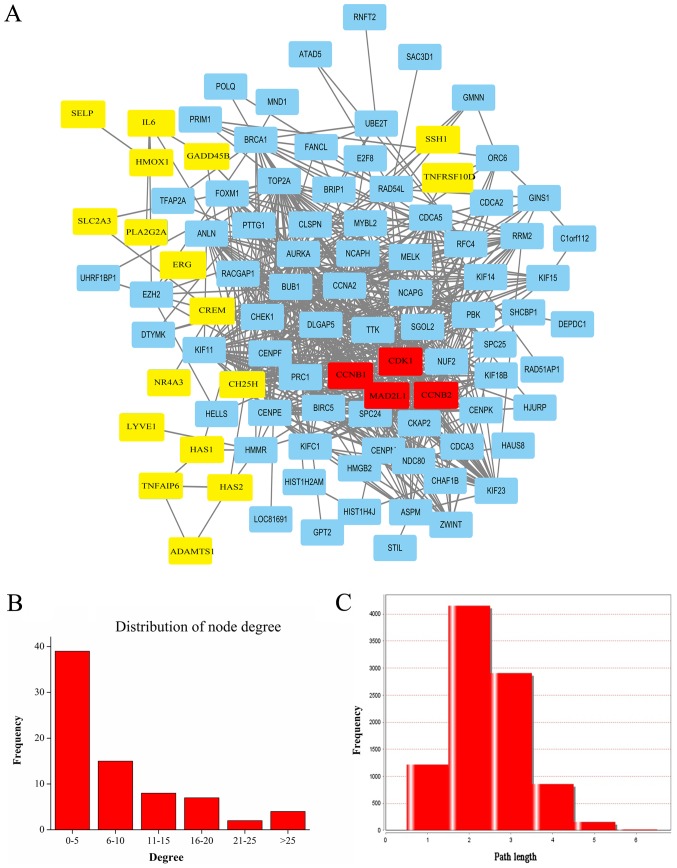
Small cell lung cancer (SCLC) is the subtype of lung cancer with the highest degree of malignancy and the lowest degree of differentiation. The purpose of this study was to investigate the molecular mechanisms of SCLC using bioinformatics analysis, and to provide new ideas for the early diagnosis and targeted therapy of SCLC. Microarray data were downloaded from Gene Expression Omnibus. Differentially expressed genes (DEGs) in SCLC were compared with the normal lung samples and identified. Gene Ontology (GO) function and pathway analysis of DEGs was performed through the DAVID database. Furthermore, microarray data was analyzed by using the clustering analysis tool GoMiner. Protein-protein interaction (PPI) networks of DEGs were constructed using the STRING online database. Protein expression was determined from the Human Protein Atlas, and SCLC gene expression was determined using Oncomine. In total, 153 DEGs were obtained. Functional enrichment analysis suggested that the majority of DEGs were associated with the cell cycle. and were identified to contribute to the progression of SCLC through combined use of GO, Kyoto Encyclopedia of Genes and Genomes enrichment analysis and a PPI network. mRNA and protein expression were also validated in an integrative database. The present study indicated that the formation of SCLC may be associated with cell cycle regulation. In addition, the four crucial genes and , which are downstream of p53, may have important roles in the occurrence and progression of SCLC, and thus may be promising potential biomarkers and therapeutic targets.
小细胞肺癌(SCLC)是肺癌中恶性程度最高、分化程度最低的亚型。本研究旨在通过生物信息学分析探究小细胞肺癌的分子机制,为小细胞肺癌的早期诊断和靶向治疗提供新思路。微阵列数据从基因表达综合数据库下载。将小细胞肺癌中的差异表达基因(DEGs)与正常肺组织样本进行比较并鉴定。通过DAVID数据库对DEGs进行基因本体论(GO)功能和通路分析。此外,使用聚类分析工具GoMiner对微阵列数据进行分析。利用STRING在线数据库构建DEGs的蛋白质-蛋白质相互作用(PPI)网络。从人类蛋白质图谱确定蛋白质表达,并使用Oncomine确定小细胞肺癌基因表达。共获得153个DEGs。功能富集分析表明,大多数DEGs与细胞周期相关。通过联合使用GO、京都基因与基因组百科全书富集分析和PPI网络,确定了 和 有助于小细胞肺癌的进展。在一个综合数据库中也验证了mRNA和蛋白质表达。本研究表明,小细胞肺癌的形成可能与细胞周期调控有关。此外,p53下游的四个关键基因 和 可能在小细胞肺癌的发生和进展中起重要作用,因此可能是有前景的潜在生物标志物和治疗靶点。