Cell and Molecular Biology Graduate Program, University of Pennsylvania Perelman School of Medicine, Philadelphia, PA 19104, USA; Division of Cancer Pathobiology, Children's Hospital of Philadelphia, Philadelphia, PA 19104, USA; Division of Protective Immunity, Children's Hospital of Philadelphia, Philadelphia, PA 19104, USA.
Division of Cancer Pathobiology, Children's Hospital of Philadelphia, Philadelphia, PA 19104, USA; Division of Protective Immunity, Children's Hospital of Philadelphia, Philadelphia, PA 19104, USA; Department of Pathology and Laboratory Medicine, University of Pennsylvania Perelman School of Medicine, Philadelphia, PA 19104, USA.
Virology. 2018 May;518:221-231. doi: 10.1016/j.virol.2018.02.023. Epub 2018 Mar 15.
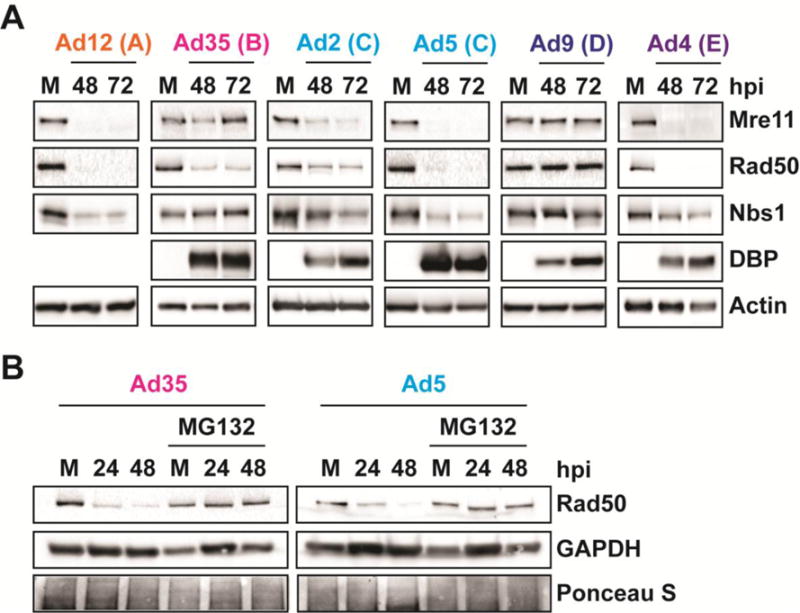
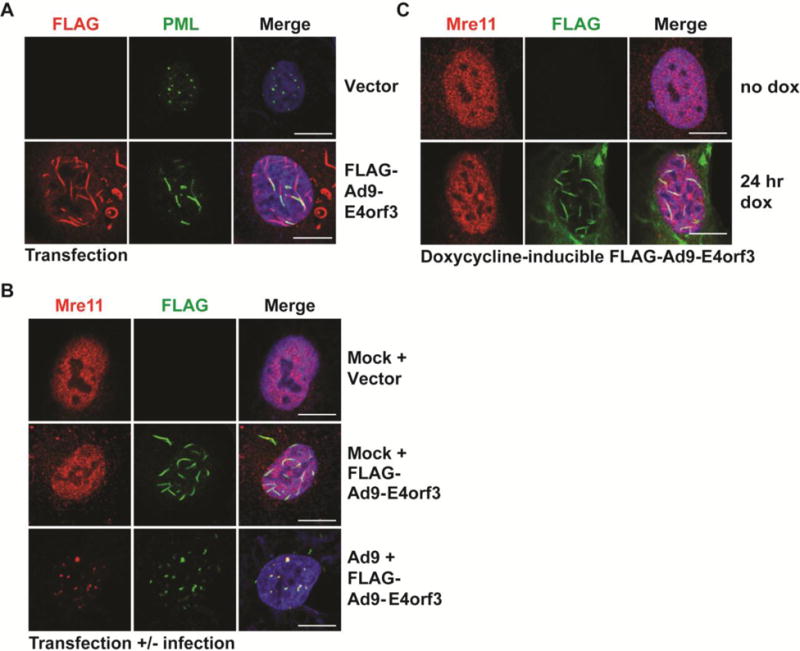
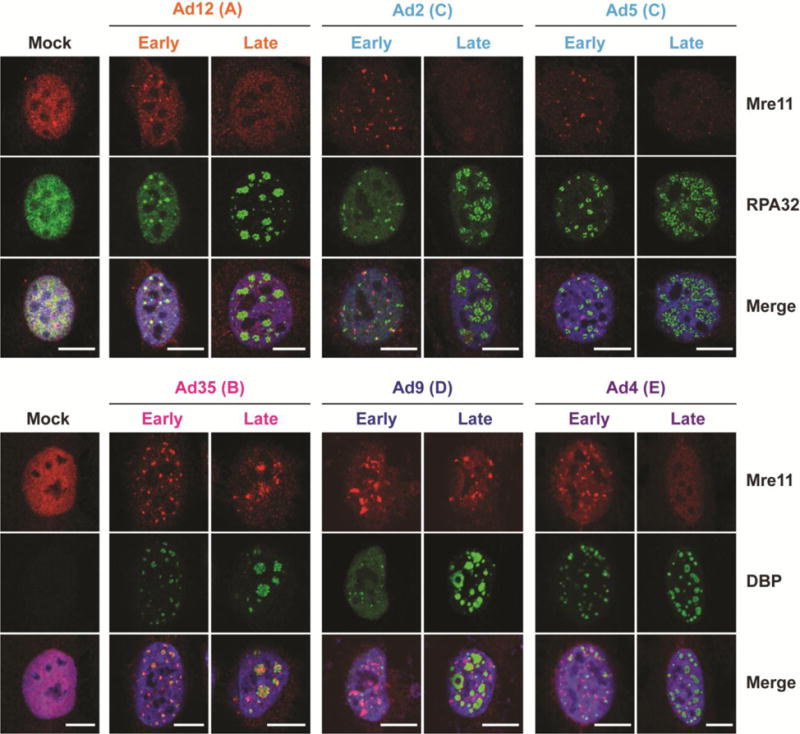
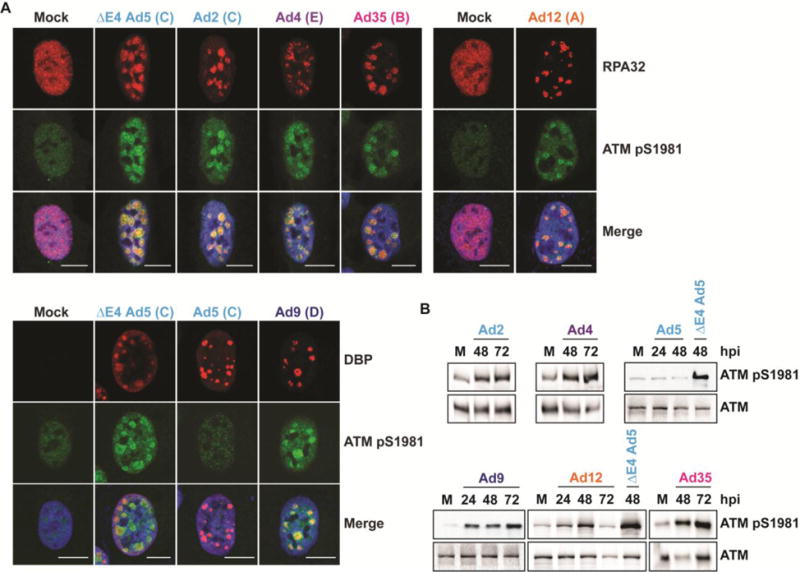
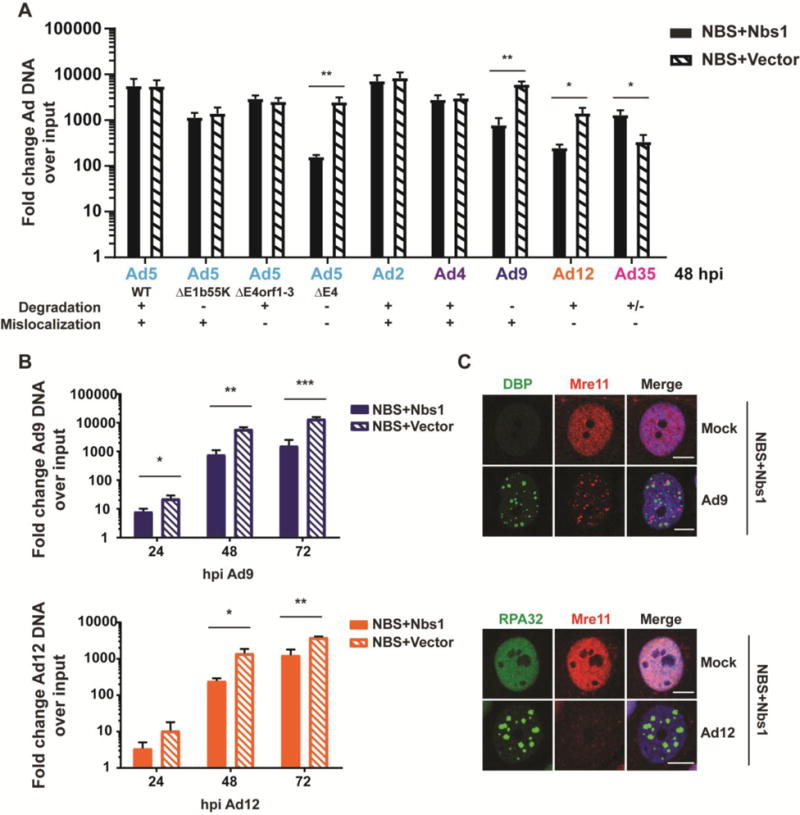
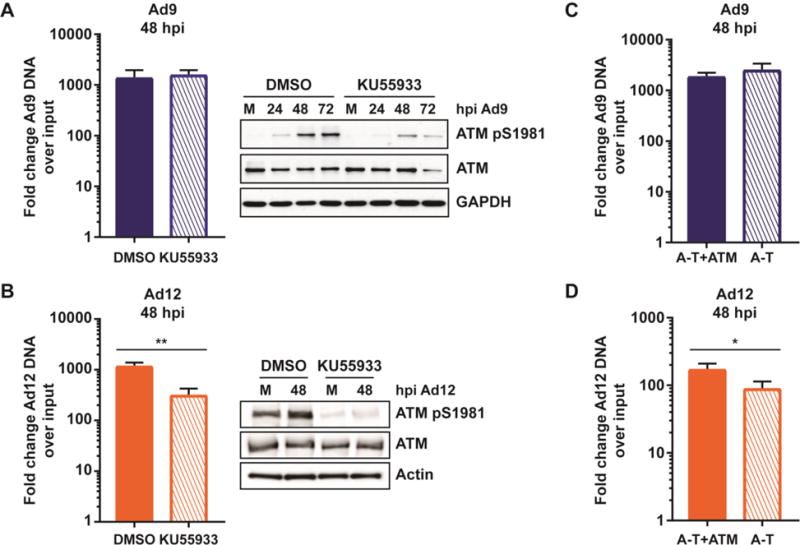
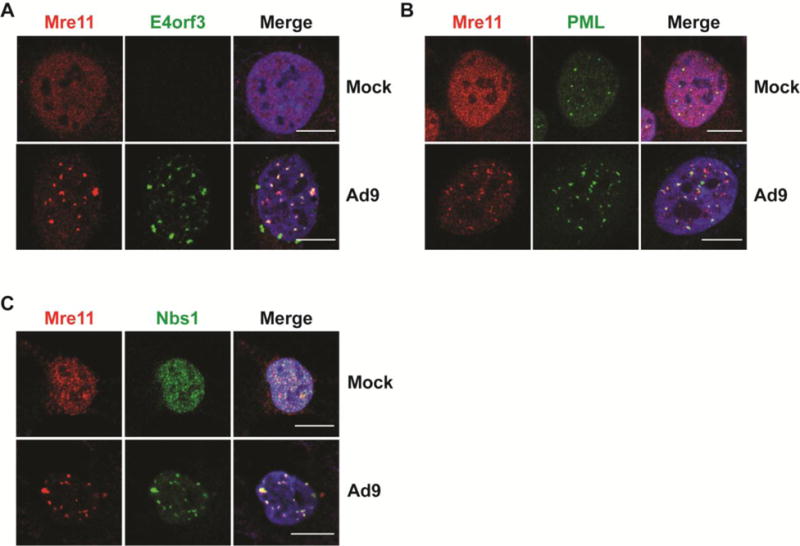
During viral replication in the nucleus, the DNA genomes of adenoviruses are accessible to cellular DNA-binding proteins. Human adenovirus type 5 (Ad5) targets the cellular Mre11-Rad50-Nbs1 complex (MRN) to evade detection by the DNA damage response (DDR). Ad5 mutants that cannot target MRN have reduced viral propagation. Previous studies showed that diverse adenovirus serotypes interact differently with MRN. While these studies revealed diverse MRN interactions among serotypes, it remains unclear how these differences influence viral replication. Here, we examined effects of the DDR on several adenovirus serotypes. We demonstrate that wild-type Ad9 and Ad12 do not overcome MRN impairment. We also examined viral proteins involved in targeting MRN and found that unlike Ad5-E4orf3, expression of Ad9-E4orf3 is not sufficient for MRN mislocalization observed during infection. We conclude that adenovirus serotypes target MRN in distinct ways, and the MRN complex can impair DNA replication of wild-type viruses across the adenovirus family.
在细胞核中的病毒复制过程中,腺病毒的 DNA 基因组可被细胞 DNA 结合蛋白所识别。人类腺病毒 5 型(Ad5)将细胞中的 Mre11-Rad50-Nbs1 复合物(MRN)作为靶标,以逃避细胞对 DNA 损伤反应(DDR)的检测。无法靶向 MRN 的 Ad5 突变体的病毒增殖能力会降低。先前的研究表明,不同的腺病毒血清型与 MRN 的相互作用方式不同。虽然这些研究揭示了不同血清型之间的多种 MRN 相互作用,但尚不清楚这些差异如何影响病毒复制。在这里,我们研究了 DDR 对几种腺病毒血清型的影响。我们证明野生型 Ad9 和 Ad12 并不能克服 MRN 的损伤。我们还研究了参与靶向 MRN 的病毒蛋白,发现与 Ad5-E4orf3 不同,Ad9-E4orf3 的表达不足以导致感染过程中观察到的 MRN 定位错误。我们得出的结论是,腺病毒血清型以不同的方式靶向 MRN,而 MRN 复合物可以在整个腺病毒家族中损害野生型病毒的 DNA 复制。