Global Health, Economics & Policy, Faculty of Medical Sciences, University of Kragujevac, Kragujevac, Serbia.
Center for Health Trends and Forecasts, Institute for Health Metrics and Evaluation, University of Washington, Seattle, USA.
Global Health. 2018 Mar 16;14(1):30. doi: 10.1186/s12992-018-0348-7.
There is a gap in knowledge on long term pace of population aging acceleration and related net-migration rate changes in WHO European Region and its adjacent MENA countries. We decided to compare European Union (EU-28) region with the EU Near Neighborhood Policy Region East and EU Near Neighborhood Policy Region South in terms of these two essential features of third demographic transition. One century long perspective dating back to both historical data and towards reliable future forecasts was observed.
United Nation's Department of Economic and Social Affairs estimates on indicators of population aging and migration were observed. Time horizon adopted was 1950-2050. Targeted 44 countries belong to either one of three regions named by EU diplomacy as: European Union or EU-28, EU Near Neighborhood Policy Region East (ENP East) and EU Near Neighborhood Policy Region South (ENP South).
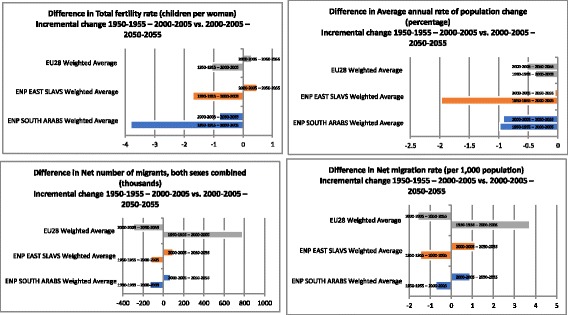
European Union region currently experiences most advanced stage of demographic aging. The latter one is the ENP East region dominated by Slavic nations whose fertility decline continues since the USSR Era back in late 1980s. ENP South region dominated by Arab League nations remains rather young compared to their northern counterparts. However, as the Third Demographic Transition is inevitably coming to these societies they remain the spring of youth and positive net emigration rate. Probably the most prominent change will be the extreme fall of total fertility rate (children per woman) in ENP South countries (dominantly Arab League) from 6.72 back in 1950 to medium-scenario forecasted 2.10 in 2050. In the same time net number of migrants in the EU28 (both sexes combined) will grow from - 91,000 in 1950 to + 394,000 in 2050.
Long term migration from Eastern Europe westwards and from MENA region northwards is historically present for many decades dating back deep into the Cold War Era. Contemporary large-scale migrations outsourcing from Arab League nations towards rich European Protestant North is probably the peak of an iceberg in long migration routes history. However, in the decades to come acceleration of aging is likely to question sustainability of such movements of people.
在世界卫生组织欧洲区域及其毗邻的中东和北非国家,人们对人口老龄化加速的长期速度以及相关净移民率变化知之甚少。我们决定比较欧盟(欧盟 28 国)区域与欧盟邻国政策东部区域和欧盟邻国政策南部区域这两个第三次人口转变的基本特征。我们从历史数据和可靠的未来预测两个方面,对长达一个世纪的人口老龄化和移民指标进行了观察。
我们观察了联合国经济和社会事务部关于人口老龄化和移民的指标。所采用的时间范围是 1950 年至 2050 年。目标是观察属于欧盟外交政策所确定的三个地区之一的 44 个国家:欧盟或欧盟 28 国、欧盟邻国政策东部区域(ENP 东部)和欧盟邻国政策南部区域(ENP 南部)。
欧盟区域目前正处于人口老龄化最先进的阶段。后者是东欧国家,其生育率自 20 世纪 80 年代末苏联时代以来一直在持续下降。与北方邻国相比,以阿拉伯联盟国家为主的南部区域相对年轻。然而,随着第三次人口转变不可避免地到来,这些国家仍然是年轻和正净移民率的源泉。可能最显著的变化将是阿拉伯联盟国家(主要是阿拉伯联盟)的总和生育率(每名妇女的儿童人数)从 1950 年的 6.72 急剧下降到 2050 年中等情景预测的 2.10。与此同时,欧盟 28 国(两性合计)的净移民人数将从 1950 年的-91000 人增加到 2050 年的+394000 人。
几十年来,东欧向西移民和中东和北非地区向北移民的情况一直存在,可以追溯到冷战时代。当代阿拉伯联盟国家向富裕的欧洲新教北方大规模外包移民,可能是长期移民历史上冰山一角的顶峰。然而,在未来几十年,老龄化的加速可能会对这种人口流动的可持续性提出质疑。