Ramya A Radhika, Ahamed M Lal, Satyavathi C Tara, Rathore Abhishek, Katiyar Pooja, Raj A G Bhasker, Kumar Sushil, Gupta Rajeev, Mahendrakar Mahesh D, Yadav Rattan S, Srivastava Rakesh K
Department of Genetics and Plant Breeding, Acharya N. G. Ranga Agricultural University, Guntur, India.
International Crops Research Institute for the Semi-Arid Crops, Patancheru, India.
Front Plant Sci. 2018 Mar 2;8:1934. doi: 10.3389/fpls.2017.01934. eCollection 2017.
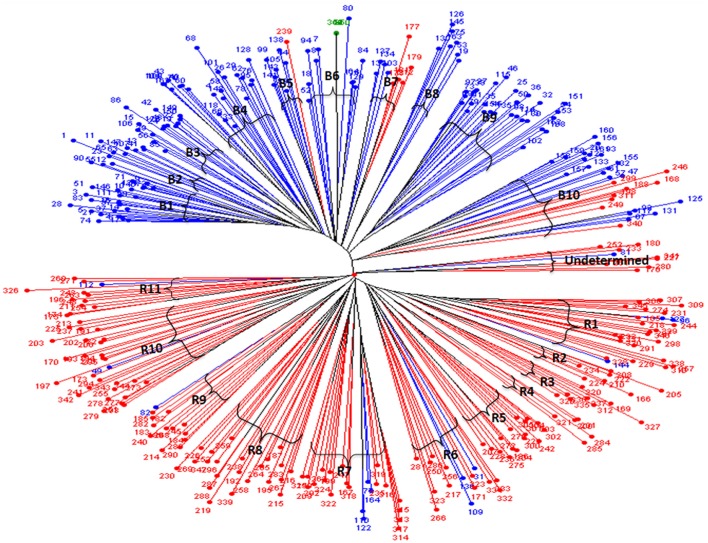
Pearl millet is a climate resilient crop and one of the most widely grown millets worldwide. Heterotic hybrid development is one of the principal breeding objectives in pearl millet. In a maiden attempt to identify heterotic groups for grain yield, a total of 343 hybrid parental [maintainer (B-) and restorer (R-)] lines were genotyped with 88 polymorphic SSR markers. The SSRs generated a total of 532 alleles with a mean value of 6.05 alleles per locus, mean gene diversity of 0.55, and an average PIC of 0.50. Out of 532 alleles, 443 (83.27%) alleles were contributed by B-lines with a mean of 5.03 alleles per locus. R-lines contributed 476 alleles (89.47%) with a mean of 5.41, while 441 (82.89%) alleles were shared commonly between B- and R-lines. The gene diversity was higher among R-lines (0.55) compared to B-lines (0.49). The unweighted neighbor-joining tree based on simple matching dissimilarity matrix obtained from SSR data clearly differentiated B- lines into 10 sub-clusters (B1 through B10), and R- lines into 11 sub-clusters (R1 through R11). A total of 99 hybrids (generated by crossing representative 9 B- and 11 R- lines) along with checks were evaluated in the hybrid trial. The 20 parents were evaluated in the line trial. Both the trials were evaluated in three environments. Based on performance, high effects and standard heterosis, Fs generated from crosses between representatives of groups B10R5, B3R5, B3R6, B4UD, B5R11, B2R4, and B9R9 had high specific combining ability for grain yield compared to rest of the crosses. These groups may represent putative heterotic gene pools in pearl millet.
珍珠粟是一种适应气候变化的作物,也是全球种植最广泛的粟类作物之一。杂种优势杂交种的培育是珍珠粟育种的主要目标之一。在首次尝试鉴定籽粒产量的杂种优势群时,利用88个多态性SSR标记对总共343个杂交亲本[保持系(B-)和恢复系(R-)]进行了基因分型。这些SSR共产生了532个等位基因,每个位点平均有6.05个等位基因,平均基因多样性为0.55,平均多态信息含量为0.50。在532个等位基因中,443个(83.27%)等位基因由B系贡献,每个位点平均有5.03个等位基因。R系贡献了476个等位基因(89.47%),平均为5.41个,而441个(82.89%)等位基因在B系和R系之间共有。R系的基因多样性(0.55)高于B系(0.49)。基于从SSR数据获得的简单匹配差异矩阵构建的非加权邻接树,将B系清晰地分为10个亚群(B1至B10),R系分为11个亚群(R1至R11)。在杂交试验中对总共99个杂交种(由9个代表性B系和11个R系杂交产生)以及对照进行了评估。在品系试验中对20个亲本进行了评估。两项试验均在三种环境下进行评估。基于表现、高效应和标准杂种优势,与其他杂交组合相比,B10R5、B3R5、B3R6、B4UD、B5R11、B2R4和B9R9组代表之间杂交产生的F1在籽粒产量方面具有较高的特殊配合力。这些组可能代表珍珠粟中假定的杂种优势基因库。