Dornsife Center for Self-Report Science, University of Southern California, Los Angeles, CA, USA.
Department of Psychology, University of Southern California, Los Angeles, CA, USA.
Pain. 2018 Jul;159(7):1346-1358. doi: 10.1097/j.pain.0000000000001215.
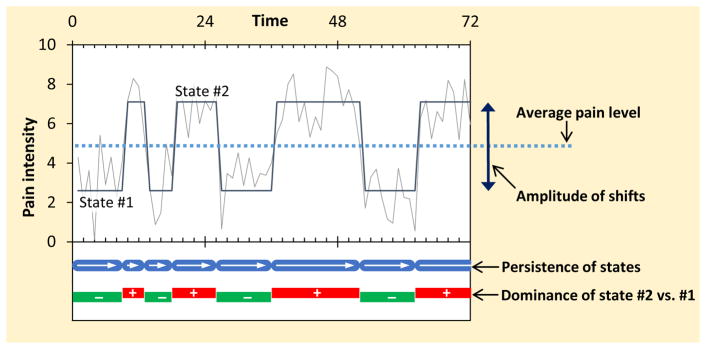
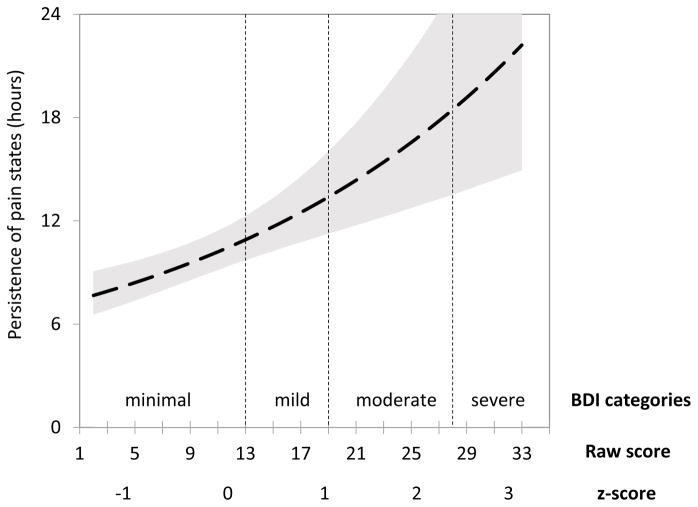
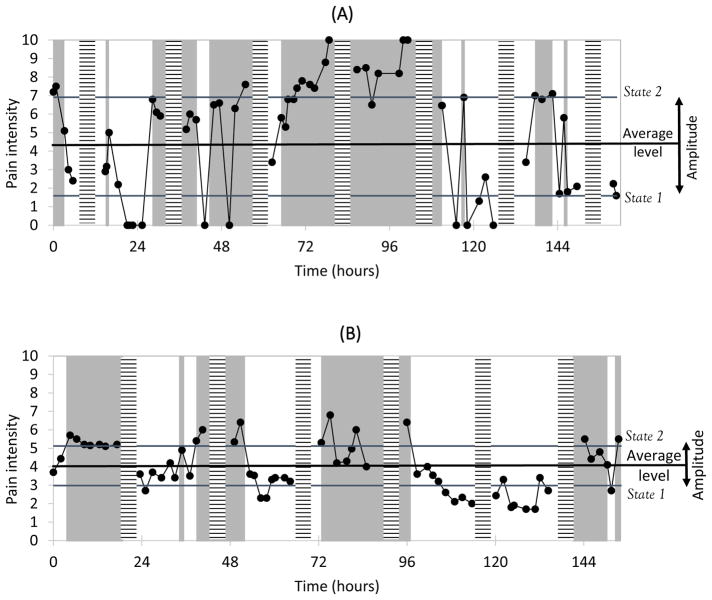
Advances in pain measurement using ecological momentary assessments offer novel opportunities for understanding the temporal dynamics of pain. This study examined whether regime-switching models, which capture processes characterized by recurrent shifts between different states, provide clinically relevant information for characterizing individuals based on their temporal pain patterns. Patients with rheumatic diseases (N = 116) provided 7 to 8 momentary pain ratings per day for 2 weekly periods, separated by 3 months. Regime-switching models extracted measures of Average pain (mean level over time), Amplitude (magnitude of shifts in pain levels), Persistence (average duration of pain states), and Dominance (relative duration of higher vs lower pain states) for each patient and assessment period. After controlling for Average pain, the Persistence of pain states uniquely predicted emotional functioning measures, whereas the Dominance of higher pain uniquely predicted physical functioning and pain interference. Longitudinal analyses of changes over the 3 months largely replicated cross-sectional results. Furthermore, patients' retrospective judgments of their pain were uniquely predicted by Amplitude and Dominance of higher pain states, and global impressions of change over the 3 months were predicted by changes on Dominance, controlling for Average pain levels. The results suggest that regime-switching models can usefully capture temporal dynamics of pain and can contribute to an improved measurement of patients' pain intensity.
使用生态瞬时评估方法测量疼痛进展为理解疼痛的时间动态提供了新的机会。本研究考察了转换状态模型是否能够提供基于个体疼痛时间模式来描述个体的临床相关信息,这些模型捕捉到了由不同状态之间反复转换所描述的过程。患有风湿性疾病的患者(N=116)在 3 个月的间隔内,每 2 周提供 7 到 8 次的瞬时疼痛评分。转换状态模型为每位患者和评估期提取了平均疼痛(随时间的平均水平)、幅度(疼痛水平变化的幅度)、持续时间(疼痛状态的平均持续时间)和优势度(较高和较低疼痛状态的相对持续时间)的测量值。在控制平均疼痛后,疼痛状态的持续时间可以独特地预测情感功能测量值,而较高疼痛状态的优势度可以独特地预测身体功能和疼痛干扰。3 个月的纵向变化分析很大程度上复制了横断面结果。此外,患者对疼痛的回顾性判断可以由较高疼痛状态的幅度和优势度来预测,而 3 个月的总体变化印象可以由优势度的变化来预测,同时控制平均疼痛水平。结果表明,转换状态模型可以有效地捕捉疼痛的时间动态,并有助于提高对患者疼痛强度的测量。