University of Southern California, Los Angeles, CA, United States.
J Med Internet Res. 2020 Sep 24;22(9):e19201. doi: 10.2196/19201.
Interest in the measurement of the temporal dynamics of people's emotional lives has risen substantially in psychological and medical research. Emotions fluctuate and change over time, and measuring the ebb and flow of people's affective experiences promises enhanced insights into people's health and functioning. Researchers have used a variety of intensive longitudinal assessment (ILA) methods to create measures of emotion dynamics, including ecological momentary assessments (EMAs), end-of-day (EOD) diaries, and the day reconstruction method (DRM). To date, it is unclear whether they can be used interchangeably or whether ostensibly similar emotion dynamics captured by the methods differ in meaningful ways.
This study aims to examine the extent to which different ILA methods yield comparable measures of intraindividual emotion dynamics.
Data from 90 participants aged 50 years or older were collected in a probability-based internet panel, the Understanding America Study, and analyzed. Participants provided positive and negative affect ratings using 3 ILA methods: (1) smartphone-based EMA, administered 6 times per day over 1 week, (2) web-based EOD diaries, administered daily over the same week, and (3) web-based DRM, administered once during that week. We calculated 11 measures of emotion dynamics (addressing mean levels, variability, instability, and inertia separately for positive and negative affect, as well as emotion network density, mixed emotions, and emotional dialecticism) from each ILA method. The analyses examined mean differences and correlations of scores addressing the same emotion dynamic across the ILA methods. We also compared the patterns of intercorrelations among the emotion dynamics and their relationships with health outcomes (general health, pain, and fatigue) across ILA methods.
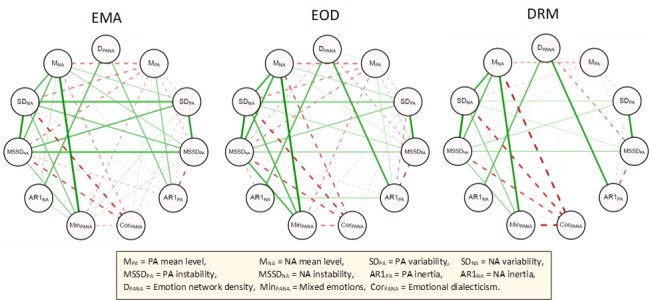
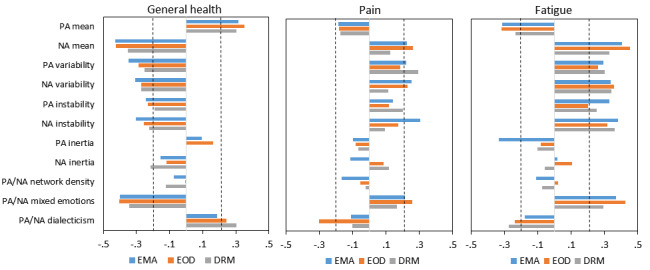
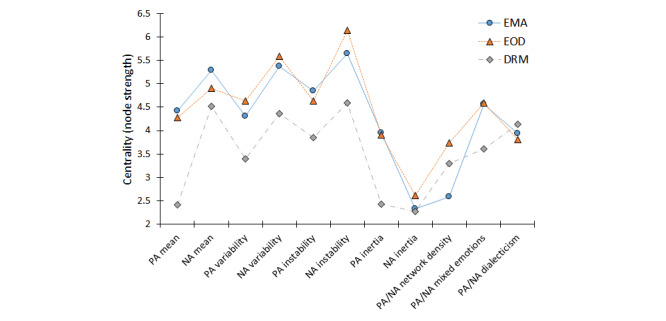
Emotion dynamics derived from EMAs and EOD diaries demonstrated moderate-to-high correspondence for measures of mean emotion levels (ρ≥0.95), variability (ρ≥0.68), instability (ρ≥0.51), mixed emotions (ρ=0.92), and emotional dialecticism (ρ=0.57), and low correspondence for measures of inertia (ρ≥0.17) and emotion network density (ρ=0.36). DRM-derived measures showed correlations with EMAs and EOD diaries that were high for mean emotion levels and mixed emotions (ρ≥0.74), moderate for variability (ρ=0.38-.054), and low to moderate for other measures (ρ=0.03-0.41). Intercorrelations among the emotion dynamics showed high convergence across EMAs and EOD diaries, and moderate convergence between the DRM and EMAs as well as EOD diaries. Emotion dynamics from all 3 ILA methods produced very similar patterns of relationships with health outcomes.
EMAs and EOD diaries provide corresponding information about individual differences in various emotion dynamics, whereas the DRM provides corresponding information about emotion levels and (to a lesser extent) variability, but not about more complex emotion dynamics. Our results caution researchers against viewing these ILA methods as universally interchangeable.
在心理和医学研究中,人们对测量个体情感生活的时间动态的兴趣大幅增加。情感会随时间波动和变化,衡量个体情感体验的涨落有望增强我们对个体健康和功能的了解。研究人员使用了各种密集型纵向评估(ILA)方法来创建情感动态的测量方法,包括生态瞬时评估(EMA)、每日结束(EOD)日记和日间重建方法(DRM)。迄今为止,尚不清楚它们是否可以互换使用,或者表面上由这些方法捕捉到的相似情感动态是否在有意义的方面存在差异。
本研究旨在考察不同 ILA 方法在多大程度上产生可比的个体情感动态测量结果。
在基于概率的互联网面板“理解美国研究”中收集了 90 名 50 岁或以上的参与者的数据,并进行了分析。参与者使用 3 种 ILA 方法提供积极和消极的情感评分:(1)基于智能手机的 EMA,每周 6 次,每天 1 次;(2)基于网络的 EOD 日记,每周 7 天每天使用;(3)基于网络的 DRM,在该周内使用一次。我们从每个 ILA 方法中计算了 11 种情感动态测量值(分别针对积极和消极情感的平均水平、变异性、不稳定性和惯性,以及情感网络密度、混合情感和情感辩证主义)。分析考察了相同情感动态的 ILA 方法之间的分数的平均差异和相关性。我们还比较了不同 ILA 方法中情感动态的相互关联模式及其与健康结果(一般健康、疼痛和疲劳)之间的关系。
EMA 和 EOD 日记得出的情感动态对于情感平均水平(ρ≥0.95)、变异性(ρ≥0.68)、不稳定性(ρ≥0.51)、混合情感(ρ=0.92)和情感辩证主义(ρ=0.57)的测量值具有中等至高的一致性,而对于惯性(ρ≥0.17)和情感网络密度(ρ=0.36)的测量值则具有低一致性。DRM 得出的测量值与 EMA 和 EOD 日记的相关性对于情感平均水平和混合情感的相关性很高(ρ≥0.74),对于变异性的相关性为中等(ρ=0.38-0.054),对于其他测量值的相关性为低到中等(ρ=0.03-0.41)。不同 ILA 方法得出的情感动态之间的相互关系在 EMA 和 EOD 日记中表现出高度一致性,在 DRM 和 EMA 以及 EOD 日记之间表现出中等一致性。所有 3 种 ILA 方法得出的情感动态都与健康结果产生了非常相似的关系模式。
EMA 和 EOD 日记提供了个体在各种情感动态方面的差异的相应信息,而 DRM 则提供了个体情感水平(以及在较小程度上的变异性)的相应信息,但不提供更复杂的情感动态信息。我们的结果提醒研究人员不要将这些 ILA 方法视为普遍可互换的。