Okamoto Teppei, Hatakeyama Shingo, Kodama Hirotake, Horiguchi Hirotaka, Kubota Yuka, Kido Koichi, Momota Masaki, Hosogoe Shogo, Tanaka Yoshimi, Takashima Tooru, Saitoh Fumitada, Suzuki Tadashi, Ohyama Chikara
Department of Urology, Oyokyo Kidney Research Institute Aomori Hospital, 101-1 Okabe, Aomori, 038-0003, Japan.
Department of Urology, Hirosaki University Graduate School of Medicine, 5 Zaifu-chou, Hirosaki, 036-8562, Japan.
BMC Nephrol. 2018 Mar 20;19(1):71. doi: 10.1186/s12882-018-0872-y.
Although aortic calcification has a significant negative impact on prognosis in patients on hemodialysis (HD), risk factors for aortic calcification progression remain unclear. The aim of this study was to investigate the relationship between malnutrition and aortic calcification progression in patients on HD.
Between April 2015 and October 2016, we treated 232 patients on HD. Of those, we retrospectively evaluated data from 184 patients who had had regular blood tests and computed tomography (CT) scans. The abdominal aortic calcification index (ACI) was quantitatively measured by abdominal CT. Nutritional status was evaluated using the Geriatric Nutritional Risk Index (GNRI). A normalized treatment ratio of functional urea clearance was evaluated by Kt/V. The difference in ACI values between 2015 and 2016 was evaluated as a ΔACI, and patients were stratified into two groups according to ΔACI value: high (≥75th percentile, ΔACI-high group) and low (<75th percentile, ΔACI-low group). Variables such as age, sex, comorbidities, dialysis vintage, serum data, and GNRI were compared between ΔACI-high and ΔACI-low patients. Factors independently associated with a higher ΔACI progression (ΔACI ≥75th percentile) were determined using multivariate logistic analysis.
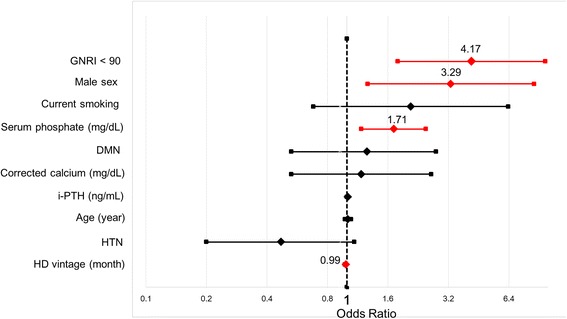
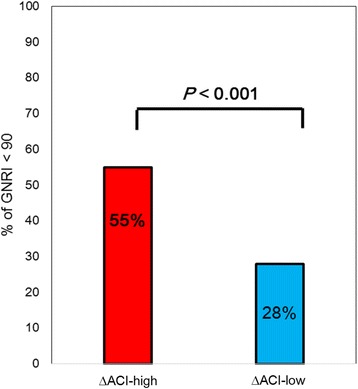
Median values of ACIs in 2015 and 2016 were 40.8 and 44.6%, respectively. Of 184 patients, 125 (68%) patients experienced ACI progression for 1 year. The median ΔACI and 75th percentile of ΔACI were 2.5% and 5.8%, respectively. The number of patients in the ΔACI-low and ΔACI-high groups were 128 (70%) and 56 (30%), respectively. There were significant differences in sex, presence of diabetic nephropathy, HD vintage, serum albumin, serum phosphate, C-reactive protein, intact parathyroid hormone, Kt/V, and GNRI. Multivariate logistic regression analysis revealed that independent factors associated with a higher ΔACI progression were male sex, serum phosphate levels, HD vintage, and GNRI of < 90.
Our results suggest that poor nutritional status is an independent risk factor for the progression of aortic calcification. Nutrition management may have the potential to improve progression of aortic calcification in patients on HD.
UMIN Clinical Trials Registry UMIN000028050 .
尽管主动脉钙化对血液透析(HD)患者的预后有显著负面影响,但主动脉钙化进展的危险因素仍不清楚。本研究旨在探讨HD患者营养不良与主动脉钙化进展之间的关系。
2015年4月至2016年10月期间,我们治疗了232例HD患者。其中,我们回顾性评估了184例接受定期血液检查和计算机断层扫描(CT)的患者的数据。通过腹部CT定量测量腹主动脉钙化指数(ACI)。使用老年营养风险指数(GNRI)评估营养状况。通过Kt/V评估功能性尿素清除率的标准化治疗率。将2015年和2016年的ACI值差异评估为ΔACI,并根据ΔACI值将患者分为两组:高(≥第75百分位数,ΔACI高组)和低(<第75百分位数,ΔACI低组)。比较ΔACI高组和ΔACI低组患者的年龄、性别、合并症、透析龄、血清数据和GNRI等变量。使用多因素逻辑分析确定与较高ΔACI进展(ΔACI≥第75百分位数)独立相关的因素。
2015年和2016年ACI的中位数分别为40.8%和44.6%。在184例患者中,125例(68%)患者1年内ACI有进展。ΔACI的中位数和第75百分位数分别为2.5%和5.8%。ΔACI低组和高组的患者人数分别为128例(70%)和56例(30%)。在性别糖尿病肾病的存在、HD龄、血清白蛋白、血清磷酸盐、C反应蛋白、完整甲状旁腺激素、Kt/V和GNRI方面存在显著差异。多因素逻辑回归分析显示,与较高ΔACI进展相关的独立因素是男性、血清磷酸盐水平、HD龄和GNRI<90。
我们的结果表明,营养状况差是主动脉钙化进展的独立危险因素。营养管理可能有改善HD患者主动脉钙化进展的潜力。
UMIN临床试验注册中心UMIN000028050 。