Cheong Youn-Soo, Kim Ae Ryoung, Park Eunhee, Yang Won-Jong, Huh Jae-Won, Oh Hyun-Min, Min Yu-Sun, Kim Chul-Hyun, Jung Tae-Du, Lee Yang-Soo
Department of Rehabilitation Medicine, Kyungpook National University Hospital, Daegu, Korea.
Department of Rehabilitation Medicine, Kyungpook National University School of Medicine, Daegu, Korea.
Ann Rehabil Med. 2018 Feb;42(1):18-25. doi: 10.5535/arm.2018.42.1.18. Epub 2018 Feb 28.
To investigate the relationship between the buttoning test and Jebsen-Taylor Hand Function Test (JTHFT), and to determine the validity of using the buttoning test as a tool to evaluate hand disability in patients with stroke.
This was a retrospective study of the medical records of 151 ischemic stroke patients affecting the dominant hand. Patients underwent the buttoning test and JTHFT for their affected hand. All patients were divided into three groups depending on how quickly they fastened a button (group A, not completed; group B, slowly completed over 18 seconds; and group C, completed within 18 seconds).
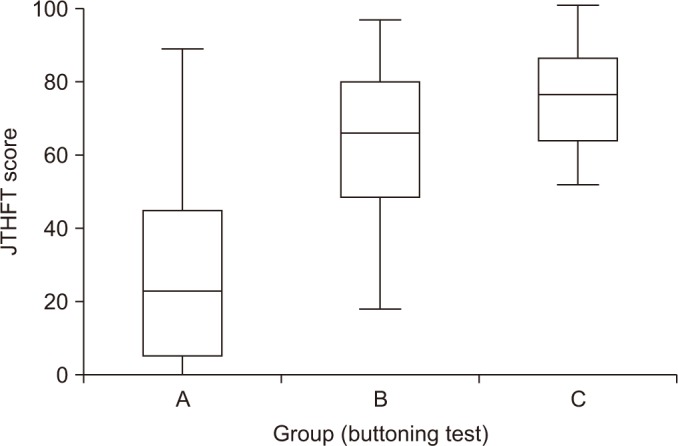
The button fastening time was negatively correlated with the total score and subtest scores of the JTHFT. Patients who experienced difficulty during the buttoning test had lower mean scores in the JTHFT (group A, 28.0±23.9; group B, 62.9±21.7; group C, 75.4±13.3; p<0.0001, Jonckheere-Terpstra test). We observed significant differences in JTHFT scores among the three groups (p<0.017, Mann-Whitney U-test), although there were considerable overlaps in JTHFT scores between the groups. Significant differences were also found in the subtest scores of the JTHFT, which include fine hand motor function (writing letters, p=0.009; moving small objects, p=0.003; stacking checkers, p=0.001 between groups B and C), among the three groups.
Considering its relationship with the JTHFT and validity, the buttoning test can be considered appropriate for evaluation of hand disability in patients with stroke.
探讨扣纽扣测试与杰布森 - 泰勒手部功能测试(JTHFT)之间的关系,并确定将扣纽扣测试作为评估中风患者手部残疾工具的有效性。
这是一项对151例影响优势手的缺血性中风患者病历的回顾性研究。患者对其患手进行扣纽扣测试和JTHFT。根据患者扣纽扣的速度,将所有患者分为三组(A组,未完成;B组,超过18秒缓慢完成;C组,18秒内完成)。
扣纽扣时间与JTHFT的总分及各子测试分数呈负相关。在扣纽扣测试中遇到困难的患者,其JTHFT的平均分数较低(A组,28.0±23.9;B组,62.9±21.7;C组,75.4±13.3;p<0.0001,琼克尔 - 特普斯特拉检验)。我们观察到三组之间JTHFT分数存在显著差异(p<0.017,曼 - 惠特尼U检验),尽管各组之间JTHFT分数有相当大的重叠。在JTHFT的子测试分数中也发现了显著差异,其中包括精细手部运动功能(书写字母,p = 0.009;移动小物体,p = 0.003;堆叠棋子,B组和C组之间p = 0.001),三组之间均有差异。
考虑到其与JTHFT的关系及有效性,扣纽扣测试可被认为适用于评估中风患者的手部残疾。