Lee Chang Hyun, Kim Jong Kyu, Jun Hyun Jung, Lee Duk-Joo, Namkoong Wook, Oh Jae Ho
Department of Physical Medicine and Rehabilitation, Seoul Medical Center, Seoul, Korea.
Division of Medical Oncology and Hematology, Department of Internal Medicine, Seoul Medical Center, Seoul, Korea.
Ann Rehabil Med. 2018 Feb;42(1):166-174. doi: 10.5535/arm.2018.42.1.166. Epub 2018 Feb 28.
To evaluate the compliance and satisfaction of rehabilitation recommendations for advanced cancer patients hospitalized in the palliative care unit.
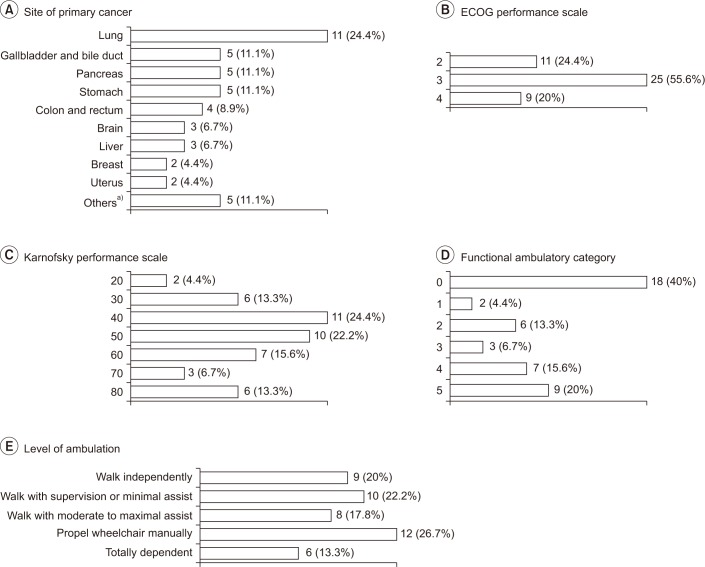
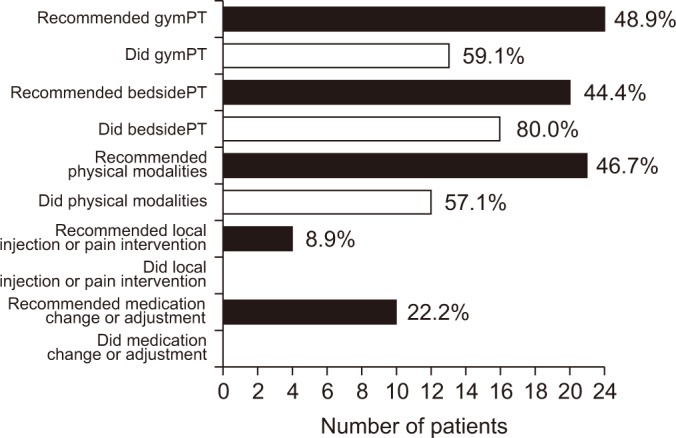
Advanced cancer patients admitted to a hospice palliative care unit were recruited. Patients with advanced cancer and a life expectancy of less than 6 months, as assumed by the oncologist were included. Patients who were expected to die within 3 days were excluded. ECOG and Karnofsky performance scales, function ambulatory category, level of ambulation, and survival days were evaluated under the perspective of comprehensive rehabilitation. Problem-based rehabilitations were provided categorized as physical therapy at the gym, bedside physical therapy, physical modalities, medications and pain intervention. Investigation of compliance for each category was completed. Patient satisfaction was surveyed using a questionnaire.
Forty-five patients were recruited and received evaluations for rehabilitation perspective. The subjects were reported to have gait-related difficulties (71.1%), pain (68.9%), poor medical conditions (68.9%), bladder or bowel problems (44.4%), dysphagias (11.1%), mental status issues (11.1%), edemas (11.1%), spasticity (2.2%), and pressure sores (2.2%). In the t-test, patients with good compliance for GymPT showed higher survival days (p<0.05). In the satisfaction survey, patients with performance scales showed a greater satisfaction in Spearman's correlation analysis (p<0.05).
Advanced cancer patients admitted to the hospice palliative care unit have many rehabilitation needs. Patients with a longer survival time showed better compliance for GymPT. Patients with a better performance scale showed a higher satisfaction. Comprehensive rehabilitation may be needed to advanced cancer patients in the hospice palliative care unit.
评估姑息治疗病房中晚期癌症住院患者对康复建议的依从性和满意度。
招募入住临终关怀姑息治疗病房的晚期癌症患者。纳入由肿瘤学家判定为晚期癌症且预期寿命少于6个月的患者。排除预计在3天内死亡的患者。从综合康复的角度评估东部肿瘤协作组(ECOG)和卡氏功能状态量表、功能活动类别、活动水平和生存天数。提供基于问题的康复治疗,分类为健身房物理治疗、床边物理治疗、物理治疗方式、药物治疗和疼痛干预。完成对每个类别的依从性调查。使用问卷对患者满意度进行调查。
招募了45名患者并从康复角度进行评估。据报告,受试者存在步态相关困难(71.1%)、疼痛(68.9%)、身体状况差(68.9%)、膀胱或肠道问题(44.4%)、吞咽困难(11.1%)、精神状态问题(11.1%)、水肿(11.1%)、痉挛(2.2%)和压疮(2.2%)。在t检验中,对健身房物理治疗依从性良好的患者生存天数更长(p<0.05)。在满意度调查中,在斯皮尔曼相关性分析中功能量表得分较高的患者满意度更高(p<0.05)。
入住临终关怀姑息治疗病房的晚期癌症患者有许多康复需求。生存时间较长的患者对健身房物理治疗的依从性更好。功能量表得分较高的患者满意度更高。临终关怀姑息治疗病房中的晚期癌症患者可能需要综合康复治疗。