Department of Radiology, University of Alabama at Birmingham, Birmingham, AL 35294, USA.
Department of Radiation Oncology, University of Alabama at Birmingham, Birmingham, AL 35294, USA.
Int J Mol Sci. 2018 Mar 21;19(4):925. doi: 10.3390/ijms19040925.
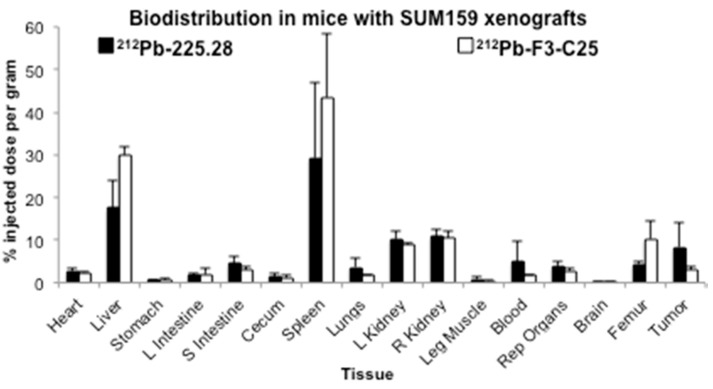
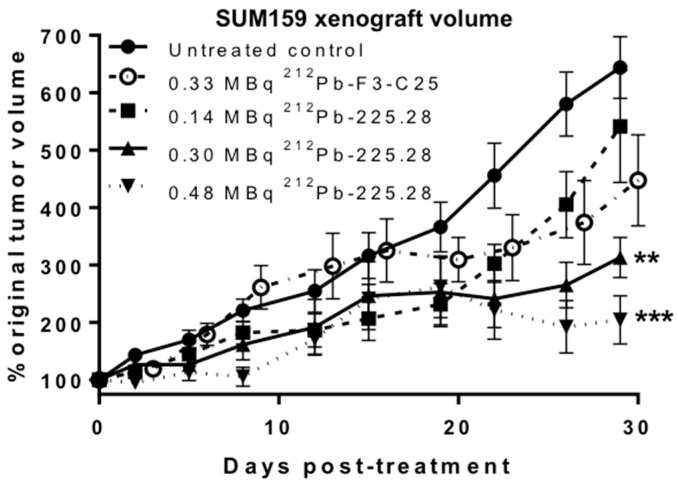
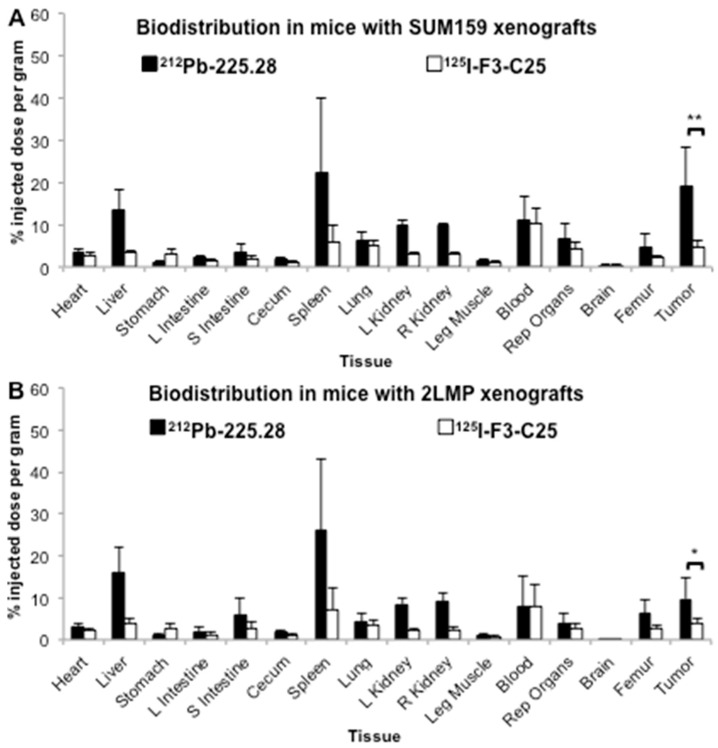
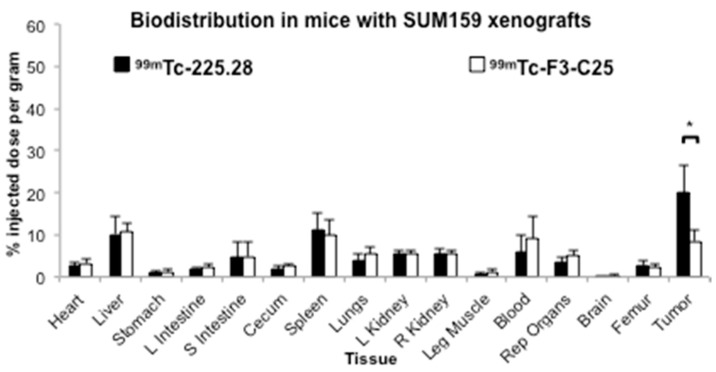
Triple-negative breast cancer (TNBC) is an aggressive subtype of breast cancer with a poor prognosis. There is a clinical need for effective, targeted therapy strategies that destroy both differentiated TNBC cells and TNBC cancer initiating cells (CICs), as the latter are implicated in the metastasis and recurrence of TNBC. Chondroitin sulfate proteoglycan 4 (CSPG4) is overexpressed on differentiated tumor cells and CICs obtained from TNBC patient specimens, suggesting that CSPG4 may be a clinically relevant target for the imaging and therapy of TNBC. The purpose of this study was to determine whether α-particle radioimmunotherapy (RIT) targeting TNBC cells using the CSPG4-specific monoclonal antibody (mAb) 225.28 as a carrier was effective at eliminating TNBC tumors in preclinical models. To this end, mAb 225.28 labeled with Pb (Pb-225.28) as a source of α-particles for RIT was used for in vitro Scatchard assays and clonogenic survival assays with human TNBC cells (SUM159 and 2LMP) grown as adherent cells or non-adherent CIC-enriched mammospheres. Immune-deficient mice bearing orthotopic SUM159 or 2LMP xenografts were injected with the targeted (225.28) or irrelevant isotype-matched control (F3-C25) mAbs, labeled with Tc, I, or Pb for in vivo imaging, biodistribution, or tumor growth inhibition studies. Pb-225.28 bound to adherent SUM159 and 2LMP cells and to CICs from SUM159 and 2LMP mammospheres with a mean affinity of 0.5 nM. Nearly ten times more binding sites per cell were present on SUM159 cells and CICs compared with 2LMP cells. Pb-225.28 was six to seven times more effective than Pb-F3-C25 at inhibiting SUM159 cell and CIC clonogenic survival ( < 0.05). Radiolabeled mAb 225.28 showed significantly higher uptake than radiolabeled mAb F3-C25 in SUM159 and 2LMP xenografts ( < 0.05), and the uptake of Pb-225.28 in TNBC xenografts was correlated with target epitope expression. Pb-225.28 caused dose-dependent growth inhibition of SUM159 xenografts; 0.30 MBq Pb-225.28 was significantly more effective than 0.33 MBq Pb-F3-C25 at inhibiting tumor growth ( < 0.01). These results suggest that CSPG4-specific Pb-225.28 is a useful reagent for RIT of CSPG4-expressing tumors, including metastatic TNBC.
三阴性乳腺癌(TNBC)是一种侵袭性乳腺癌亚型,预后较差。目前临床上需要有效的靶向治疗策略,既能破坏分化的 TNBC 细胞,又能破坏 TNBC 起始细胞(CICs),因为后者与 TNBC 的转移和复发有关。软骨素硫酸蛋白聚糖 4(CSPG4)在 TNBC 患者标本中获得的分化肿瘤细胞和 CICs 上过度表达,表明 CSPG4 可能是 TNBC 成像和治疗的临床相关靶点。本研究旨在确定使用 CSPG4 特异性单克隆抗体(mAb)225.28 作为载体的靶向 TNBC 细胞的α粒子放射免疫疗法(RIT)是否能有效消除临床前模型中的 TNBC 肿瘤。为此,用 Pb(Pb-225.28)标记 mAb 225.28 作为 RIT 的α粒子源,用于体外 Scatchard 测定和贴壁细胞生长的克隆存活测定或非贴壁 CIC 富集的类器官。将携带原位 SUM159 或 2LMP 异种移植物的免疫缺陷小鼠用靶向(225.28)或无关同种型匹配对照(F3-C25)mAb 进行注射,并用 Tc、I 或 Pb 标记进行体内成像、生物分布或肿瘤生长抑制研究。Pb-225.28 与贴壁 SUM159 和 2LMP 细胞以及 SUM159 和 2LMP 类器官中的 CIC 结合,平均亲和力为 0.5 nM。与 2LMP 细胞相比,SUM159 细胞和 CIC 上的结合位点数量多近 10 倍。与 Pb-F3-C25 相比,Pb-225.28 对抑制 SUM159 细胞和 CIC 集落形成存活的效果高 6 至 7 倍(<0.05)。放射性标记的 mAb 225.28 在 SUM159 和 2LMP 异种移植物中的摄取明显高于放射性标记的 mAb F3-C25(<0.05),并且 TNBC 异种移植物中 Pb-225.28 的摄取与靶抗原表达相关。Pb-225.28 导致 SUM159 异种移植物的生长受到剂量依赖性抑制;0.30 MBq Pb-225.28 比 0.33 MBq Pb-F3-C25 更有效地抑制肿瘤生长(<0.01)。这些结果表明,CSPG4 特异性 Pb-225.28 是一种用于治疗包括转移性 TNBC 在内的 CSPG4 表达肿瘤的有用试剂。