Department of Clinical Biochemistry, Faculty of Pharmacy and Pharmaceutical Sciences, Isfahan University of Medical Sciences, Isfahan 81746-73461, Iran.
Department of Molecular Biology and Genetics, Faculty of Medicine, Isfahan University of Medical Sciences, Isfahan 81746-73461, Iran.
Molecules. 2018 Mar 21;23(4):715. doi: 10.3390/molecules23040715.
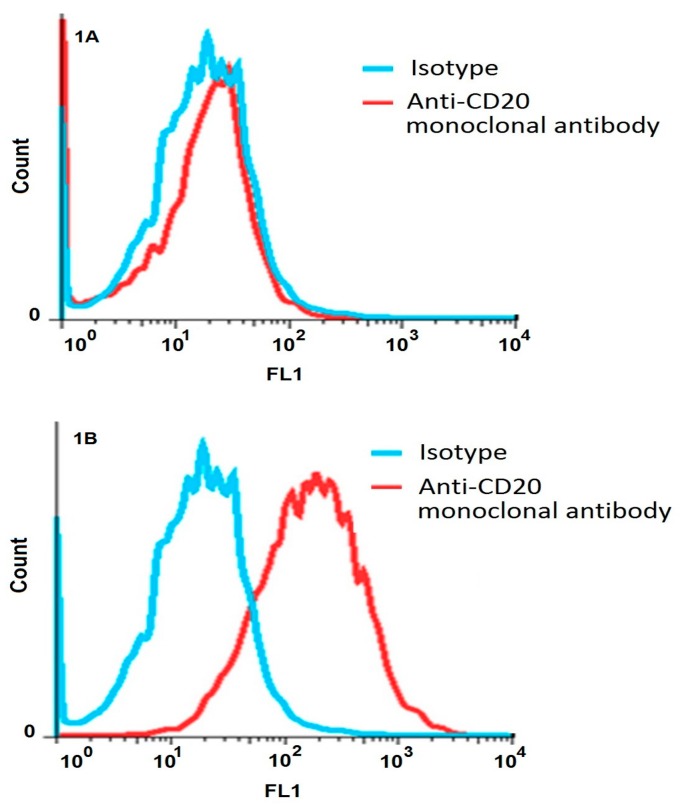
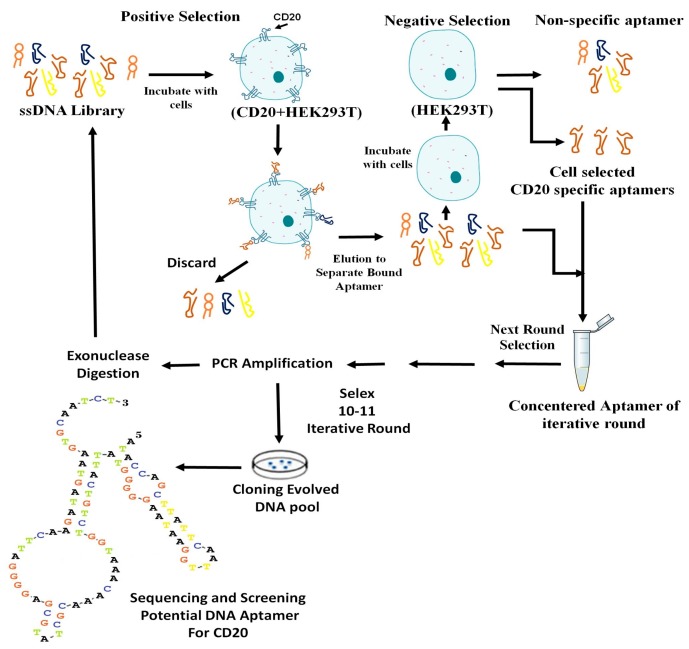
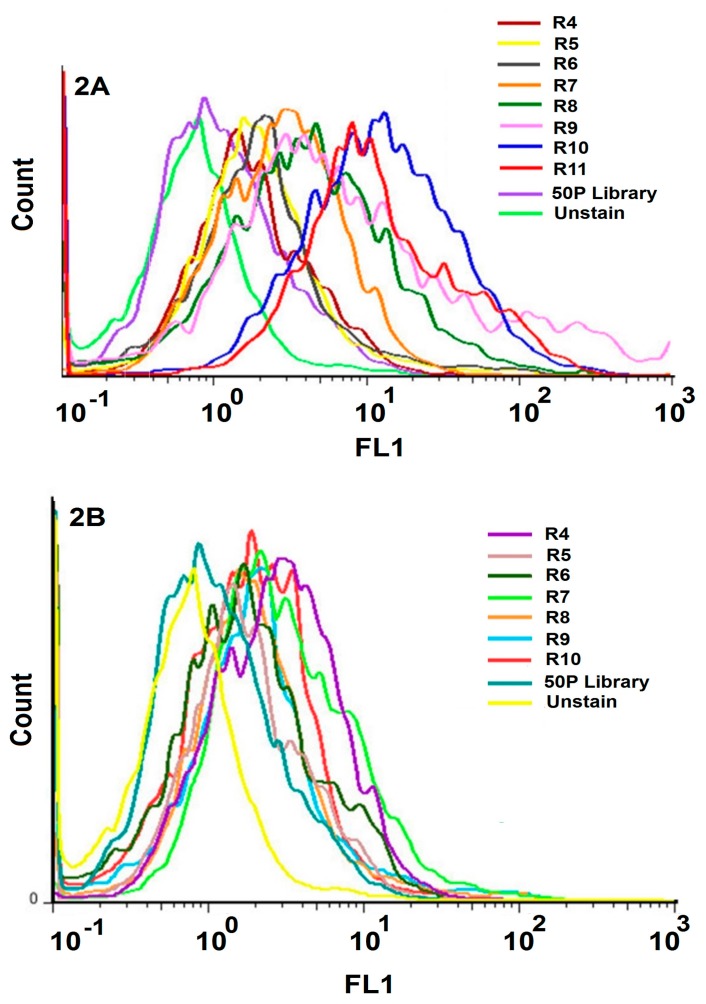
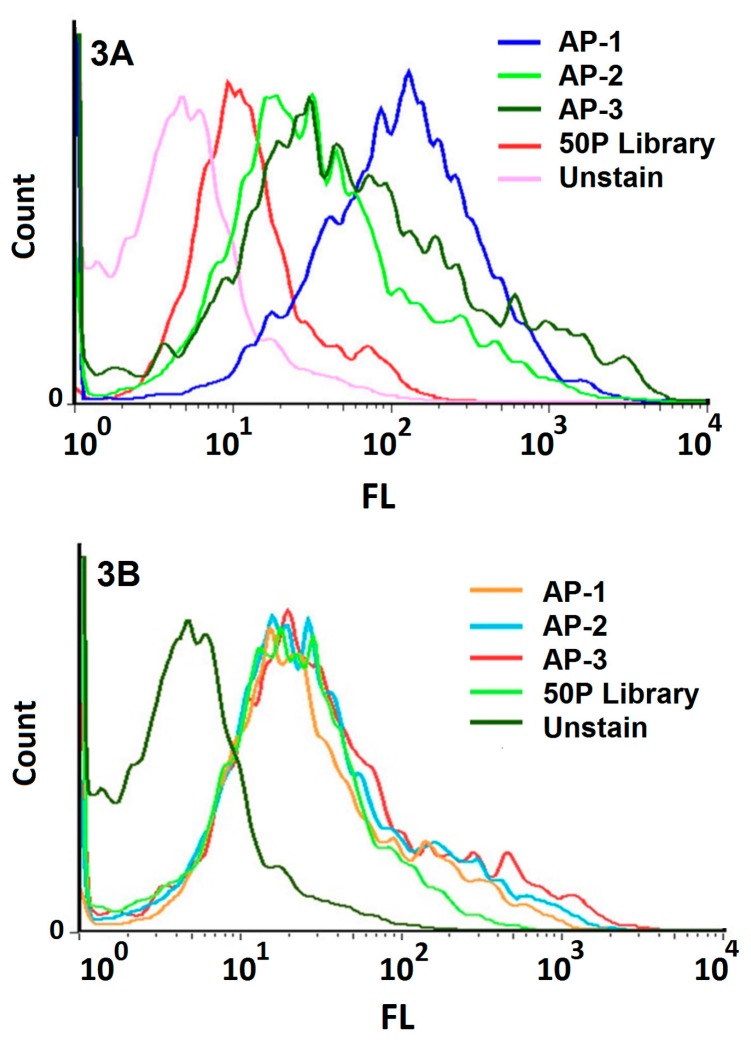
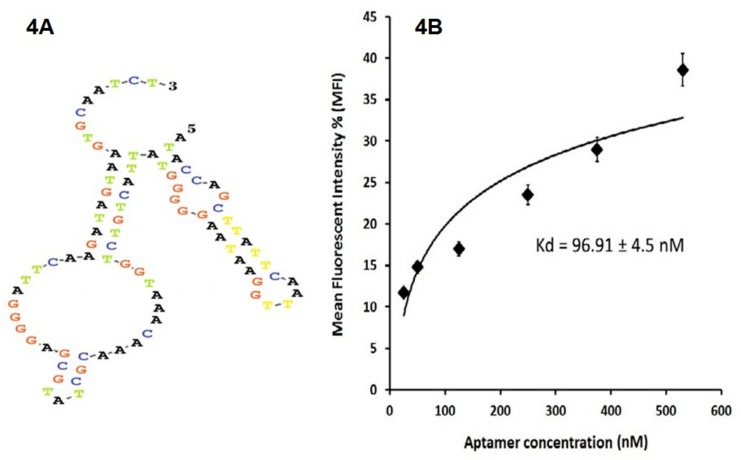
The B-lymphocyte antigen (CD20) is a suitable target for single-stranded (ss) nucleic acid oligomer (aptamers). The aim of study was selection and characterization of a ssDNA aptamer against CD20 using Cell-Systematic Evolution of Ligands by Exponential Enrichment (Cell-SELEX). The cDNA clone of CD20 (pcDNA-CD20) was transfected to human embryonic kidney (HEK293T) cells. Ten rounds of Cell-SELEX was performed on recombinant HEK-CD20 cells. The final eluted ssDNA pool was amplified and ligated in T/A vector for cloning. The plasmids of positive clones were extracted, sequenced and the secondary structures of the aptamers predicted using DNAMAN software. The sequencing results revealed 10 different types; three of them had the highest thermodynamic stability, named AP-1, AP-2 and AP-3. The AP-1 aptamer was the most thermodynamically stable one (ΔGAP-1 = -10.87 kcal/mol) with the highest binding affinity to CD20 (96.91 ± 4.5 nM). Since, the CD20 is a suitable target for recognition of B-Cell. The selected aptamers could be comparable to antibodies with many advantages. The AP-1, AP-2 and AP-3 could be candidate instead of antibodies for diagnostic and therapeutic applications in immune deficiency, autoimmune diseases, leukemia and lymphoma.
B 淋巴细胞抗原 (CD20) 是单链 (ss) 核酸寡聚物 (适体) 的理想靶标。本研究的目的是使用细胞系统进化配体的指数富集 (Cell-SELEX) 来选择和鉴定针对 CD20 的 ssDNA 适体。将 CD20 的 cDNA 克隆 (pcDNA-CD20) 转染到人胚肾 (HEK293T) 细胞中。在重组 HEK-CD20 细胞上进行了 10 轮 Cell-SELEX。最后洗脱的 ssDNA 池被扩增并连接到 T/A 载体进行克隆。提取阳性克隆的质粒,测序,并使用 DNAMAN 软件预测适体的二级结构。测序结果显示有 10 种不同类型;其中三种具有最高的热力学稳定性,分别命名为 AP-1、AP-2 和 AP-3。AP-1 适体具有最高的热力学稳定性(ΔGAP-1 = -10.87 kcal/mol),与 CD20 的结合亲和力最高(96.91 ± 4.5 nM)。由于 CD20 是识别 B 细胞的合适靶标。所选适体可与抗体相媲美,具有许多优势。AP-1、AP-2 和 AP-3 可作为抗体的替代品,用于免疫缺陷、自身免疫性疾病、白血病和淋巴瘤的诊断和治疗应用。