Kuo Yi-Hung, Shi Chung-Sheng, Huang Cheng Yi, Huang Yun-Ching, Chin Chih-Chien
Division of Colon and Rectal Surgery, Department of Surgery, Chang Gung Memorial Hospital, Puzeh, Chiayi 61363, Taiwan, R.O.C.
Graduate Institute of Clinical Medical Science, College of Medicine, Chang Gung University, Taoyuan 33302, Taiwan, R.O.C.
Mol Clin Oncol. 2018 Apr;8(4):533-538. doi: 10.3892/mco.2018.1582. Epub 2018 Feb 26.
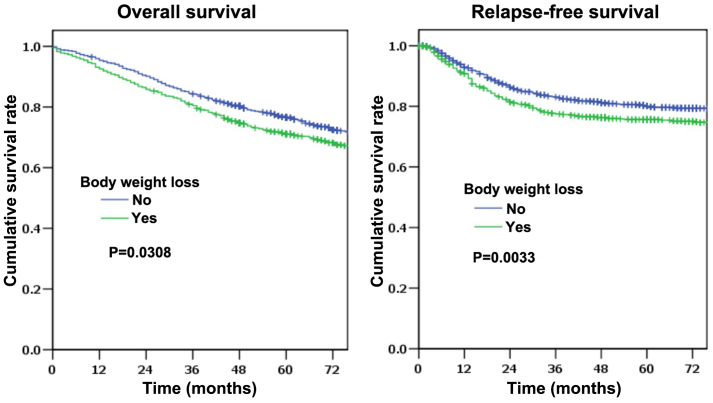
The aim of the present study was to investigate whether unintentional body weight loss (BWL) provides additional clinical information in terms of tumor progression and prognosis in non-metastatic colon cancer. In the present study, a total of 2,406 consecutive colon cancer patients without metastasis were retrospectively enrolled. Unintentional BWL was defined as loss of >5% of body weight within the last 6-12 months, or defined subjectively upon fulfillment of at least two of the following: Evidence of change in clothing size and corroboration of the reported weight loss by family or friend. This category was recorded as present ('with') or absent ('without'). Logistic regression analysis was performed to determine the correlation between BWL and the tumor characteristics and post-operative outcomes of patients with colon cancer. The Cox regression model was used to determine the association of BWL with long-term survival of colon cancer patients. A significant association between BWL and tumor location [right vs. left: Odds ratio (OR)=1.62; P<0.001], tumor size (≥5 vs. <5 cm: OR=2.17; P<0.001), and tumor stage based on the tumor-nodes-metastasis system (T3-T4 vs. T1-T2: OR=2.02; P<0.001). Post-operative morbidity and mortality were not significantly influenced by BWL. Multivariate analysis revealed that BWL was significantly associated with overall survival [with vs. without BWL: Hazard ratio (HR)=1.178; P=0.036] and relapse-free survival (with vs. without BWL: HR=1.332; P=0.003). In conclusion, BWL in patients with colon cancer is not just a symptom, but it is also correlated with tumor location, size and depth, and is a prognostic factor for poor outcomes including overall survival and tumor relapse.
本研究的目的是调查非转移性结肠癌患者的非故意体重减轻(BWL)在肿瘤进展和预后方面是否能提供额外的临床信息。在本研究中,回顾性纳入了总共2406例连续的无转移结肠癌患者。非故意BWL定义为在过去6至12个月内体重减轻超过5%,或在满足以下至少两项时主观定义:衣服尺寸变化的证据以及家人或朋友对所报告体重减轻的证实。该类别记录为存在(“有”)或不存在(“无”)。进行逻辑回归分析以确定BWL与结肠癌患者的肿瘤特征和术后结局之间的相关性。使用Cox回归模型确定BWL与结肠癌患者长期生存的关联。BWL与肿瘤位置[右半结肠与左半结肠:比值比(OR)=1.62;P<0.001]、肿瘤大小(≥5 cm与<5 cm:OR=2.17;P<0.001)以及基于肿瘤-淋巴结-转移系统的肿瘤分期(T3-T4与T1-T2:OR=2.02;P<0.001)之间存在显著关联。术后发病率和死亡率未受到BWL的显著影响。多变量分析显示,BWL与总生存[有BWL与无BWL:风险比(HR)=1.178;P=0.036]和无复发生存(有BWL与无BWL:HR=1.332;P=0.003)显著相关。总之,结肠癌患者的BWL不仅是一种症状,而且还与肿瘤位置、大小和深度相关,并且是包括总生存和肿瘤复发在内的不良结局的预后因素。