Lindsey Derek P, Kiapour Ali, Yerby Scott A, Goel Vijay K
Research and Development, SI-BONE, Inc., San Jose, CA 95128, United States.
Engineering Center for Orthopaedic Research Excellenc, Departments of Bioengineering and Orthopaedic Surgery, Colleges of Engineering and Medicine, University of Toledo, Toledo, OH 43606, United States.
World J Orthop. 2018 Mar 18;9(3):14-23. doi: 10.5312/wjo.v9.i3.14.
To analyze how various implants placement variables affect sacroiliac (SI) joint range of motion.
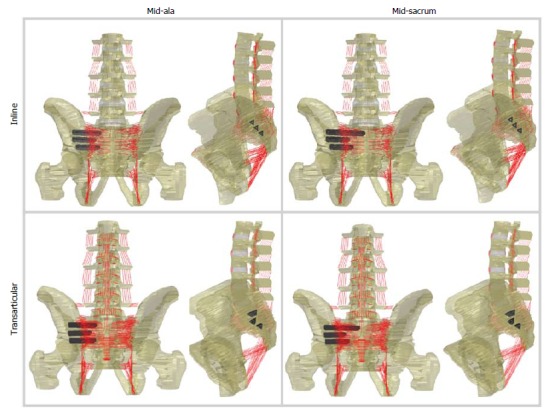
An experimentally validated finite element model of the lumbar spine and pelvis was used to simulate a fusion of the SI joint using various placement configurations of triangular implants (iFuse Implant System). Placement configurations were varied by changing implant orientation, superior implant length, and number of implants. The range of motion of the SI joint was calculated using a constant moment of 10 N-m with a follower load of 400 N. The changes in motion were compared between the treatment groups to assess how the different variables affected the overall motion of the SI joint.
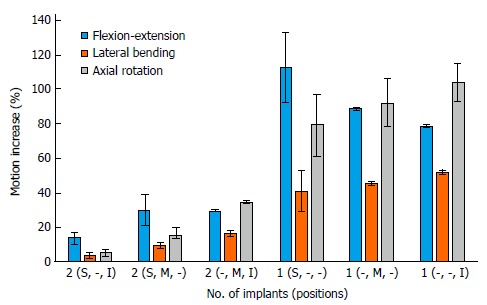
Transarticular placement of 3 implants with superior implants that end in the middle of the sacrum resulted in the greatest reduction in range of motion (flexion/extension = 73%, lateral bending = 42%, axial rotation = 72%). The range of motions of the SI joints were reduced with use of transarticular orientation (9%-18%) when compared with an inline orientation. The use of a superior implant that ended mid-sacrum resulted in median reductions of (8%-14%) when compared with a superior implant that ended in the middle of the ala. Reducing the number of implants, resulted in increased SI joint range of motions for the 1 and 2 implant models of 29%-133% and 2%-39%, respectively, when compared with the 3 implant model.
Using a validated finite element model we demonstrated that placement of 3 implants across the SI joint using a transarticular orientation with superior implant reaching the sacral midline resulted in the most stable construct. Additional clinical studies may be required to confirm these results.
分析各种植入物放置变量如何影响骶髂(SI)关节的活动范围。
使用经过实验验证的腰椎和骨盆有限元模型,通过三角形植入物(iFuse植入系统)的各种放置配置来模拟SI关节融合。通过改变植入物方向、上位植入物长度和植入物数量来改变放置配置。使用10 N-m的恒定力矩和400 N的随动载荷计算SI关节的活动范围。比较各治疗组之间的运动变化,以评估不同变量如何影响SI关节的整体运动。
3枚植入物经关节放置且上位植入物止于骶骨中部时,活动范围减小最为明显(屈伸=73%,侧弯=42%,轴向旋转=72%)。与直线方向相比,采用经关节方向时SI关节的活动范围减小(9%-18%)。与止于骶骨翼中部的上位植入物相比,止于骶骨中部的上位植入物导致活动范围中位数减小(8%-14%)。与3枚植入物模型相比,减少植入物数量后,1枚和2枚植入物模型的SI关节活动范围分别增加29%-133%和2%-39%。
使用经过验证的有限元模型,我们证明经关节方向放置3枚植入物且上位植入物到达骶骨中线时,构建物最稳定。可能需要更多临床研究来证实这些结果。