Department of Otorhinolaryngology, Head and Neck Surgery, Osaka Medical College, 2-7 Daigaku-Machi, Takatsuki, Osaka, 569-8686, Japan.
Department of Pathology, Osaka Medical College, Takatsuki, Osaka, Japan.
Int J Clin Oncol. 2018 Aug;23(4):615-624. doi: 10.1007/s10147-018-1266-7. Epub 2018 Mar 21.
This study investigated the clinical outcomes of patients with parotid carcinoma at a single institution during an 18-year period, with the focus on diagnosis, treatment, and survival.
The subjects were 171 patients with parotid carcinoma treated at our department during the 18-year period from September 1999 to August 2017. There were 19 patients in stage I, 65 patients in stage II, 22 patients in stage III, and 65 patients in stage IV. The symptoms, preoperative diagnosis, node metastasis, survival rate, prognostic factors, and immunohistological findings were investigated.
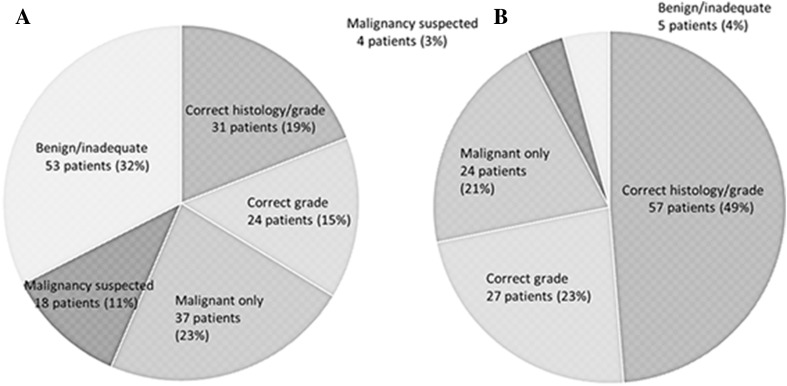
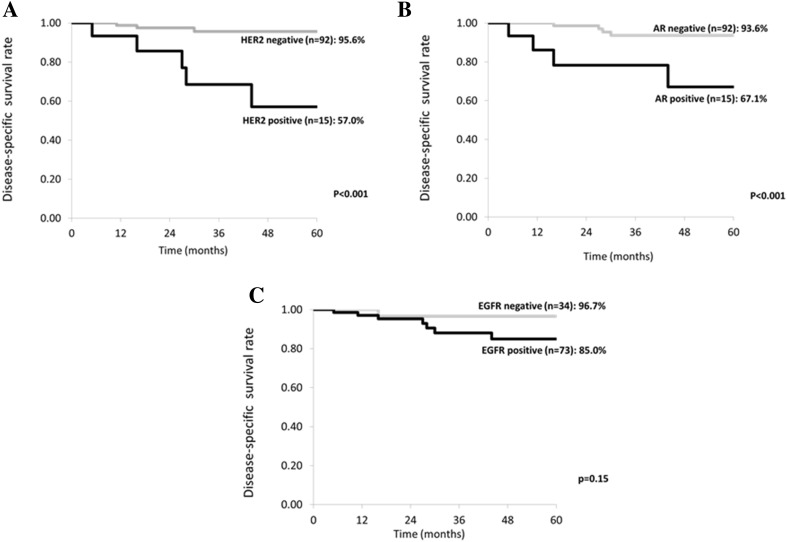
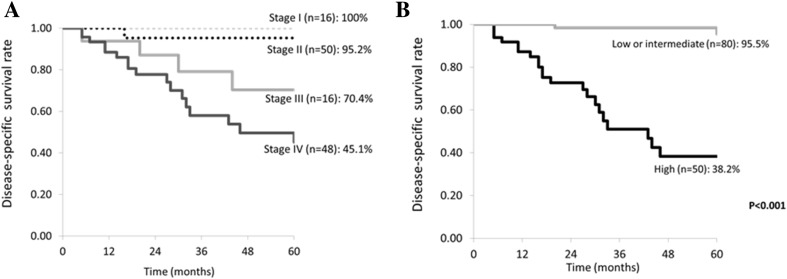
Preoperative diagnosis of the histological grade by fine-needle aspiration cytology was only possible in 34% of the patients, while the histological grade was correctly determined by frozen section biopsy in 72%. The overall frequency of lymph node metastasis was 29%, with 59% in patients with high-grade carcinoma and only 6% in those with low-/intermediate-grade tumors. The disease-specific 5-year survival rate was 100% for patients in stage I, 95.2% in stage II, 70.4% in stage III, and 45.1% in stage IV. Multivariate analysis showed that the pathological grade was the most important prognostic factor. Immunohistological investigation showed patients with HER-2 or androgen receptor-positive tumors had a significantly worse prognosis.
Although a high-grade tumor is the most important prognostic factor, preoperative diagnosis of the grade was not always accurate. Since advanced cancer has a poor prognosis with a limited response to surgery and radiation therapy, development of new treatment strategies, such as molecular-targeting therapies directed against HER-2 and AR, is required.
本研究旨在探讨 18 年间单中心腮腺癌患者的临床结局,重点关注诊断、治疗和生存情况。
研究对象为 1999 年 9 月至 2017 年 8 月期间在我院接受治疗的 171 例腮腺癌患者。Ⅰ期 19 例,Ⅱ期 65 例,Ⅲ期 22 例,Ⅳ期 65 例。分析患者的症状、术前诊断、淋巴结转移、生存率、预后因素和免疫组化结果。
术前细针穿刺细胞学检查对组织学分级的诊断率仅为 34%,而冰冻切片活检的正确诊断率为 72%。淋巴结转移的总发生率为 29%,高级别癌患者的转移率为 59%,低/中级别肿瘤患者的转移率仅为 6%。Ⅰ期患者的疾病特异性 5 年生存率为 100%,Ⅱ期为 95.2%,Ⅲ期为 70.4%,Ⅳ期为 45.1%。多因素分析显示,病理分级是最重要的预后因素。免疫组化研究显示,HER-2 或雄激素受体阳性肿瘤患者的预后明显较差。
虽然高级别肿瘤是最重要的预后因素,但术前分级诊断并不总是准确。由于晚期癌症对手术和放疗的反应有限,预后较差,因此需要开发新的治疗策略,如针对 HER-2 和 AR 的分子靶向治疗。