Santillo Elpidio, Migale Monica, Massini Carlo, Incalzi Raffaele Antonelli
Geriatric-Rehabilitative Department, Italian National Research Center on Aging (INRCA), Fermo, Italy.
Cardiac, Thoracic and Vascular Surgery Ward, Salus Hospital-GVM Care & Research, Reggio Emilia, Italy.
Curr Cardiol Rev. 2018;14(3):142-152. doi: 10.2174/1573403X14666180322104015.
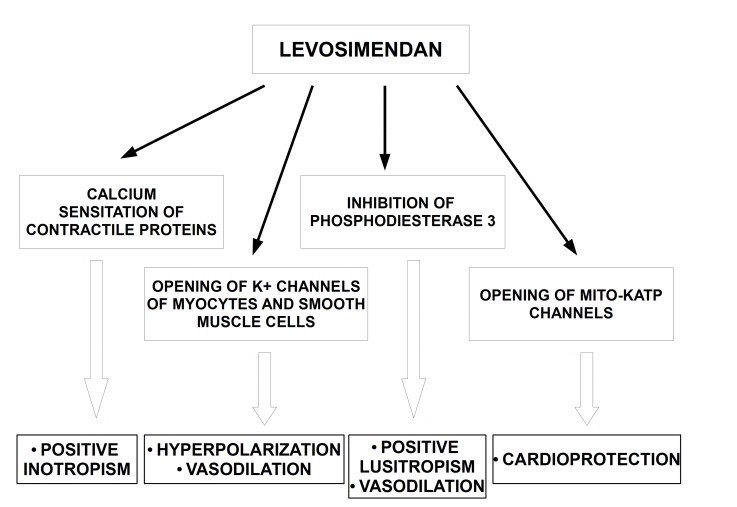
Levosimendan is a calcium sensitizer drug causing increased contractility in the myocardium and vasodilation in the vascular system. It is mainly used for the therapy of acute decompensated heart failure. Several studies on animals and humans provided evidence of the cardioprotective properties of levosimendan including preconditioning and anti-apoptotic. In view of these favorable effects, levosimendan has been tested in patients undergoing cardiac surgery for the prevention or treatment of low cardiac output syndrome. However, initial positive results from small studies have not been confirmed in three recent large trials.
To summarize levosimendan mechanisms of action and clinical use and to review available evidence on its perioperative use in a cardiac surgery setting.
We searched two electronic medical databases for randomized controlled trials studying levosimendan in cardiac surgery patients, ranging from January 2000 to August 2017. Metaanalyses, consensus documents and retrospective studies were also reviewed.
In the selected interval of time, 54 studies on the use of levosimendan in heart surgery have been performed. Early small size studies and meta-analyses have suggested that perioperative levosimendan infusion could diminish mortality and other adverse outcomes (i.e. intensive care unit stay and need for inotropic support). Instead, three recent large randomized controlled trials (LEVO-CTS, CHEETAH and LICORN) showed no significant survival benefits from levosimendan. However, in LEVO-CTS trial, prophylactic levosimendan administration significantly reduced the incidence of low cardiac output syndrome.
Based on most recent randomized controlled trials, levosimendan, although effective for the treatment of acute heart failure, can't be recommended as standard therapy for the management of heart surgery patients. Further studies are needed to clarify whether selected subgroups of heart surgery patients may benefit from perioperative levosimendan infusion.
左西孟旦是一种钙增敏剂药物,可增强心肌收缩力并使血管系统扩张。它主要用于治疗急性失代偿性心力衰竭。多项针对动物和人类的研究提供了左西孟旦具有心脏保护特性的证据,包括预处理和抗凋亡作用。鉴于这些有益效果,已在接受心脏手术的患者中对左西孟旦进行了测试,以预防或治疗低心排血量综合征。然而,早期小型研究的初步阳性结果在最近的三项大型试验中并未得到证实。
总结左西孟旦的作用机制和临床应用,并综述其在心脏手术围手术期应用的现有证据。
我们检索了两个电子医学数据库,以查找2000年1月至2017年8月期间在心脏手术患者中研究左西孟旦的随机对照试验。还查阅了荟萃分析、共识文件和回顾性研究。
在选定的时间段内,已进行了54项关于左西孟旦在心脏手术中应用的研究。早期的小型研究和荟萃分析表明,围手术期输注左西孟旦可降低死亡率和其他不良结局(即重症监护病房住院时间和对血管活性药物支持的需求)。相反,最近的三项大型随机对照试验(LEVO-CTS、CHEETAH和LICORN)显示,左西孟旦并无显著的生存获益。然而,在LEVO-CTS试验中,预防性给予左西孟旦可显著降低低心排血量综合征的发生率。
基于最近的随机对照试验,左西孟旦虽然对治疗急性心力衰竭有效,但不能推荐作为心脏手术患者管理的标准疗法。需要进一步研究以阐明心脏手术患者的特定亚组是否可能从围手术期输注左西孟旦中获益。