Department of Epidemiology, Boston University School of Public Health, Boston, Massachusetts.
Department of Epidemiology, Boston University School of Public Health, Boston, Massachusetts; RTI International, Research Triangle Park, North Carolina.
Fertil Steril. 2018 Mar;109(3):453-459. doi: 10.1016/j.fertnstert.2017.11.037.
To evaluate prospectively the association between male sleep duration and fecundability.
Pregnancy Online Study (PRESTO), a Web-based prospective cohort study of North American couples enrolled during the preconception period (2013-2017).
Not applicable.
PATIENT(S): Male participants were aged ≥21 years; female participants were aged 21-45 years.
INTERVENTION(S): None.
MAIN OUTCOME MEASURE(S): At enrollment, men reported their average nightly sleep duration in the previous month. Pregnancy status was updated on female follow-up questionnaires every 8 weeks for up to 12 months or until conception. Analyses were restricted to 1,176 couples who had been attempting to conceive for up to six cycles at enrollment. Proportional probabilities regression models were used to estimate fecundability ratios (FRs) and 95% confidence intervals (CIs), adjusting for potential confounders.
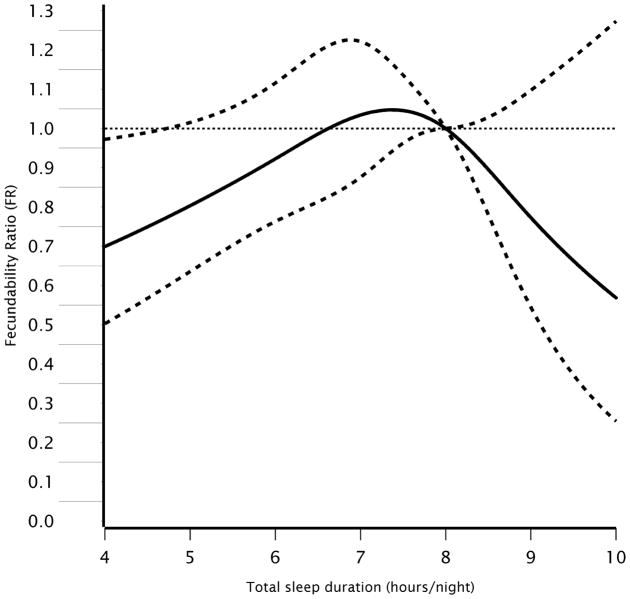
RESULT(S): Relative to 8 hours per night of sleep, multivariable-adjusted FRs for <6, 6, 7, and ≥9 hours per night of sleep were 0.62 (95% CI 0.45-0.87), 1.06 (95% CI 0.87-1.30), 0.97 (95% CI 0.81-1.17), and 0.73 (95% CI 0.46-1.15), respectively. The association between short sleep duration (<6 hours per night) and fecundability was similar among men not working nights or rotating shifts (FR 0.60, 95% CI 0.41-0.88) and among men without a history of infertility (FR 0.62, 95% CI 0.44-0.87) and was stronger among fathers (FR 0.46, 95% CI 0.28-0.76).
CONCLUSION(S): Short sleep duration in men was associated with reduced fecundability. Because male factor accounts for 50% of couple infertility, identifying modifiable determinants of infertility could provide alternatives to expensive fertility workups and treatments.
前瞻性评估男性睡眠时间与生育能力之间的关系。
基于网络的北美夫妇孕前队列研究(Presto),于 2013-2017 年期间入组。
不适用。
男性参与者年龄≥21 岁;女性参与者年龄 21-45 岁。
无。
入组时,男性报告其前一个月的平均夜间睡眠时间。女性在后续问卷中每 8 周更新一次妊娠状态,最长 12 个月或直至受孕。分析仅限于在入组时已尝试怀孕不超过 6 个周期的 1176 对夫妇。采用比例概率回归模型,估计生育力比值(FR)及其 95%置信区间(CI),并校正潜在混杂因素。
与每晚 8 小时睡眠相比,每晚睡眠<6、6、7 和≥9 小时的多变量校正 FR 分别为 0.62(95%CI 0.45-0.87)、1.06(95%CI 0.87-1.30)、0.97(95%CI 0.81-1.17)和 0.73(95%CI 0.46-1.15)。睡眠时间短(<6 小时/晚)与生育能力的关系在不轮班或倒班的男性(FR0.60,95%CI0.41-0.88)和无不孕史的男性(FR0.62,95%CI0.44-0.87)中相似,在父亲中更强(FR0.46,95%CI0.28-0.76)。
男性睡眠时间短与生育能力降低有关。由于男性因素占夫妇不孕的 50%,确定可改变的不孕决定因素可能为昂贵的生育力检查和治疗提供替代方案。