Centro de Estudios Parasitológicos y de Vectores (CEPAVE-CCT-La Plata-CONICET-UNLP), Boulevard 120 e/61y 62, 1900, La Plata, Argentina.
Departamento de Ecología, Genética y Evolución, Facultad de Ciencias Exactas y Naturales, Universidad de Buenos Aires, IEGEBA (CONICET-UBA), Intendente Güiraldes y Av. Costanera Norte s/n, 4to Piso, Pabellón II, Ciudad Universitaria, CI1428 EHA, Ciudad Autónoma de Buenos Aires, Argentina.
Sci Rep. 2018 Mar 22;8(1):5041. doi: 10.1038/s41598-018-23401-7.
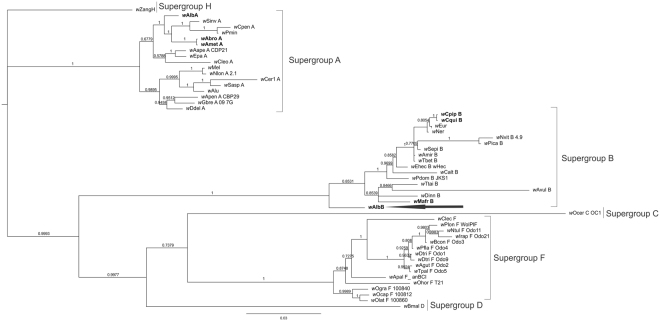
Aedes albopictus (Diptera: Culicidae) is an invasive mosquito, native to Asia, that has expanded its range worldwide. It is considered to be a public health threat as it is a competent vector of viruses of medical importance, including dengue, chikungunya, and Zika. Despite its medical importance there is almost no information on biologically important traits of Ae. albopictus in Argentina. We studied life cycle traits, demographic parameters and analyzed the competence of this mosquito as a virus vector. In addition, we determined the prevalence of Wolbachia strains in Ae. albopictus as a first approach to investigate the potential role of this bacteria in modulating vector competence for arboviruses. We observed low hatch rates of eggs, which led to a negative growth rate. We found that Ae. albopictus individuals were infected with Wolbachia in the F1 but while standard superinfection with wAlbA and wAlbB types was found in 66.7% of the females, 16.7% of the females and 62.5% of the males were single-infected with the wAlbB strain. Finally, despite high levels of infection and dissemination, particularly for chikungunya virus, Ae. albopictus from subtropical Argentina were found to be relatively inefficient vectors for transmission of both chikungunya and dengue viruses.
白纹伊蚊(双翅目:蚊科)是一种入侵性蚊子,原产于亚洲,现已在全球范围内广泛分布。它被认为是一种公共卫生威胁,因为它是具有医学重要性病毒的有效传播媒介,包括登革热、基孔肯雅热和寨卡病毒。尽管它具有医学重要性,但在阿根廷,关于白纹伊蚊的生物学重要特征几乎没有信息。我们研究了白纹伊蚊的生命周期特征、人口统计学参数,并分析了这种蚊子作为病毒传播媒介的能力。此外,我们还确定了白纹伊蚊中沃尔巴克氏体菌株的流行情况,作为研究这种细菌在调节对虫媒病毒的媒介能力方面的潜在作用的初步尝试。我们观察到卵的孵化率低,导致负增长率。我们发现,白纹伊蚊个体在 F1 中感染了沃尔巴克氏体,但在 66.7%的雌性个体中发现了 wAlbA 和 wAlbB 型的标准超级感染,而 16.7%的雌性个体和 62.5%的雄性个体则单一感染了 wAlbB 菌株。最后,尽管感染和传播水平很高,特别是对基孔肯雅热病毒,但来自阿根廷亚热带地区的白纹伊蚊被发现对传播基孔肯雅热和登革热病毒的效率相对较低。