Inácio da Silva Luísa Maria, Dezordi Filipe Zimmer, Paiva Marcelo Henrique Santos, Wallau Gabriel Luz
Departamento de Entomologia, Instituto Aggeu Magalhães (IAM), Fundação Oswaldo Cruz (FIOCRUZ), Av. Professor Moraes Rego, s/n, Campus da UFPE, Cidade Universitária, Recife 50740-465, Brazil.
Núcleo de Bioinformática (NBI), Instituto Aggeu Magalhães (IAM), Fundação Oswaldo Cruz (FIOCRUZ), Recife 50670-420, Brazil.
Pathogens. 2021 Jan 6;10(1):39. doi: 10.3390/pathogens10010039.
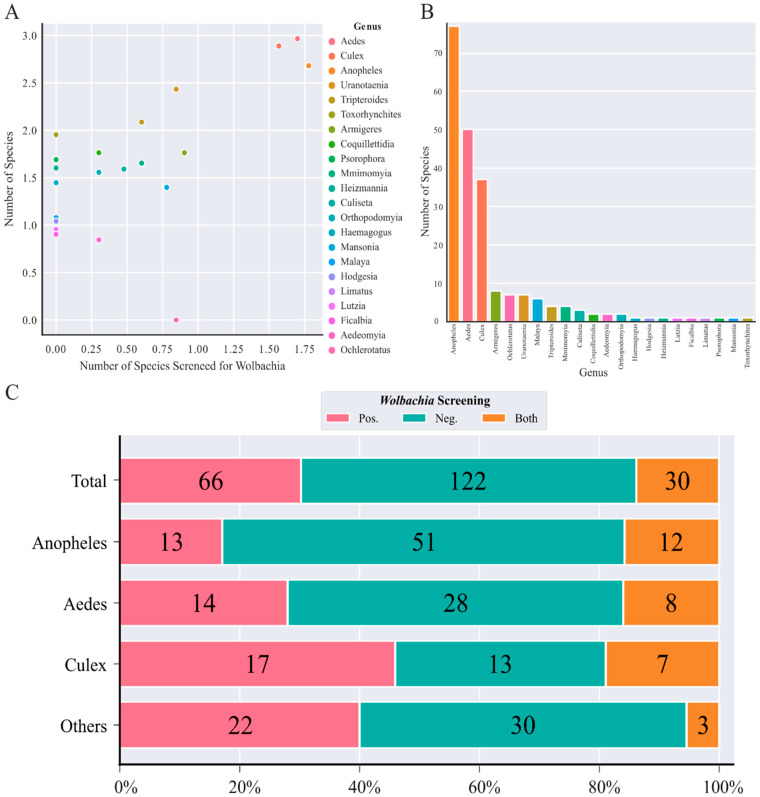
is an endosymbiotic bacterium that naturally infects several arthropods and nematode species. gained particular attention due to its impact on their host fitness and the capacity of specific strains in reducing pathogen vector and agricultural pest populations and pathogens transmission. Despite the success of mosquito/pathogen control programs using -infected mosquito release, little is known about the abundance and distribution of in most mosquito species, a crucial knowledge for planning and deployment of mosquito control programs and that can further improve our basic biology understanding of and host relationships. In this systematic review, was detected in only 30% of the mosquito species investigated. Fourteen percent of the species were considered positive by some studies and negative by others in different geographical regions, suggesting a variable infection rate and/or limitations of the detection methods employed. Eighty-three percent of the studies screened with only one technique. Our findings highlight that the assessment of using a single approach limited the inference of true infection in most of the studied species and that researchers should carefully choose complementary methodologies and consider different -mosquito population dynamics that may be a source of bias to ascertain the correct infectious status of the host species.
是一种内共生细菌,自然感染多种节肢动物和线虫物种。由于其对宿主适应性的影响以及特定菌株在减少病原体载体和农业害虫种群及病原体传播方面的能力,它受到了特别关注。尽管使用感染的蚊子释放进行蚊虫/病原体控制计划取得了成功,但对于大多数蚊子物种中该细菌的丰度和分布情况知之甚少,而这对于蚊虫控制计划的规划和部署至关重要,并且可以进一步增进我们对该细菌及其与宿主关系的基础生物学理解。在这项系统综述中,在所调查的蚊子物种中仅30%检测到了该细菌。在不同地理区域,14%的物种在一些研究中被认为呈阳性,而在其他研究中呈阴性,这表明感染率存在差异和/或所采用的该细菌检测方法存在局限性。83%的研究仅用一种技术筛查该细菌。我们的研究结果强调,使用单一方法评估该细菌会限制对大多数研究物种中真正感染情况的推断,并且研究人员应谨慎选择互补方法,并考虑不同的该细菌 - 蚊子种群动态,这些动态可能是偏差的来源,以确定宿主物种的正确感染状态。