Wongkanya Rapeeporn, Pankam Tippawan, Wolf Shauna, Pattanachaiwit Supanit, Jantarapakde Jureeporn, Pengnongyang Supabhorn, Thapwong Prasopsuk, Udomjirasirichot Apichat, Churattanakraisri Yutthana, Prawepray Nanthika, Paksornsit Apiluk, Sitthipau Thidadaow, Petchaithong Sarayut, Jitsakulchaidejt Raruay, Nookhai Somboon, Lertpiriyasuwat Cheewanan, Ongwandee Sumet, Phanuphak Praphan, Phanuphak Nittaya
Thai Red Cross AIDS Research Centre, Bangkok, Thailand.
The Henry M Jackson Foundation for the Advancement of Military Medicine, Inc., and the US Department of the Army.
J Virus Erad. 2018 Jan 1;4(1):12-15. doi: 10.1016/S2055-6640(20)30235-1.
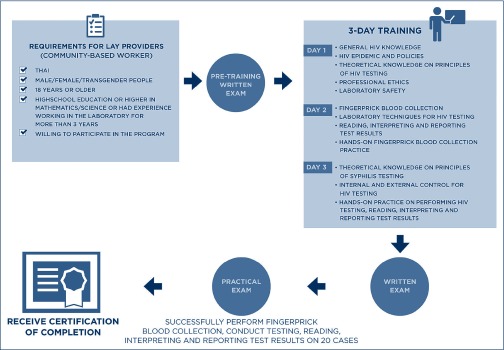
Rapid diagnostic testing (RDT) for HIV has a quick turn-around time, which increases the proportion of people testing who receive their result. HIV RDT in Thailand has traditionally been performed only by medical technologists (MTs), which is a barrier to its being scaled up. We evaluated the performance of HIV RDT conducted by trained lay providers who were members of, or worked closely with, a group of men who have sex with men (MSM) and with transgender women (TG) communities, and compared it to tests conducted by MTs. Lay providers received a 3-day intensive training course on how to perform a finger-prick blood collection and an HIV RDT as part of the Key Population-led Health Services (KPLHS) programme among MSM and TG. All the samples were tested by lay providers using Alere Determine HIV 1/2. HIV-reactive samples were confirmed by DoubleCheckGold Ultra HIV 1&2 and SD Bioline HIV 1/2. All HIV-positive and 10% of HIV-negative samples were re-tested by MTs using Serodia HIV 1/2. Of 1680 finger-prick blood samples collected and tested using HIV RDT by lay providers in six drop-in centres in Bangkok, Chiang Mai, Chonburi and Songkhla, 252 (15%) were HIV-positive. MTs re-tested these HIV-positive samples and 143 randomly selected HIV-negative samples with 100% concordant test results. Lay providers in Thailand can be trained and empowered to perform HIV RDT as they were found to achieve comparable results in sample testing with MTs. Based on the task-shifting concept, this rapid HIV testing performed by lay providers as part of the KPLHS programme has great potential to enhance HIV prevention and treatment programmes among key at-risk populations.
艾滋病毒快速诊断检测(RDT)周转时间短,这使得接受检测并获得结果的人数比例有所增加。在泰国,传统上艾滋病毒RDT仅由医学技术人员(MT)进行,这成为扩大检测规模的一个障碍。我们评估了由经过培训的非专业提供者进行的艾滋病毒RDT的性能,这些提供者是男男性行为者(MSM)和变性女性(TG)群体的成员或与这些群体密切合作,并且将其与MT进行的检测进行了比较。作为MSM和TG中关键人群主导的卫生服务(KPLHS)项目的一部分,非专业提供者接受了为期3天的强化培训课程,内容包括如何进行手指采血和艾滋病毒RDT。所有样本均由非专业提供者使用Alere Determine HIV 1/2进行检测。艾滋病毒反应性样本通过DoubleCheckGold Ultra HIV 1&2和SD Bioline HIV 1/2进行确认。所有艾滋病毒阳性样本和10%的艾滋病毒阴性样本由MT使用Serodia HIV 1/2进行重新检测。在曼谷、清迈、春武里和宋卡的六个接待中心,由非专业提供者收集并使用艾滋病毒RDT检测的1680份手指采血样本中,252份(15%)为艾滋病毒阳性。MT对这些艾滋病毒阳性样本和143份随机选择的艾滋病毒阴性样本进行了重新检测,检测结果100%一致。泰国的非专业提供者经过培训并获得授权后能够进行艾滋病毒RDT,因为发现他们在样本检测中能取得与MT相当的结果。基于任务转移的理念,作为KPLHS项目一部分由非专业提供者进行的这种快速艾滋病毒检测在加强关键高危人群中的艾滋病毒预防和治疗项目方面具有巨大潜力。