Nyandat Joram, van Rensburg Gisela
Department of Health Studies, University of South Africa, South Africa.
South Afr J HIV Med. 2017 Nov 29;18(1):691. doi: 10.4102/sajhivmed.v18i1.691. eCollection 2017.
Many factors contribute to an enhanced risk of infant HIV acquisition, two of which may include failure of a mother to disclose her HIV-positive status to her partner and exclusion of male partners in preventing mother-to-child transmission of HIV (PMTCT) interventions. To justify why HIV programmes need to integrate male partner involvement and partner disclosure, we need to establish an association between the two factors and infant HIV acquisition.
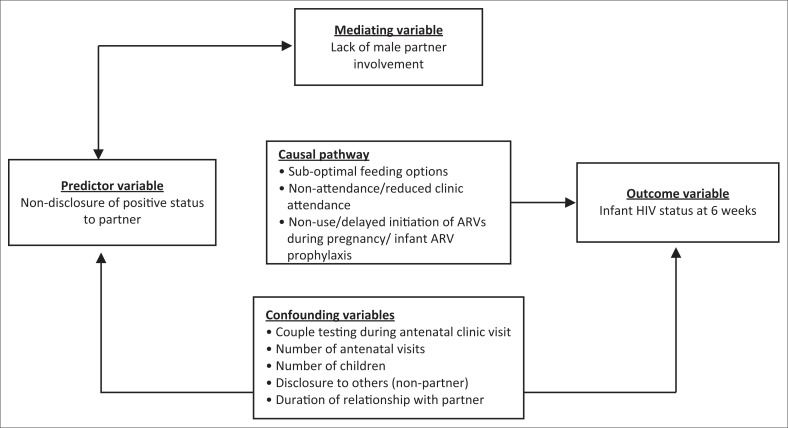
To determine whether failure to disclose an HIV-positive status to a male partner is associated with increased risk of infant HIV acquisition, and whether part of the association is explained by exclusion of male partner in PMTCT programmes.
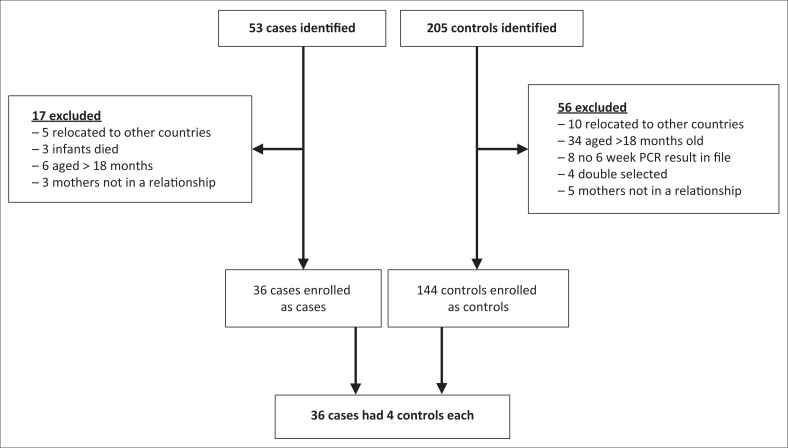
Using a case-control study design, we identified a total of 180 mother-baby pairs with HIV-exposed infants. Thirty-six pairs with HIV-positive babies (cases) were compared to 144 pairs with HIV-negative babies (controls) on whether the mothers had disclosed their HIV status to their partner in order to determine whether a disclosure or lack of it contributed to increased risk of mother-to-child transmission of HIV (MTCT). Each case pair was matched to four control pairs from the same facility.
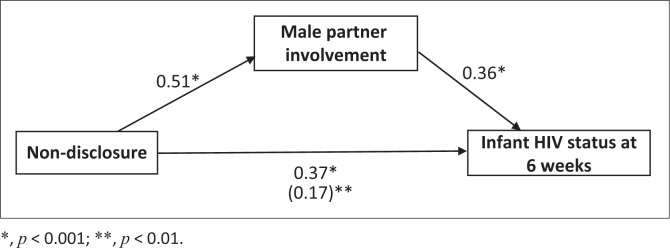
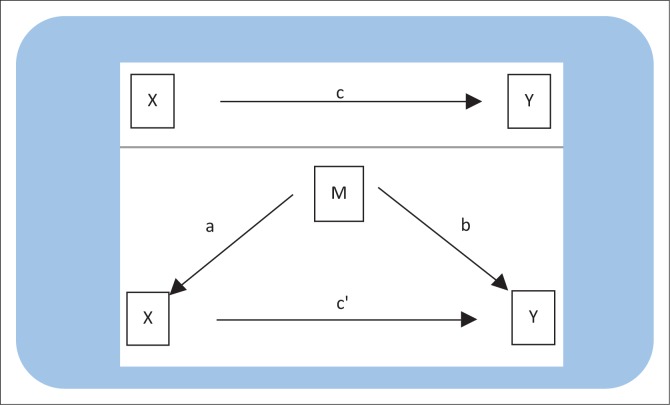
Overall, 16.7% of mothers had not disclosed their HIV status to their partners, the proportion being significantly more among cases (52.8% vs. 7.6%, < 0.001). Non-disclosure was significantly associated with infant HIV acquisition (aOR 9.8 (3.0-26.3); < 0.001) and male partner involvement partially mediated the effect of non-disclosure on infant HIV acquisition (indirect coefficient = 0.17, < 0.005).
Failure of an HIV-positive woman to disclose her status to her male partner and exclusion of male partners in PMTCT programmes are two social factors that may curtail success of interventions towards the goal of eliminating MTCT.
许多因素导致婴儿感染艾滋病毒的风险增加,其中两个因素可能包括母亲未向其伴侣透露自己的艾滋病毒阳性状态,以及在预防母婴传播艾滋病毒(PMTCT)干预措施中排除男性伴侣。为了说明艾滋病毒项目为何需要将男性伴侣的参与和伴侣告知纳入其中,我们需要确定这两个因素与婴儿感染艾滋病毒之间的关联。
确定未向男性伴侣透露艾滋病毒阳性状态是否与婴儿感染艾滋病毒的风险增加有关,以及这种关联的部分原因是否是在PMTCT项目中排除了男性伴侣。
采用病例对照研究设计,我们共确定了180对母婴,其婴儿均暴露于艾滋病毒环境。将36对婴儿感染艾滋病毒的母婴(病例组)与144对婴儿未感染艾滋病毒的母婴(对照组)进行比较,比较母亲是否向其伴侣透露了自己的艾滋病毒状态,以确定透露或未透露是否会增加母婴传播艾滋病毒(MTCT)的风险。每个病例组与来自同一机构的四个对照组进行匹配。
总体而言,16.7%的母亲未向其伴侣透露自己的艾滋病毒状态,这一比例在病例组中显著更高(52.8%对7.6%,<0.001)。未透露与婴儿感染艾滋病毒显著相关(调整后的比值比为9.8(3.0 - 26.3);<0.001),男性伴侣的参与部分介导了未透露对婴儿感染艾滋病毒的影响(间接系数 = 0.17,<0.005)。
艾滋病毒呈阳性的女性未向其男性伴侣透露自己的状态,以及在PMTCT项目中排除男性伴侣,是两个可能会削弱实现消除母婴传播目标干预措施成功性的社会因素。