Division of General Academic Pediatrics, Massachusetts General Hospital for Children, Boston, MA.
Division of General Pediatrics, Oregon Health & Science University, Portland, OR.
J Dev Behav Pediatr. 2018 Apr;39(3):217-227. doi: 10.1097/DBP.0000000000000536.
Many US children use complementary health approaches (CHAs), including some modalities that may be ineffective, unsafe, and/or costly. Yet, little is known about the prevalence and correlates of CHA use among children with developmental disabilities (DDs), as well as parent nondisclosure of CHAs used for children with DDs to health care providers. We, therefore, aimed to profile the use and nondisclosure of CHAs among US children with DDs.
We analyzed data from the 2012 National Health Interview Survey, which included the most recent Child Complementary and Alternative Medicine Supplement. The study sample was comprised of 2141 children with DDs aged 4 to 17 years.
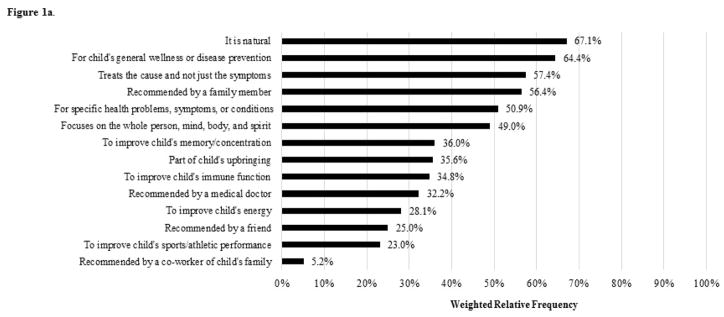
Nearly one-quarter (23%) of US children with DDs used CHAs. Among those with a personal health provider, 42% of parents did not disclose some or all CHAs used to the child's provider. The adjusted odds ratios of using CHAs were greater among those with female sex, higher household income, residences not in the South, difficulty accessing care, or comorbid conditions. CHA was most commonly used because "it is natural." Nondisclosure was associated with female sex, older age, having no functional limitations, less conventional services use, and use of fewer CHAs. The most common reason for nondisclosure was that the child's provider did not ask.
Complementary health approach use is prevalent among US children with DDs, and nondisclosure is likely among those who use CHAs. Future intervention targeting education and communication about CHAs for parents of children with DDs and their health care providers may promote disclosure.
许多美国儿童使用补充健康方法(CHAs),包括一些可能无效、不安全和/或昂贵的方法。然而,对于发育障碍(DD)儿童中 CHA 使用的流行程度和相关性,以及父母未向儿童 DD 的医疗保健提供者披露 CHA 使用情况,知之甚少。因此,我们旨在描述美国患有 DD 的儿童中 CHA 的使用和未披露情况。
我们分析了来自 2012 年全国健康访谈调查的数据,其中包括最近的儿童补充和替代医学补充。研究样本由 2141 名年龄在 4 至 17 岁之间的患有 DD 的儿童组成。
近四分之一(23%)的美国患有 DD 的儿童使用 CHAs。在有私人医疗服务提供者的儿童中,42%的父母未向孩子的提供者披露部分或全部使用的 CHAs。使用 CHAs 的调整后优势比在女性、高收入家庭、不在南部居住、难以获得医疗保健或合并症的儿童中更高。使用 CHAs 的主要原因是“它是天然的”。未披露与女性、年龄较大、无功能限制、较少使用传统服务和使用较少 CHAs 有关。未披露的最常见原因是孩子的提供者没有询问。
补充健康方法的使用在美国患有 DD 的儿童中很普遍,而且那些使用 CHAs 的儿童可能不会披露。未来针对患有 DD 的儿童的父母及其医疗保健提供者的 CHA 教育和沟通的干预措施可能会促进披露。