
生物钟依赖性染色质拓扑结构调节昼夜节律转录和行为。
Clock-dependent chromatin topology modulates circadian transcription and behavior.
机构信息
School of Life Sciences, Ecole Polytechnique Fédérale de Lausanne (EPFL), CH-1015 Lausanne, Switzerland.
Nestle Institute of Health Sciences, CH-1015 Lausanne, Switzerland.
出版信息
Genes Dev. 2018 Mar 1;32(5-6):347-358. doi: 10.1101/gad.312397.118. Epub 2018 Mar 23.
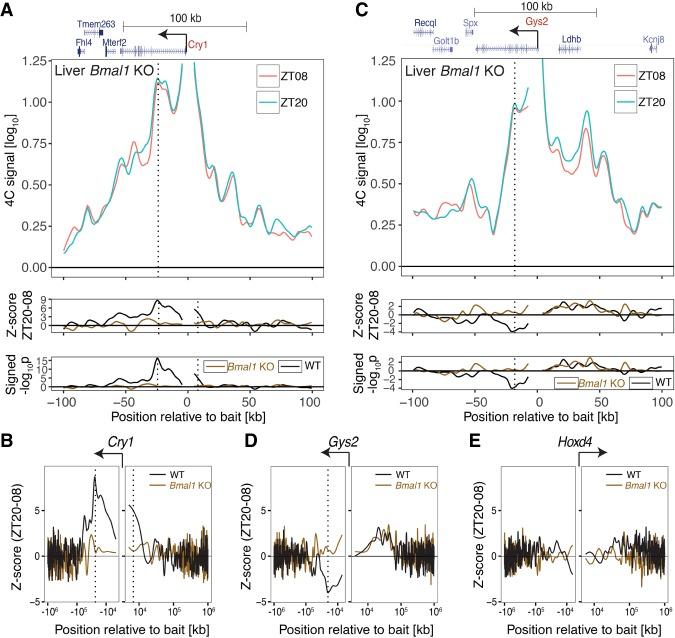
The circadian clock in animals orchestrates widespread oscillatory gene expression programs, which underlie 24-h rhythms in behavior and physiology. Several studies have shown the possible roles of transcription factors and chromatin marks in controlling cyclic gene expression. However, how daily active enhancers modulate rhythmic gene transcription in mammalian tissues is not known. Using circular chromosome conformation capture (4C) combined with sequencing (4C-seq), we discovered oscillatory promoter-enhancer interactions along the 24-h cycle in the mouse liver and kidney. Rhythms in chromatin interactions were abolished in arrhythmic knockout mice. Deleting a contacted intronic enhancer element in the () gene was sufficient to compromise the rhythmic chromatin contacts in tissues. Moreover, the deletion reduced the daily dynamics of transcriptional burst frequency and, remarkably, shortened the circadian period of locomotor activity rhythms. Our results establish oscillating and clock-controlled promoter-enhancer looping as a regulatory layer underlying circadian transcription and behavior.
动物中的生物钟协调广泛的振荡基因表达程序,这些程序是行为和生理学 24 小时节律的基础。几项研究表明,转录因子和染色质标记可能在控制周期性基因表达中发挥作用。然而,在哺乳动物组织中,每日活跃的增强子如何调节节律基因转录尚不清楚。我们使用圆形染色体构象捕获(4C)结合测序(4C-seq),在小鼠肝脏和肾脏中发现了沿着 24 小时周期的振荡启动子-增强子相互作用。在非节律性 基因敲除小鼠中,染色质相互作用的节律被消除。删除 ()基因中一个接触的内含子增强子元件足以破坏组织中的节律性染色质接触。此外,该缺失降低了 转录爆发频率的日动态变化,值得注意的是,还缩短了运动活动节律的生物钟周期。我们的研究结果确立了振荡和时钟控制的启动子-增强子环作为生物钟转录和行为的调控层。




 Zotero 插件