The Vancouver Prostate Centre, Department of Urologic Sciences, University of British Columbia, Vancouver, BC, Canada.
EMBO Mol Med. 2018 Apr;10(4). doi: 10.15252/emmm.201808928.
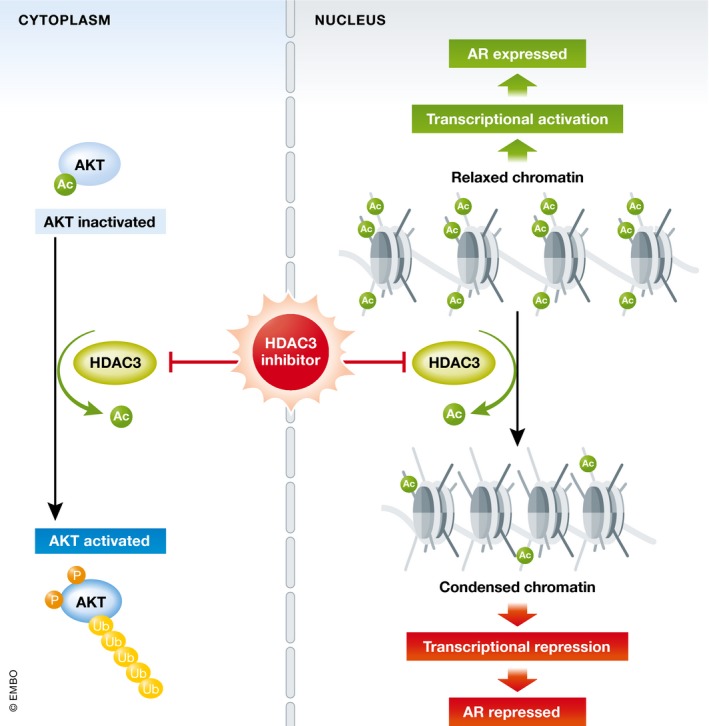
Co‐targeting strategies strive to improve cancer outcomes by combining therapies under contextualized genetic and environmental conditions that selectively target exploitable alterations in tumor cells. Adaptive survival pathways triggered by inhibition of driver genes in the androgen receptor (AR) or PI3K/AKT pathways are of great interest, since they are among the most frequently altered in castrate‐resistant prostate cancer (CRPC). Unfortunately, negative feedback loops exist between the AR and PI3K/AKT pathways such that targeting AR leads to activation of PI3K/AKT signaling, while PI3K/AKT pathway inhibition leads to increased AR transcriptional activity. Hence, targeting both pathways provides an opportunity for conditional lethality and a high therapeutic index. In this issue of , Yan (2018) present an elegant study showing that histone deacetylase 3 (HDAC3) acts as a common upstream activator of both AR and AKT signaling pathways, and use HDAC3 inhibitors as a monotherapy to co‐target two major pathways driving CRPC growth.
联合靶向策略旨在通过在上下文相关的遗传和环境条件下联合治疗,来改善癌症的治疗效果,这些条件选择性地针对肿瘤细胞中可利用的改变。由于雄激素受体 (AR) 或 PI3K/AKT 通路中的驱动基因抑制所触发的适应性生存途径非常重要,因为它们在去势抵抗性前列腺癌 (CRPC) 中最常发生改变。不幸的是,AR 和 PI3K/AKT 通路之间存在负反馈回路,因此靶向 AR 会导致 PI3K/AKT 信号转导的激活,而 PI3K/AKT 通路抑制会导致 AR 转录活性增加。因此,靶向这两条通路为条件性致死和高治疗指数提供了机会。在本期的 中,Yan 等人(2018)发表了一项精巧的研究,表明组蛋白去乙酰化酶 3 (HDAC3) 作为 AR 和 AKT 信号通路的共同上游激活剂,并用 HDAC3 抑制剂作为单一疗法来共同靶向两种主要的 CRPC 生长驱动通路。