Medisch Centrum Zuid, Sportlaan 2-1, 9728 PH, Groningen, The Netherlands.
Center for Human Movement Science, University of Groningen, University Medical Center Groningen, Antonius Deusinglaan 1, 9713 AV, Groningen, The Netherlands.
Knee Surg Sports Traumatol Arthrosc. 2018 Dec;26(12):3636-3644. doi: 10.1007/s00167-018-4916-4. Epub 2018 Mar 24.
The purpose of the current prospective study was to assess the changes over time in patients tested at 6 months and 9 months after anterior cruciate ligament reconstruction (ACLR) with a return to sport (RTS) test battery. It was hypothesized that more patients passed RTS criteria at 9 months compared to 6 months.
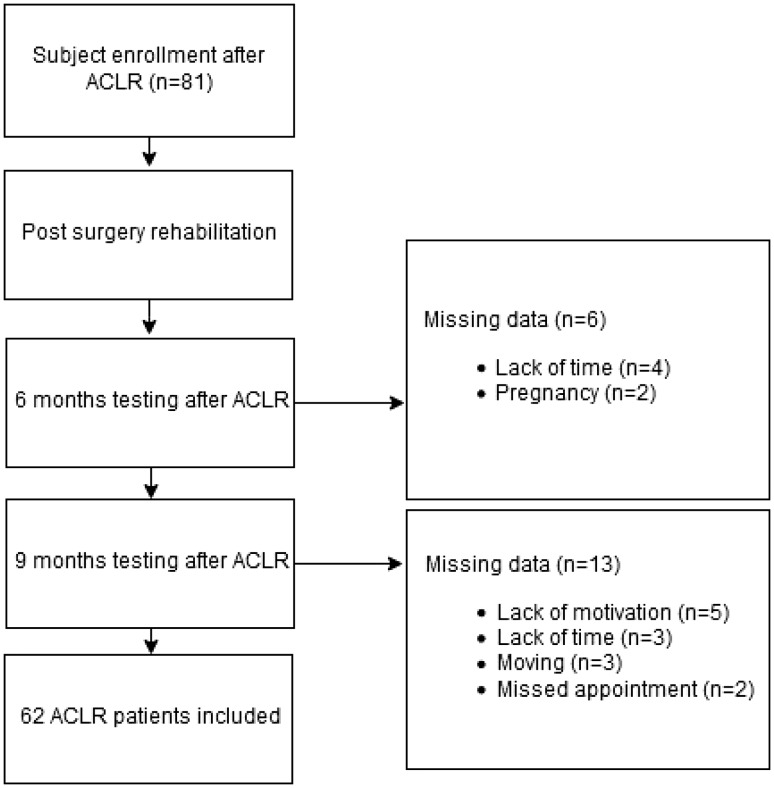
Sixty-two ACLR patients performed a test battery at an average of 6.5 ± 0.7 and 9.5 ± 0.9 months after ACLR. All patients underwent a standardized rehabilitation protocol. The test battery consisted of the following tests: a jump-landing task assessed with the Landing Error Scoring System (LESS), three single-leg hop tasks (single-leg hop test, triple-leg hop test, side hop test), isokinetic quadriceps and hamstring strength at 60, 180 and 300°/s and two questionnaires (IKDC and ACL-RSI). Cut off criteria were set as Limb Symmetry Index (LSI) > 90% (for isokinetic strength and for single-leg hop tasks), LESS < 5, IKDC score within 15th percentage of healthy subjects and ACL-RSI > 56 respectively.
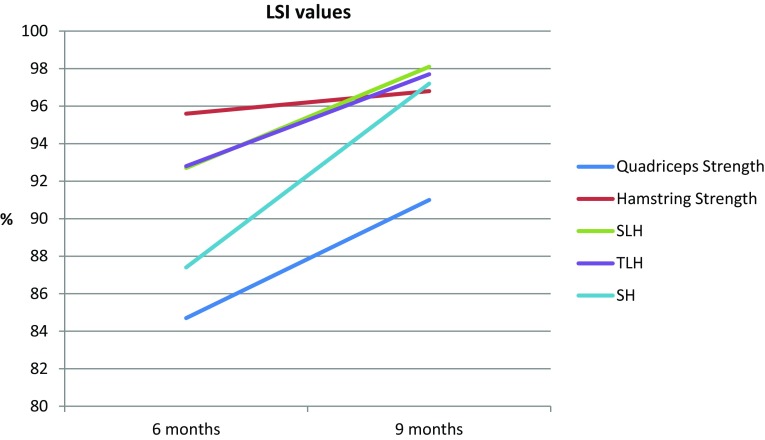
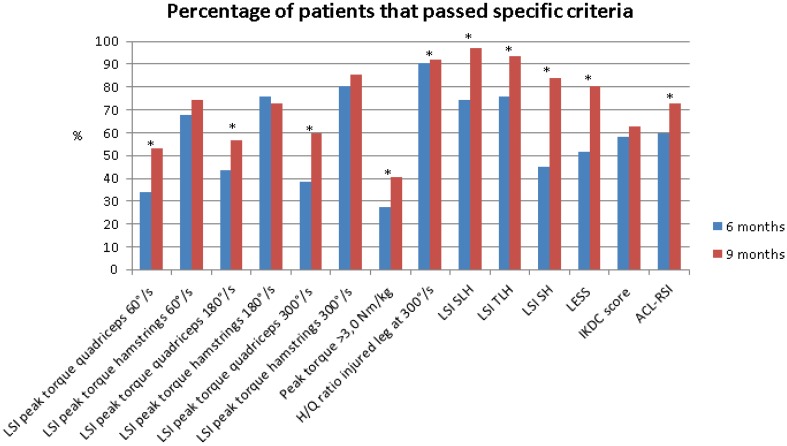
At 6 months, two patients (3.2%) passed all criteria. At 9 months, seven patients (11.3%) passed all criteria. Patients improved in all RTS criteria over time except for the IKDC score. Twenty-nine patients (46.8%) did not pass the strength criterion at 60°/s at 9 months after ACLR.
The percentages of patients passing all RTS criteria were low at both 6 and 9 months after ACLR. Quadriceps strength revealed persistent deficits and the lack of improvement in the IKDC score questionnaires shows insufficient self-reported knee function for RTS.
III.
本前瞻性研究旨在评估前交叉韧带重建(ACL)后 6 个月和 9 个月接受重返运动(RTS)测试的患者的变化。假设与 6 个月相比,9 个月时有更多的患者通过 RTS 标准。
62 例 ACLR 患者在 ACLR 后平均 6.5±0.7 和 9.5±0.9 个月时进行了测试。所有患者均接受了标准化康复方案。测试包括以下测试:跳落地任务,使用落地错误评分系统(LESS)评估;三种单腿跳跃测试(单腿跳跃测试、三腿跳跃测试、侧跳测试);60、180 和 300°/s 的等速股四头肌和腘绳肌力量以及两个问卷(IKDC 和 ACL-RSI)。截值标准设定为:等速力量和单腿跳跃任务的肢体对称性指数(LSI)>90%,LESS<5,IKDC 评分在健康受试者的第 15 个百分位内,ACL-RSI>56。
6 个月时,两名患者(3.2%)通过了所有标准。9 个月时,七名患者(11.3%)通过了所有标准。除 IKDC 评分外,所有 RTS 标准的患者在时间上均有所改善。29 名患者(46.8%)在 ACLR 后 9 个月时 60°/s 的等速力量标准未通过。
ACL 后 6 个月和 9 个月时,通过所有 RTS 标准的患者比例较低。股四头肌力量仍然存在缺陷,IKDC 评分问卷的改善不足表明膝关节功能自我报告不足以进行 RTS。
III。