Kelly Ryan P, Gallego Ramón, Jacobs-Palmer Emily
School of Marine and Environmental Affairs, University of Washington, Seattle, WA, United States of America.
PeerJ. 2018 Mar 19;6:e4521. doi: 10.7717/peerj.4521. eCollection 2018.
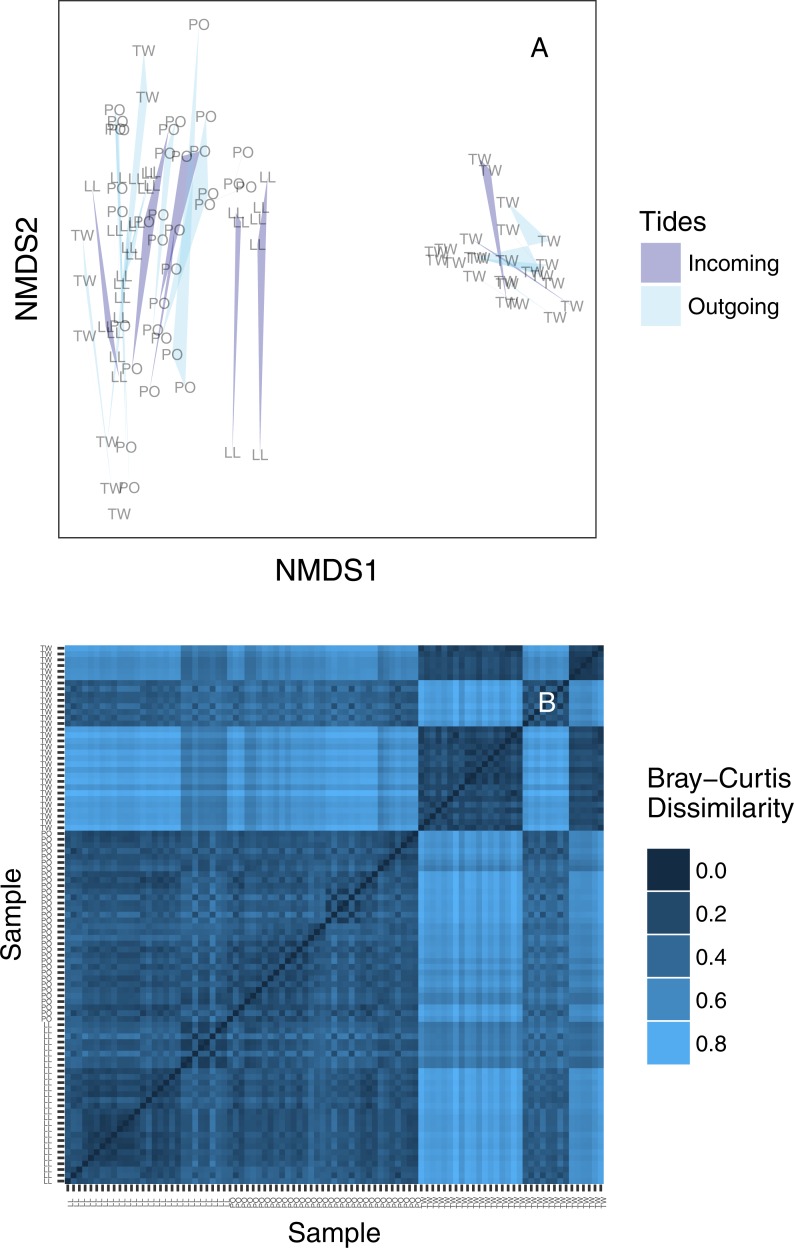
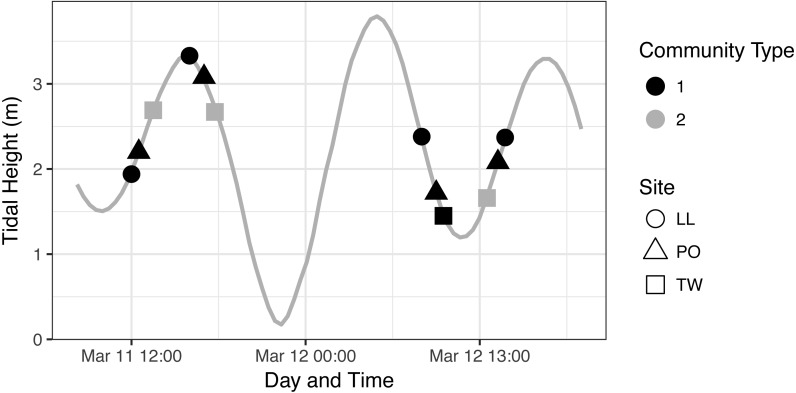
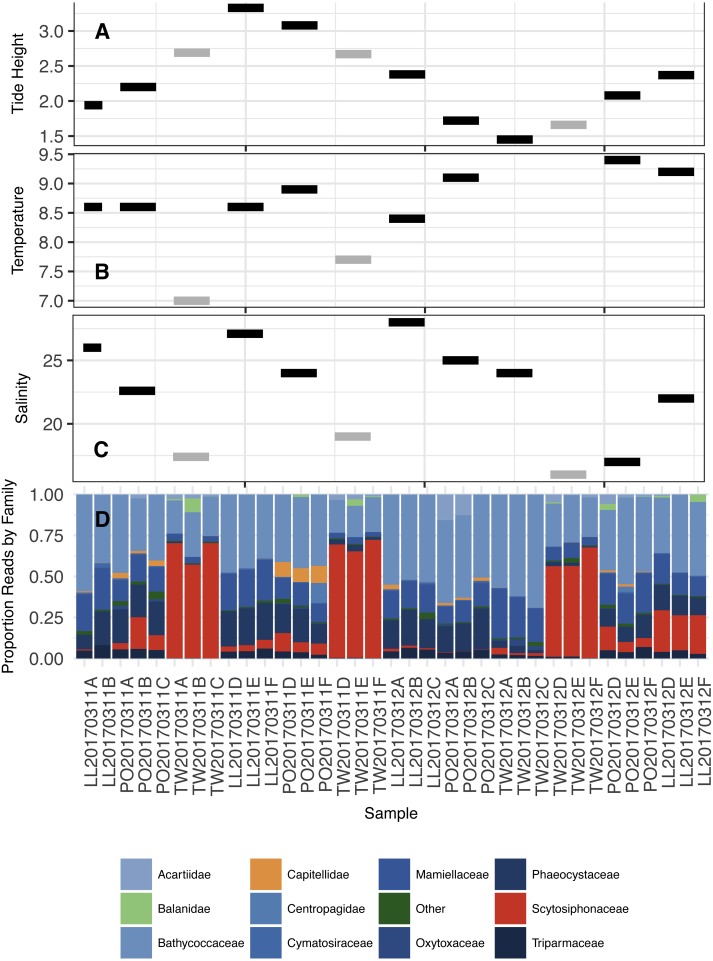
We can recover genetic information from organisms of all kinds using environmental sampling. In recent years, sequencing this environmental DNA (eDNA) has become a tractable means of surveying many species using water, air, or soil samples. The technique is beginning to become a core tool for ecologists, environmental scientists, and biologists of many kinds, but the temporal resolution of eDNA sampling is often unclear, limiting the ecological interpretations of the resulting datasets. Here, in a temporally and spatially replicated field study using ca. 313 bp of eukaryotic COI mtDNA as a marker, we find that nearshore organismal communities are largely consistent across tides. Our findings suggest that nearshore eDNA from both benthic and planktonic taxa tends to be endogenous to the site and water mass sampled, rather than changing with each tidal cycle. However, where physiochemical water mass characteristics change, we find that the relative contributions of a broad range of organisms to eDNA communities shift in concert.
我们可以通过环境采样从各种生物中恢复遗传信息。近年来,对这种环境DNA(eDNA)进行测序已成为一种利用水、空气或土壤样本对许多物种进行调查的可行方法。该技术正开始成为生态学家、环境科学家和众多生物学家的核心工具,但eDNA采样的时间分辨率往往不明确,限制了对所得数据集的生态学解释。在此,在一项使用约313bp真核生物细胞色素氧化酶亚基I(COI)线粒体DNA作为标记的时间和空间重复的实地研究中,我们发现近岸生物群落随潮汐变化基本保持一致。我们的研究结果表明,来自底栖和浮游类群的近岸eDNA往往源自所采样的地点和水体,而非随每个潮汐周期变化。然而,在理化水体特征发生变化的地方,我们发现广泛生物对eDNA群落的相对贡献会协同变化。