Department of Biology, University of Florida, Gainesville, FL, USA.
Emerging Pathogens Institute, University of Florida, Gainesville, FL, USA.
Infect Dis Poverty. 2018 Mar 27;7(1):20. doi: 10.1186/s40249-018-0402-y.
As leprosy elimination becomes an increasingly realistic goal, it is essential to determine the factors that contribute to its persistence. We evaluate social and economic factors as predictors of leprosy annual new case detection rates within India, where the majority of leprosy cases occur.
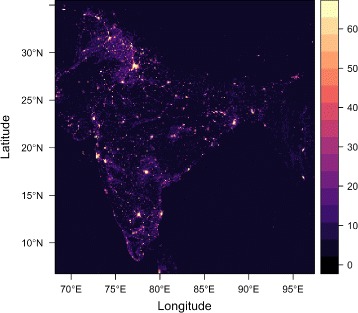
We used correlation and linear mixed effect regressions to assess whether poverty, illiteracy, nighttime satellite radiance (an index of development), and other covariates can explain district-wise annual new case detection rate and Grade 2 disability diagnoses.
We find only weak evidence of an association between poverty and annual new case detection rates at the district level, though illiteracy and satellite radiance are statistically significant predictors of leprosy at the district level. We find no evidence of rapid decline over the period 2008-2015 in either new case detection or new Grade 2 disability.
Our findings suggest a somewhat higher rate of leprosy detection, on average, in poorer districts; the overall effect is weak. The divide between leprosy case detection and true incidence of clinical leprosy complicates these results, particularly given that the detection rate is likely disproportionately lower in impoverished settings. Additional information is needed to distinguish the determinants of leprosy case detection and transmission during the elimination epoch.
随着麻风病消除成为一个日益现实的目标,确定导致其持续存在的因素至关重要。我们评估了社会和经济因素,以预测印度的麻风病年新发病例检出率,因为印度是大多数麻风病病例发生的地方。
我们使用相关分析和线性混合效应回归来评估贫困、文盲、夜间卫星辐射(发展指数)和其他协变量是否可以解释各地区的年新发病例检出率和 2 级残疾诊断。
我们发现贫困与地区年度新发病例检出率之间仅存在微弱的关联,但文盲和卫星辐射是地区一级麻风病的统计学显著预测因子。我们没有发现 2008 年至 2015 年间新发病例检出率或新 2 级残疾率有快速下降的证据。
我们的研究结果表明,在较贫困的地区,麻风病的检出率平均略高;总体效果较弱。麻风病病例检出与临床麻风病实际发病率之间的差距使这些结果复杂化,特别是考虑到在贫困环境中,检测率可能不成比例地较低。需要更多的信息来区分消除时代麻风病病例检出和传播的决定因素。