University of Iowa, 102 Field House, Iowa City, IA, 52242, USA.
University of Iowa, N418 CPHB, Iowa City, IA, 52242, USA.
BMC Public Health. 2018 Mar 27;18(1):412. doi: 10.1186/s12889-018-5310-3.
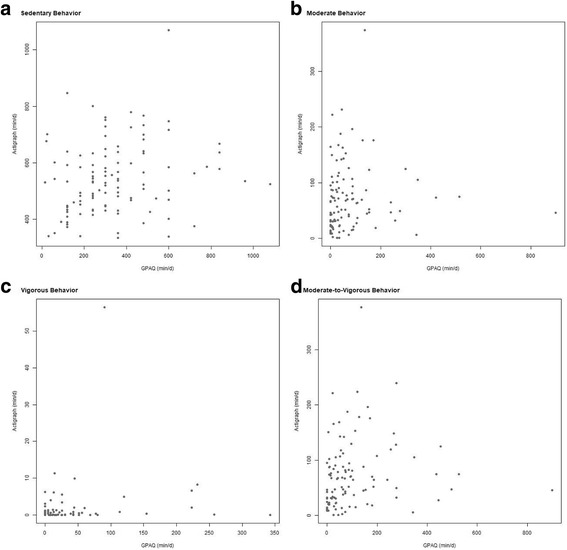
Self-report questionnaires are a valuable method of physical activity measurement in public health research; however, accuracy is often lacking. The purpose of this study is to improve the validity of the Global Physical Activity Questionnaire by calibrating it to 7 days of accelerometer measured physical activity and sedentary behavior.
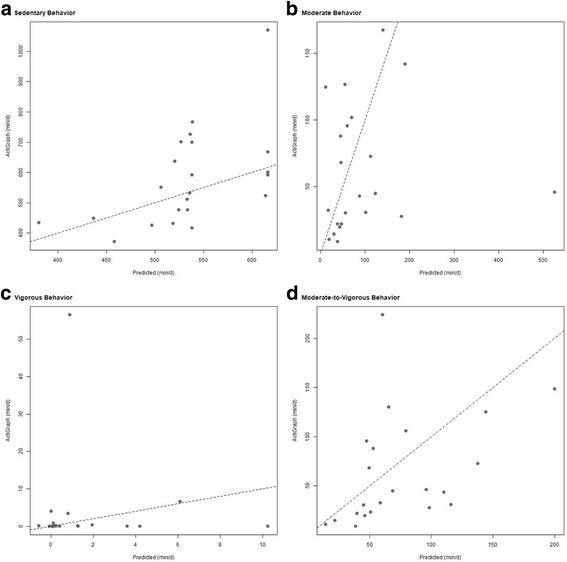
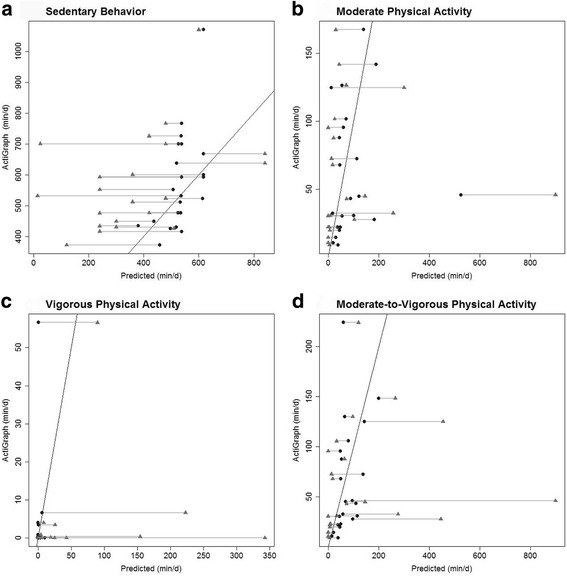
Participants (n = 108) wore an ActiGraph GT9X Link on their non-dominant wrist for 7 days. Following the accelerometer wear period, participants completed a telephone Global Physical Activity Questionnaire with a research assistant. Data were split into training and testing samples, and multivariable linear regression models built using functions of the GPAQ self-report data to predict ActiGraph measured physical activity and sedentary behavior. Models were evaluated with the testing sample and an independent validation sample (n = 120) using Mean Squared Prediction Errors.
The prediction models utilized sedentary behavior, and moderate- and vigorous-intensity physical activity self-reported scores from the questionnaire, and participant age. Transformations of each variable, as well as break point analysis were considered. Prediction errors were reduced by 77.7-80.6% for sedentary behavior and 61.3-98.6% for physical activity by using the multivariable linear regression models over raw questionnaire scores.
This research demonstrates the utility of calibrating self-report questionnaire data to objective measures to improve estimates of physical activity and sedentary behavior. It provides an understanding of the divide between objective and subjective measures, and provides a means to utilize the two methods as a unified measure.
自我报告问卷是公共卫生研究中测量身体活动的一种有价值的方法,但准确性往往不足。本研究的目的是通过将全球体力活动问卷(GPAQ)校准至 7 天的加速度计测量的体力活动和久坐行为,来提高其有效性。
参与者(n=108)在非优势手腕上佩戴 ActiGraph GT9X Link 加速度计,佩戴 7 天。在加速度计佩戴期结束后,参与者通过电话完成全球体力活动问卷(GPAQ)的自我报告,由研究助理进行电话访谈。数据分为训练和测试样本,使用 GPAQ 自我报告数据的函数构建多变量线性回归模型,以预测 ActiGraph 测量的体力活动和久坐行为。使用测试样本和独立验证样本(n=120),通过均方预测误差评估模型。
预测模型利用了问卷中的久坐行为、中高强度体力活动自我报告得分以及参与者年龄。考虑了每个变量的变换以及断点分析。与原始问卷得分相比,使用多变量线性回归模型可以将久坐行为的预测误差降低 77.7-80.6%,将体力活动的预测误差降低 61.3-98.6%。
本研究证明了校准自我报告问卷数据以获得客观测量值来提高体力活动和久坐行为估计值的有效性。它提供了对客观和主观测量之间差异的理解,并提供了一种利用两种方法作为统一测量方法的手段。