Department of Food Science, Cornell University, Ithaca, New York, USA.
Department of Population Medicine and Diagnostic Sciences, Cornell University, Ithaca, New York, USA.
mBio. 2018 Mar 27;9(2):e00467-18. doi: 10.1128/mBio.00467-18.
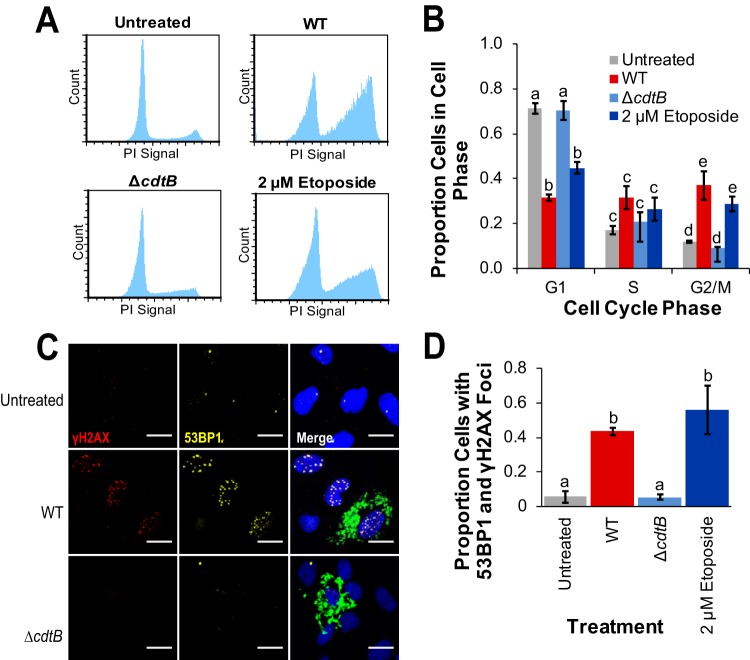
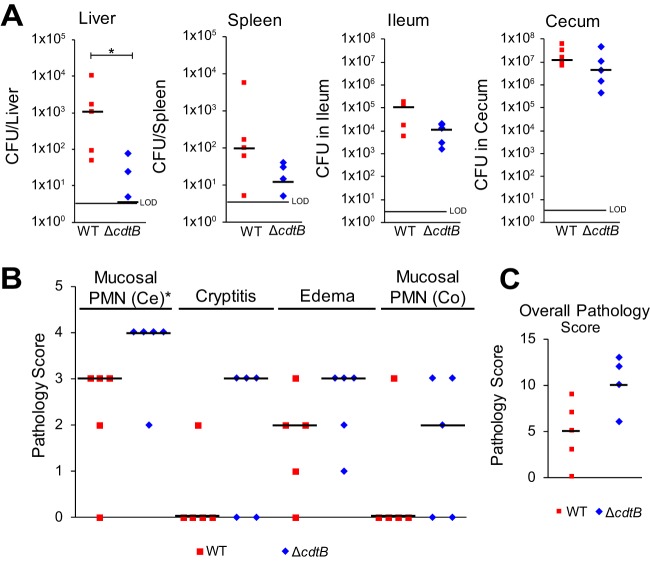
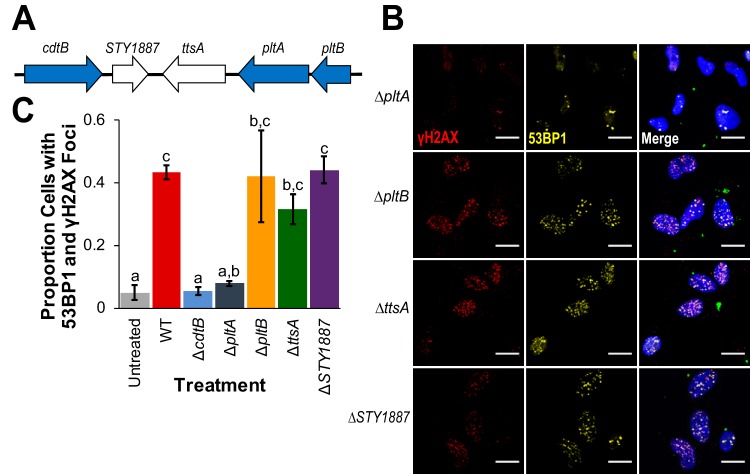
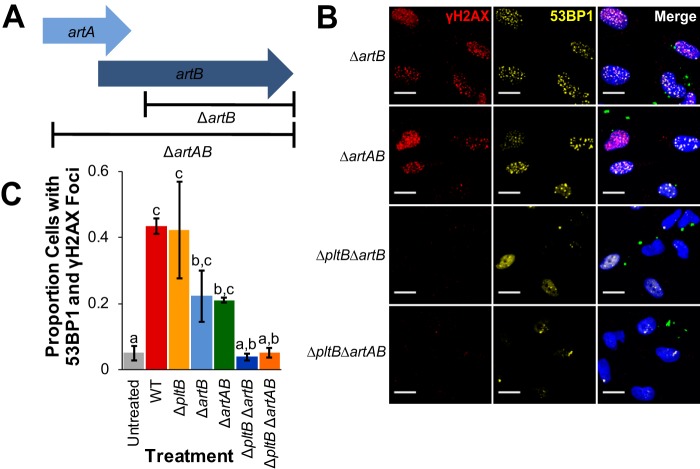
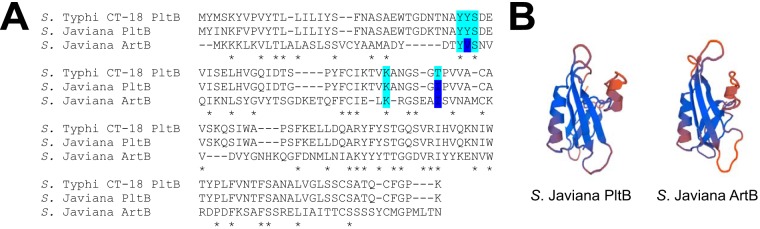
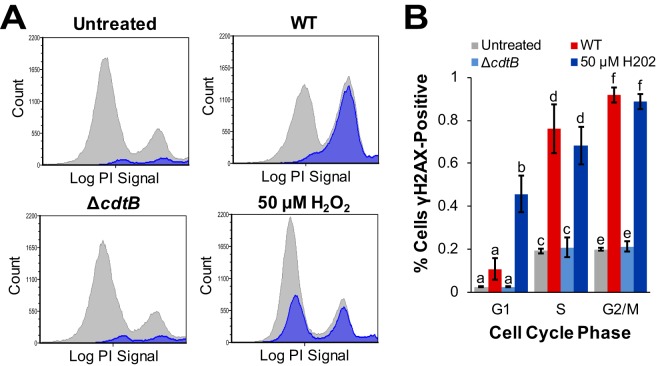
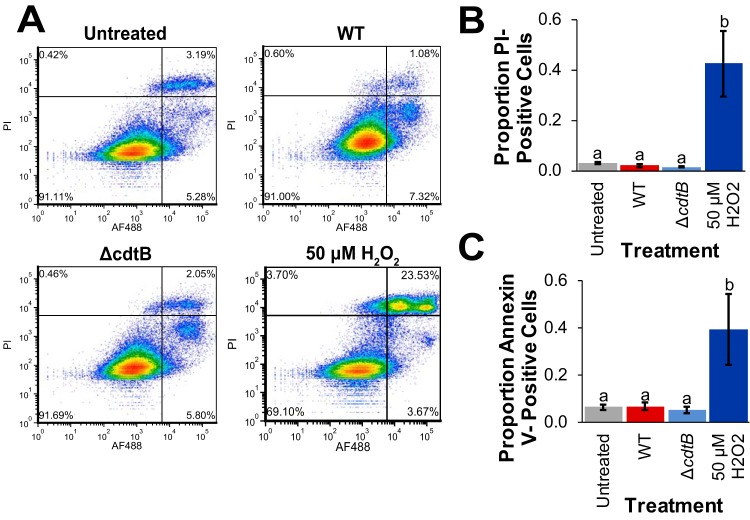
The cytolethal distending toxin (S-CDT), first described as the "typhoid toxin" in subsp. serotype Typhi, induces DNA damage in eukaryotic cells. Recent studies have shown that more than 40 nontyphoidal (NTS) serotypes carry genes that encode S-CDT, yet very little is known about the activity, function, and role of S-CDT in NTS. Here we show that deletion of genes encoding the binding subunit () and a bacteriophage muramidase predicted to play a role in toxin export () does not abolish toxin activity in the S-CDT-positive NTS subsp. serotype Javiana. However, Javiana strains harboring deletions of both and its homolog , had a complete loss of S-CDT activity, suggesting that Javiana carries genes encoding two variants of the binding subunit. S-CDT-mediated DNA damage, as determined by phosphorylation of histone 2AX (H2AX), producing phosphorylated H2AX (γH2AX), was restricted to epithelial cells in S and G/M phases of the cell cycle and did not result in apoptosis or cell death. Compared to mice infected with a Δ strain, mice infected with wild-type Javiana had significantly higher levels of Javiana in the liver, but not in the spleen, ileum, or cecum. Overall, we show that production of active S-CDT by NTS serotype Javiana requires different genes (, , and either or ) for expression of biologically active toxin than those reported for S-CDT production by Typhi (, , , and ). However, as in Typhi, NTS S-CDT influences the outcome of infection both and Nontyphoidal (NTS) are a major cause of bacterial food-borne illness worldwide; however, our understanding of virulence mechanisms that determine the outcome and severity of nontyphoidal salmonellosis is incompletely understood. Here we show that S-CDT produced by NTS plays a significant role in the outcome of infection both and , highlighting S-CDT as an important virulence factor for nontyphoidal serotypes. Our data also contribute novel information about the function of S-CDT, as S-CDT-mediated DNA damage occurs only during certain phases of the cell cycle, and the resulting damage does not induce cell death as assessed using a propidium iodide exclusion assay. Importantly, our data support that, despite having genetically similar S-CDT operons, NTS serotype Javiana has different genetic requirements than Typhi, for the production and export of active S-CDT.
细胞致死膨胀毒素 (S-CDT) 最初在 Typhi 亚种血清型 Typhi 中被描述为“伤寒毒素”,它会导致真核细胞的 DNA 损伤。最近的研究表明,超过 40 种非伤寒型 (NTS) 血清型携带编码 S-CDT 的基因,但对于 S-CDT 在 NTS 中的活性、功能和作用知之甚少。在这里,我们表明,缺失编码结合亚基 () 和预测在毒素外排中起作用的噬菌体溶菌酶 () 的基因不会在 S-CDT 阳性的 NTS 亚种中消除毒素活性。然而,Javiana 菌株缺失 及其同源物 ,完全丧失了 S-CDT 活性,表明 Javiana 携带编码两种结合亚基变体的基因。通过组蛋白 2AX (H2AX) 的磷酸化来确定 S-CDT 介导的 DNA 损伤,产生磷酸化的 H2AX (γH2AX),仅限于细胞周期的 S 和 G/M 期的上皮细胞,并且不会导致细胞凋亡或死亡。与感染 Δ 株的小鼠相比,感染野生型 Javiana 的小鼠肝脏中的 Javiana 水平明显更高,但在脾脏、回肠或盲肠中没有。总的来说,我们表明,NTS 血清型 Javiana 产生有活性的 S-CDT 需要不同的基因 (、、和 或 ) 来表达具有生物活性的毒素,而不是用于生产 S-CDT 的 Typhi 报告的基因 (、、、和 )。然而,与 Typhi 一样,NTS S-CDT 影响感染的结果 非伤寒型 (NTS) 是全球细菌性食源性疾病的主要原因;然而,我们对决定非伤寒型沙门氏菌病结局和严重程度的毒力机制的理解还不完全清楚。在这里,我们表明,NTS 产生的 S-CDT 在感染的结果中都起着重要作用,强调了 S-CDT 是 NTS 血清型的一个重要毒力因子。我们的数据还提供了有关 S-CDT 功能的新信息,因为 S-CDT 介导的 DNA 损伤仅发生在细胞周期的某些阶段,并且使用碘化丙啶排除测定法评估,不会诱导细胞死亡。重要的是,我们的数据支持尽管 NTS 血清型 Javiana 具有遗传上相似的 S-CDT 操纵子,但与 Typhi 相比,它具有不同的遗传要求,用于生产和外排有活性的 S-CDT。