Morano Alessandra, Cifelli Pierangelo, Nencini Paolo, Antonilli Letizia, Fattouch Jinane, Ruffolo Gabriele, Roseti Cristina, Aronica Eleonora, Limatola Cristina, Di Bonaventura Carlo, Palma Eleonora, Giallonardo Anna Teresa
Department of Neurology and Psychiatry Pasteur Institute-Cenci Bolognetti Foundation University of Rome Sapienza Rome Italy.
Department of Physiology and Pharmacology Pasteur Institute-Cenci Bolognetti Foundation University of Rome Sapienza Rome Italy.
Epilepsia Open. 2016 Sep 19;1(3-4):145-151. doi: 10.1002/epi4.12015. eCollection 2016 Dec.
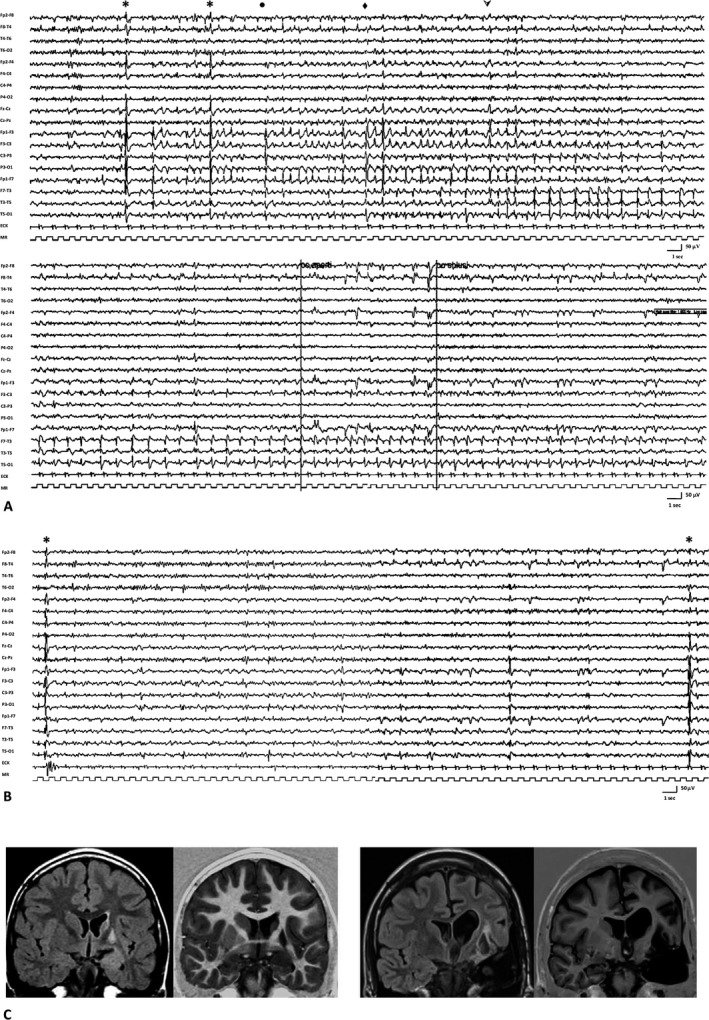
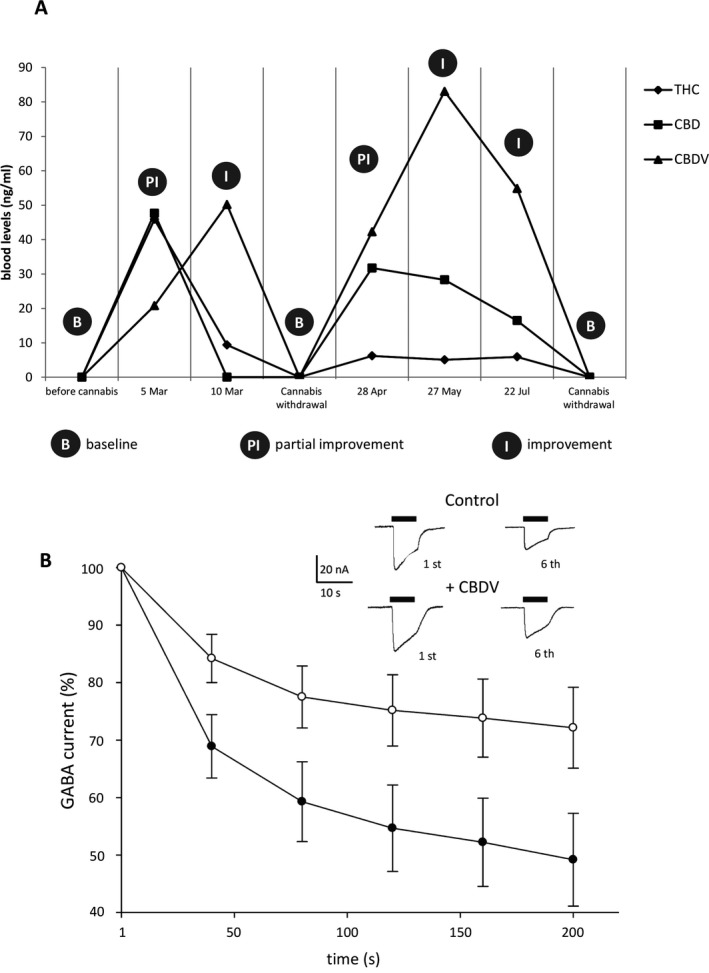
Cannabidivarin (CBDV) and cannabidiol (CBD) have recently emerged among cannabinoids for their potential antiepileptic properties, as shown in several animal models. We report the case of a patient affected by symptomatic partial epilepsy who used cannabis as self-medication after the failure of countless pharmacological/surgical treatments. Clinical and video electroencephalogram (EEG) evaluations were periodically performed, and the serum levels of CBDV, CBD, and Δ9-tetrahydrocannabinol were repeatedly measured. After cannabis administration, a dramatic clinical improvement, in terms of both decrease in seizure frequency and recovery of cognitive functions, was observed, which might parallel high CBDV plasma concentrations. To widen the spectrum of CBDV possible mechanisms of action, electrophysiological methods were applied to investigate whether it could exert some effects on γ-aminobutyric acid (GABA) receptors. Our experiments showed that, in human hippocampal tissues of four patients affected by drug-resistant temporal lobe epilepsy (TLE) transplanted in oocytes, there is decrease of current rundown (i.e., reduction of use-dependent GABA current) after prolonged exposure to CBDV. This result has been confirmed using a single case of Rasmussen encephalitis (RE). Our patient's electroclinical improvement supports the hypothesis that cannabis could actually represent an effective, well-tolerated antiepileptic drug. Moreover, the experimental data suggest that CBDV may greatly contribute to cannabis anticonvulsant effect through its possible GABAergic action.
大麻二萜戊酸(CBDV)和大麻二酚(CBD)最近在大麻素中崭露头角,因其在多种动物模型中显示出潜在的抗癫痫特性。我们报告了一例症状性部分性癫痫患者的病例,该患者在无数药物/手术治疗失败后自行使用大麻进行自我治疗。定期进行临床和视频脑电图(EEG)评估,并反复测量血清中CBDV、CBD和Δ9-四氢大麻酚的水平。在使用大麻后,观察到癫痫发作频率降低和认知功能恢复,临床症状显著改善,这可能与高血浆CBDV浓度平行。为了拓宽CBDV可能的作用机制范围,应用电生理方法研究其是否对γ-氨基丁酸(GABA)受体有影响。我们的实验表明,在移植到卵母细胞中的4例耐药性颞叶癫痫(TLE)患者的人海马组织中,长时间暴露于CBDV后电流衰减减少(即使用依赖性GABA电流减少)。这一结果在1例拉斯穆森脑炎(RE)患者中得到了证实。我们患者的电临床改善支持了大麻实际上可能是一种有效且耐受性良好的抗癫痫药物的假设。此外,实验数据表明,CBDV可能通过其可能的GABA能作用对大麻的抗惊厥作用有很大贡献。