Unit of Epidemiology, Institute of Environmental Medicine, Karolinska Institutet, Box 210, 171 77, Stockholm, Sweden.
Department of Clinical Sciences in Malmö, Clinical Research Centre, Lund University, Malmö, Sweden.
Diabetologia. 2018 Jun;61(6):1333-1343. doi: 10.1007/s00125-018-4596-0. Epub 2018 Mar 27.
AIMS/HYPOTHESIS: Excessive weight is a risk factor for type 2 diabetes, but its role in the promotion of autoimmune diabetes is not clear. We investigated the risk of latent autoimmune diabetes in adults (LADA) in relation to overweight/obesity in two large population-based studies.
Analyses were based on incident cases of LADA (n = 425) and type 2 diabetes (n = 1420), and 1704 randomly selected control participants from a Swedish case-control study and prospective data from the Norwegian HUNT Study including 147 people with LADA and 1,012,957 person-years of follow-up (1984-2008). We present adjusted ORs and HRs with 95% CI.
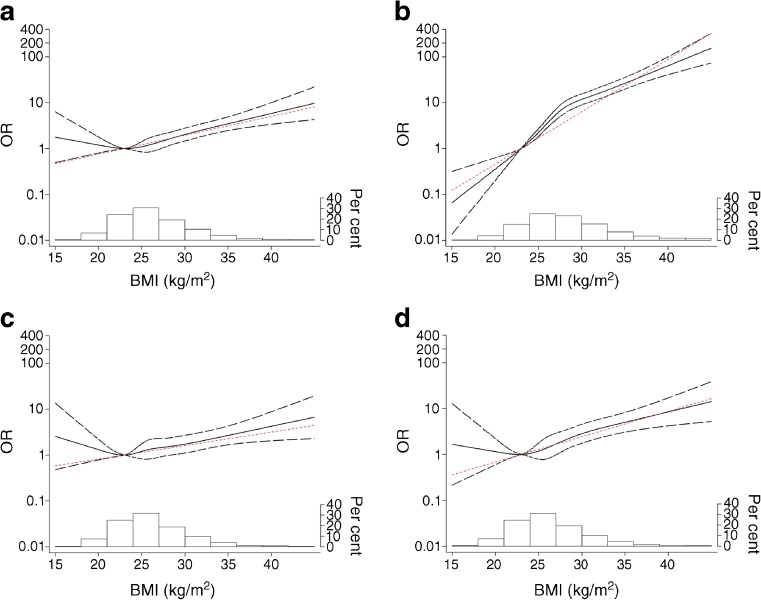
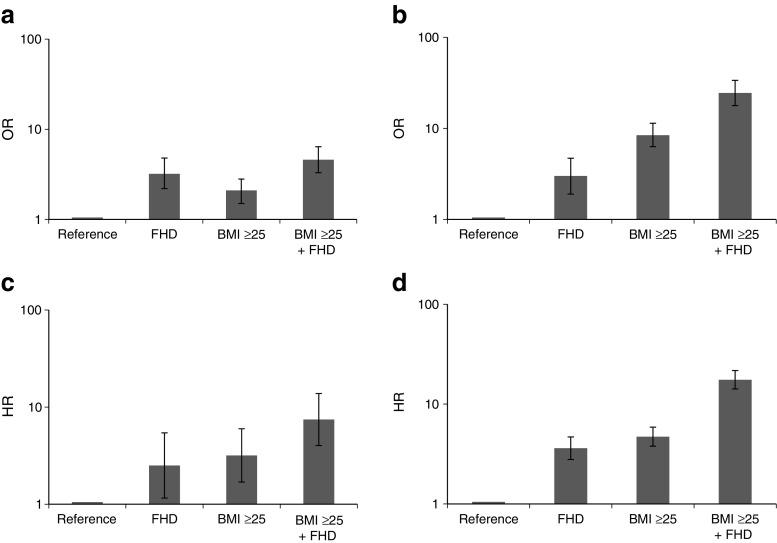
In the Swedish data, obesity was associated with an increased risk of LADA (OR 2.93, 95% CI 2.17, 3.97), which was even stronger for type 2 diabetes (OR 18.88, 95% CI 14.29, 24.94). The association was stronger in LADA with low GAD antibody (GADA; <median) (OR 4.25; 95% CI 2.76, 6.52) but present also in LADA with high GADA (OR 2.14; 95% CI 1.42, 3.24). In the Swedish data, obese vs normal weight LADA patients had lower GADA levels, better beta cell function, and were more likely to have low-risk HLA-genotypes. The combination of overweight and family history of diabetes (FHD) conferred an OR of 4.57 (95% CI 3.27, 6.39) for LADA and 24.51 (95% CI 17.82, 33.71) for type 2 diabetes. Prospective data from HUNT indicated even stronger associations; HR for LADA was 6.07 (95% CI 3.76, 9.78) for obesity and 7.45 (95% CI 4.02, 13.82) for overweight and FHD.
CONCLUSIONS/INTERPRETATION: Overweight/obesity is associated with increased risk of LADA, particularly when in combination with FHD. These findings support the hypothesis that, even in the presence of autoimmunity, factors linked to insulin resistance, such as excessive weight, could promote onset of diabetes.
目的/假设:超重是 2 型糖尿病的一个风险因素,但它在促进自身免疫性糖尿病方面的作用尚不清楚。我们在两项大型基于人群的研究中调查了超重/肥胖与成人隐匿性自身免疫性糖尿病(LADA)风险之间的关系。
分析基于瑞典病例对照研究中的 LADA(n=425)和 2 型糖尿病(n=1420)的发病病例,以及挪威 HUNT 研究中的 1704 名随机选择的对照参与者,该研究包括 147 名 LADA 患者和 1012957 人年的随访时间(1984-2008 年)。我们呈现了调整后的比值比(OR)和危险比(HR)及其 95%置信区间。
在瑞典数据中,肥胖与 LADA 风险增加相关(OR 2.93,95%CI 2.17,3.97),与 2 型糖尿病的相关性更强(OR 18.88,95%CI 14.29,24.94)。在 LADA 中,GADA 抗体水平较低的患者(GADA;<中位数)(OR 4.25;95%CI 2.76,6.52)的相关性更强,但在 GADA 抗体水平较高的患者中(OR 2.14;95%CI 1.42,3.24)也存在这种相关性。在瑞典数据中,与正常体重的 LADA 患者相比,肥胖的 LADA 患者的 GADA 水平较低,β细胞功能更好,且更有可能具有低风险 HLA 基因型。超重和糖尿病家族史(FHD)的组合使 LADA 的 OR 达到 4.57(95%CI 3.27,6.39),2 型糖尿病的 OR 达到 24.51(95%CI 17.82,33.71)。HUNT 的前瞻性数据表明了更强烈的相关性;肥胖的 LADA 风险 HR 为 6.07(95%CI 3.76,9.78),超重和 FHD 的 HR 为 7.45(95%CI 4.02,13.82)。
结论/解释:超重/肥胖与 LADA 风险增加相关,尤其是与 FHD 相结合时。这些发现支持了这样一种假设,即在存在自身免疫的情况下,与胰岛素抵抗相关的因素,如超重,可能会促进糖尿病的发生。