Department of Biological, Geological and Environmental Sciences-BiGeA, University of Bologna Via Selmi 3, Bologna, Italy.
Department of Cultural Heritage, University of Bologna, Via degli Ariani 1, Ravenna, Italy.
PLoS One. 2018 Mar 28;13(3):e0193796. doi: 10.1371/journal.pone.0193796. eCollection 2018.
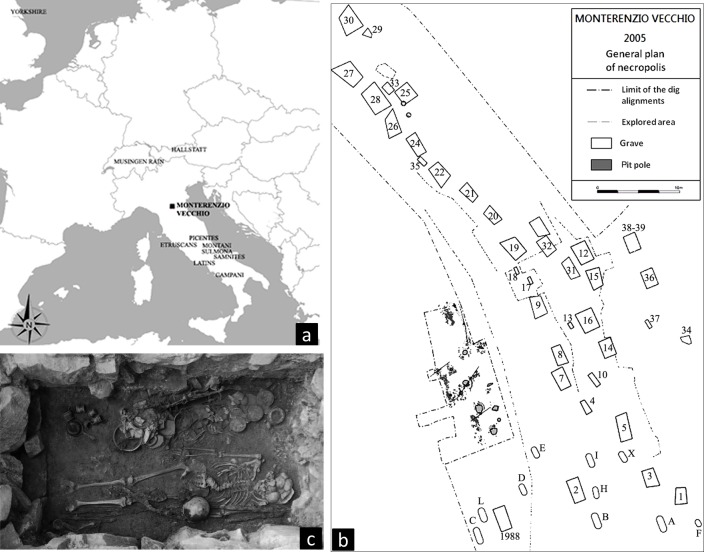
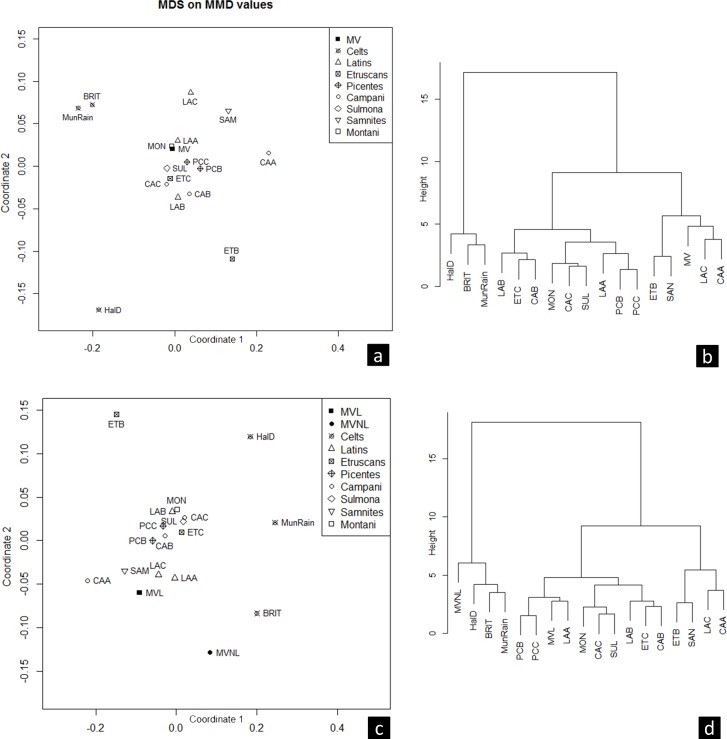
The 4th century BC marks the main entrance of Celtic populations in northern Italy. Their arrival has been suggested based on the presence of Celtic customs in Etruscan mortuary contexts, yet up to now few bioarchaeological data have been examined to support or reject the arrival of these newcomers. Here we use strontium isotopes, non-metric dental traits and funerary patterns to unravel the biocultural structure of the necropolis of Monterenzio Vecchio (Bologna, Italy). Subsamples of our total sample of 38 individuals were analyzed based on different criteria characterizing the following analyses: 1) strontium isotope analysis to investigate migratory patterns and provenance; 2) non-metric dental traits to establish biological relationships between Monterenzio Vecchio, 13 Italian Iron age necropolises and three continental and non-continental Celtic necropolises; 3) grave goods which were statistically explored to detect possible patterns of cultural variability. The strontium isotopes results indicate the presence of local and non-local individuals, with some revealing patterns of mobility. The dental morphology reveals an affinity between Monterenzio Vecchio and Iron Age Italian samples. However, when the Monterenzio Vecchio sample is separated by isotopic results into locals and non-locals, the latter share affinity with the sample of non-continental Celts from Yorkshire (UK). Moreover, systematic analyses demonstrate that ethnic background does not retain measurable impact on the distribution of funerary elements. Our results confirm the migration of Celtic populations in Monterenzio as archaeologically hypothesized on the basis of the grave goods, followed by a high degree of cultural admixture between exogenous and endogenous traits. This contribution shows that combining different methods offers a more comprehensive perspective for the exploration of biocultural processes in past and present populations.
公元前 4 世纪标志着凯尔特人族群主要进入意大利北部。他们的到来是基于凯尔特人习俗在伊特鲁里亚人的丧葬背景中存在的假设,但到目前为止,很少有生物考古学数据被用来支持或否定这些新来者的到来。在这里,我们使用锶同位素、非度量牙齿特征和丧葬模式来揭示莫特雷泽尼奥·维奇奥(意大利博洛尼亚)墓地的生物文化结构。根据以下分析的不同标准,对我们的 38 个人的总样本进行了亚样本分析:1)锶同位素分析,以研究迁徙模式和来源;2)非度量牙齿特征,以确定莫特雷泽尼奥·维奇奥与 13 个意大利铁器时代墓地以及三个欧洲大陆和非欧洲大陆凯尔特墓地之间的生物学关系;3)对随葬品进行了统计学分析,以发现可能的文化变异性模式。锶同位素的结果表明存在本地和非本地个体,其中一些显示出移动模式。牙齿形态揭示了莫特雷泽尼奥·维奇奥与意大利铁器时代样本之间的亲缘关系。然而,当莫特雷泽尼奥·维奇奥样本根据同位素结果分为本地人和非本地人时,后者与来自英国约克郡(英国)的非欧洲凯尔特人样本具有亲缘关系。此外,系统分析表明,民族背景不会对丧葬元素的分布产生可衡量的影响。我们的结果证实了考古学上假设的凯尔特人口在莫特雷泽尼奥的迁移,随后是外来和内生特征之间的高度文化混合。这一贡献表明,结合不同的方法可以为探索过去和现在的人群中的生物文化过程提供更全面的视角。