Department of Sarcoma Medical Oncology, The University of Texas MD Anderson Cancer Center, Houston, Texas.
Department of Pediatrics, The University of Texas MD Anderson Cancer Center, Houston, Texas.
Mol Cancer Ther. 2018 Jun;17(6):1315-1323. doi: 10.1158/1535-7163.MCT-17-0901. Epub 2018 Mar 28.
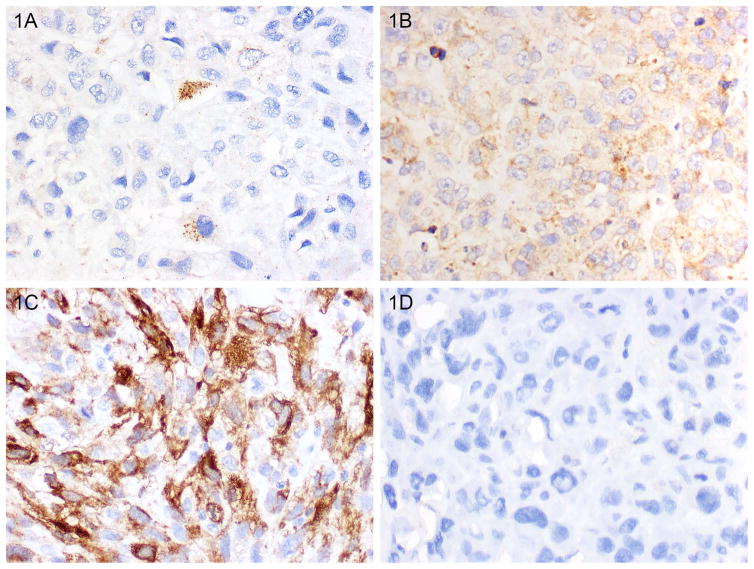
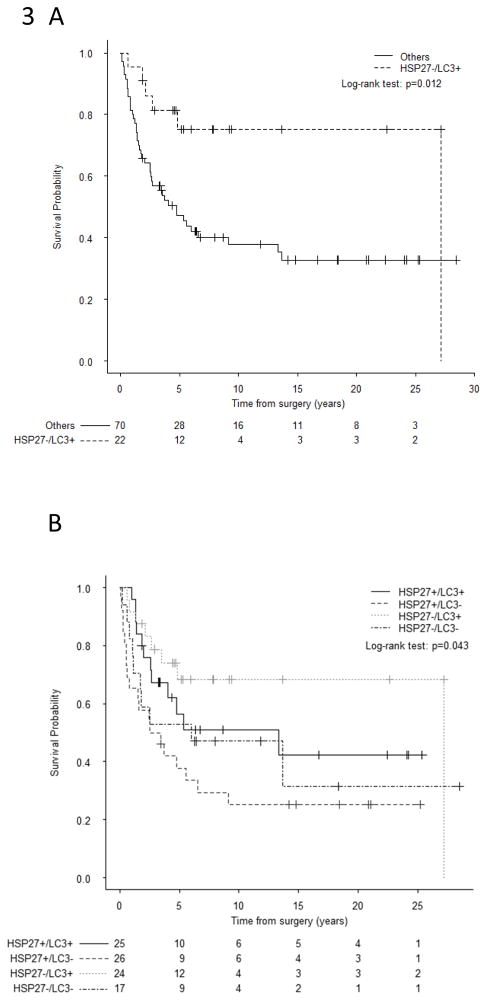
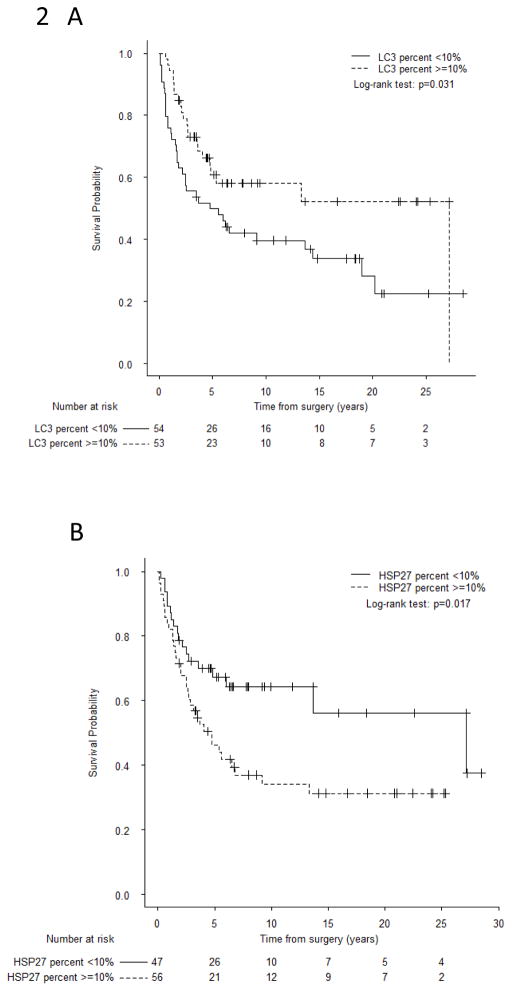
Chemotherapy-induced autophagy is a proposed mechanism of chemoresistance and potential therapeutic target in osteosarcoma. We evaluated heat shock protein 27 (HSP27) and autophagy-related proteins as predictors of pathologic treatment response and prognostic markers among osteosarcoma patients who received standard chemotherapy. We analyzed 394 tumor specimens (pre-treatment, post-treatment, and metastases) from 260 osteosarcoma patients by immunohistochemistry for cytoplasmic light chain 3B (LC3B)-positive puncta, sequestosome 1 (SQSTM1), high mobility group box 1 (HMGB1), and HSP27 expression. The staining percentage and intensity for each marker were scored and the extent to which marker expression was correlated with pathologic response, relapse-free survival (RFS), and overall survival (OS) was assessed. LCB3 puncta in post-treatment primary tumors (50%) and metastases (67%) was significantly higher than in pre-treatment biopsy specimens (30%; = 0.023 and <0.001). Among 215 patients with localized osteosarcoma, both pre-treatment [multivariate hazard ratio (HR), 26.7; 95% confidence interval (CI), 1.47-484; = 0.026] and post-treatment HSP27 expression (multivariate HR, 1.85; 95% CI, 1.03-3.33; = 0.039) were associated with worse OS. Lack of LC3B puncta at resection was an independent poor prognostic marker in both univariate (HR, 1.78; 95% CI, 1.05-3.03; = 0.034) and multivariate models (HR, 1.75; 95% CI, 1.01-3.04; = 0.045). Patients with LC3B/HSP27 tumors at resection had the best 10-year OS (75%) whereas patients with LC3B/HSP27 tumors had the worst 10-year survival (25%). Neither HSP27 expression nor the presence of LCB3 puncta was correlated with pathologic treatment response. Our findings establish HSP27 expression and LC3B puncta as independent prognostic markers in osteosarcoma patients receiving standard chemotherapy and support further investigation into strategies targeting HSP27 or modulating autophagy in osteosarcoma treatment. .
化疗诱导的自噬是骨肉瘤化疗耐药的一种拟议机制,也是潜在的治疗靶点。我们评估了热休克蛋白 27(HSP27)和自噬相关蛋白作为骨肉瘤患者接受标准化疗后病理治疗反应和预后标志物的预测因子。我们通过免疫组织化学分析了 260 名骨肉瘤患者的 394 个肿瘤标本(治疗前、治疗后和转移),检测细胞质轻链 3B(LC3B)阳性斑点、自噬相关蛋白 1(SQSTM1)、高迁移率族蛋白 1(HMGB1)和 HSP27 的表达。对每个标志物的染色百分比和强度进行评分,并评估标志物表达与病理反应、无复发生存(RFS)和总生存(OS)的相关性。治疗后原发肿瘤(50%)和转移瘤(67%)中的 LC3B 斑点明显高于治疗前活检标本(30%; = 0.023 和 <0.001)。在 215 名局限性骨肉瘤患者中,治疗前[多变量风险比(HR),26.7;95%置信区间(CI),1.47-484; = 0.026]和治疗后 HSP27 表达(多变量 HR,1.85;95%CI,1.03-3.33; = 0.039)均与 OS 较差相关。切除时缺乏 LC3B 斑点是单变量(HR,1.78;95%CI,1.05-3.03; = 0.034)和多变量模型(HR,1.75;95%CI,1.01-3.04; = 0.045)中独立的不良预后标志物。切除时具有 LC3B/HSP27 肿瘤的患者 10 年 OS 最佳(75%),而具有 LC3B/HSP27 肿瘤的患者 10 年生存率最差(25%)。HSP27 表达和 LC3B 斑点均与病理治疗反应无相关性。我们的研究结果确立了 HSP27 表达和 LC3B 斑点作为接受标准化疗的骨肉瘤患者的独立预后标志物,并支持进一步研究针对 HSP27 或调节骨肉瘤治疗中自噬的策略。