Division of Biological & Life Sciences, School of Arts & Sciences, (Formerly, Institute of Life Sciences), Ahmedabad University, Ahmedabad, Gujarat.
Nanotherapeutics & Nanomaterial Toxicology Group, CSIR-Indian Institute of Toxicology Research, Mahatma Gandhi Marg, Lucknow, Uttar Pradesh, India.
Int J Nanomedicine. 2018 Mar 15;13(T-NANO 2014 Abstracts):71-73. doi: 10.2147/IJN.S125011. eCollection 2018.
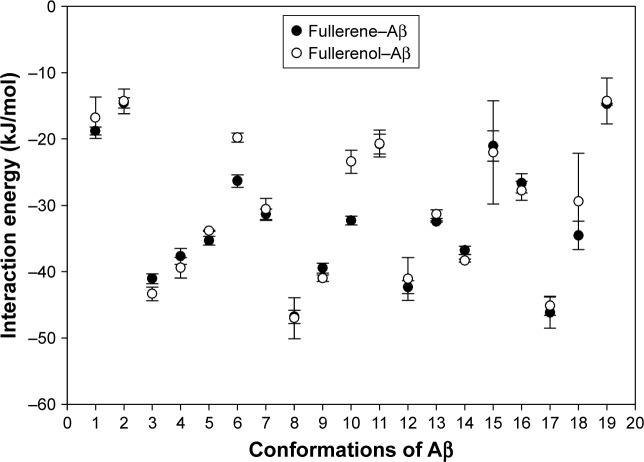
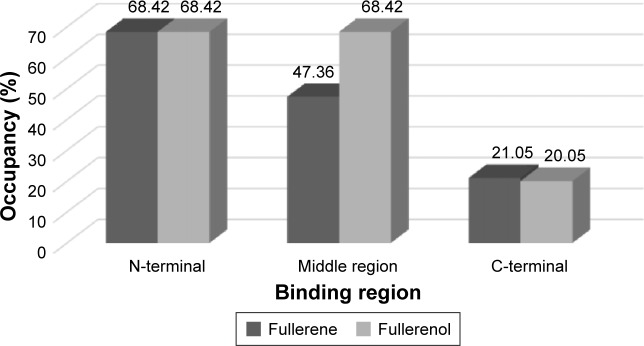
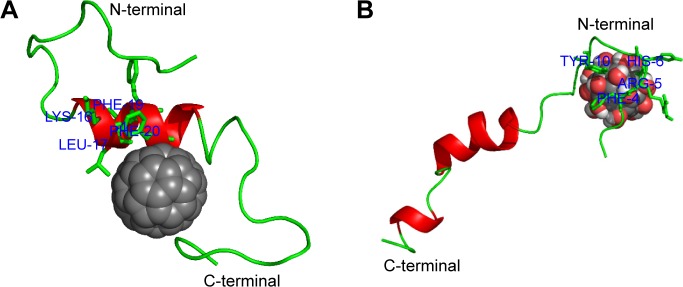
Amyloid beta (Aβ) deposits are implicated in the pathogenesis of debilitating neurodegenerative disorders such as Alzheimer's disease. In the present study, the interactions of carbon-based nanoparticles (NPs) such as fullerene and fullerenol having different surface chemistry with Aβ were investigated using molecular dynamics simulations and docking studies. A detailed analysis of docking results showed that in 68% of the Aβ conformations, fullerene and fullerenol showed interactions with the N-terminal region of the peptide. However, the high-affinity binding site (E=-48.31 kJ/mol) of fullerene resides in the hydrophobic middle region of the peptide, whereas fullerenol interacts favorably with the charged N-terminal region with a binding energy of -50.42 kJ/mol. The above differences in binding could be attributed to the surface chemistry of fullerene and fullerenol. Moreover, the N-terminal and middle regions of Aβ play an important role in Aβ aggregation. Therefore, the binding of fullerene and fullerenol could inhibit amyloid aggregation. This information will be helpful in designing NPs for targeting amyloid-related disorders.
淀粉样蛋白β(Aβ)沉积与阿尔茨海默病等使人衰弱的神经退行性疾病的发病机制有关。在本研究中,使用分子动力学模拟和对接研究了具有不同表面化学性质的碳基纳米粒子(如富勒烯和富勒醇)与 Aβ 的相互作用。对接结果的详细分析表明,在 68%的 Aβ构象中,富勒烯和富勒醇与肽的 N 端区域相互作用。然而,富勒烯的高亲和力结合位点(E=-48.31 kJ/mol)位于肽的疏水区,而富勒醇与带电荷的 N 端区域有利结合,结合能为-50.42 kJ/mol。结合的上述差异可能归因于富勒烯和富勒醇的表面化学性质。此外,Aβ 的 N 端和中间区域在 Aβ 聚集中起重要作用。因此,富勒烯和富勒醇的结合可以抑制淀粉样蛋白的聚集。这些信息将有助于设计针对淀粉样蛋白相关疾病的纳米颗粒。