Schuler Nadine, Palm Jan, Schmitz Sabine, Lorat Yvonne, Rübe Claudia E
Department of Radiation Oncology, Saarland University, D-66421 Homburg/Saar, Germany.
Department of Safety and Radiation Protection, Forschungszentrum Jülich GmbH, D-52425 Jülich, Germany.
Clin Transl Radiat Oncol. 2017 Nov 2;7:71-78. doi: 10.1016/j.ctro.2017.10.004. eCollection 2017 Dec.
Li-Fraumeni syndrome (LFS) is a cancer predisposition disorder characterized by germline mutations of the p53 tumor-suppressor gene. In response to DNA damage, p53 stimulates protective cellular processes including cell-cycle arrest and apoptosis to prevent aberrant cell proliferation. Current cancer therapies involve agents that damage DNA, which also affect non-cancerous hematopoietic stem/progenitor cells. Here, we report on a child with LFS who developed genomic instability during craniospinal irradiation for metastatic choroid plexus carcinoma (CPC).
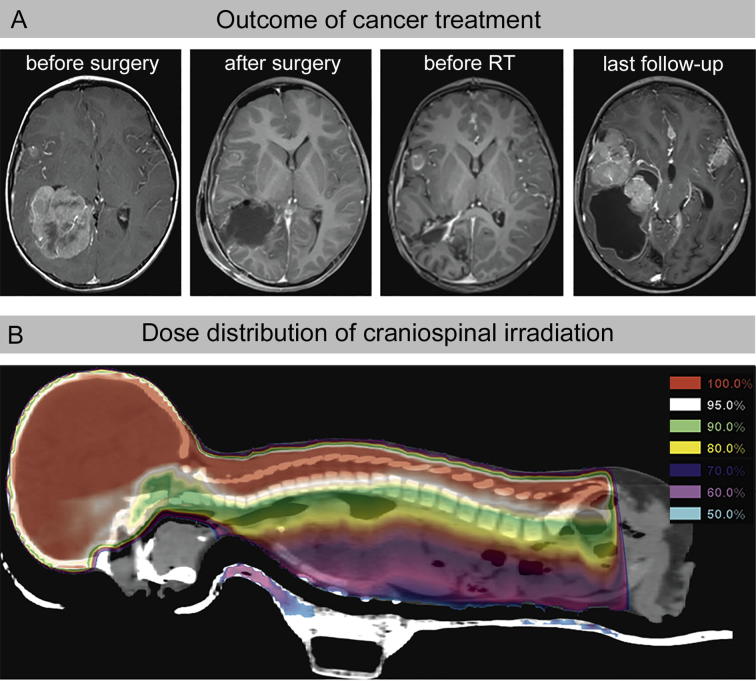
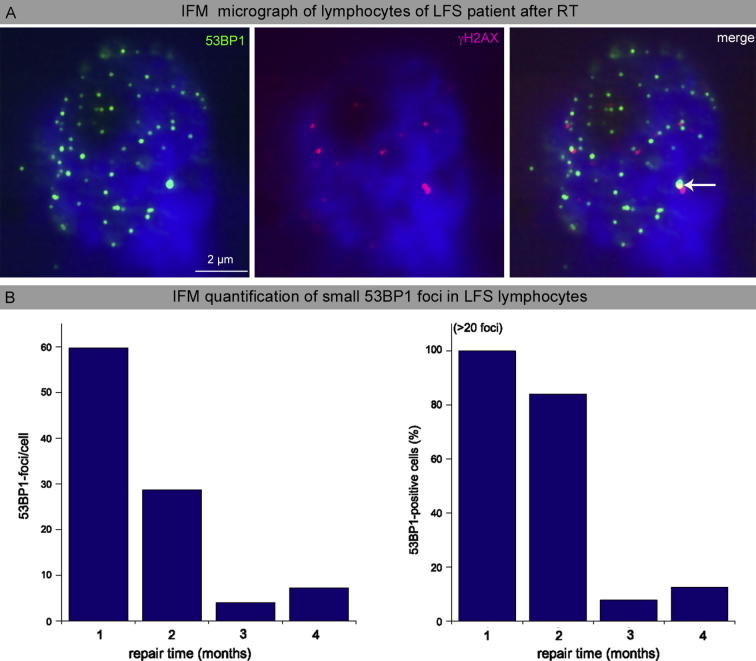
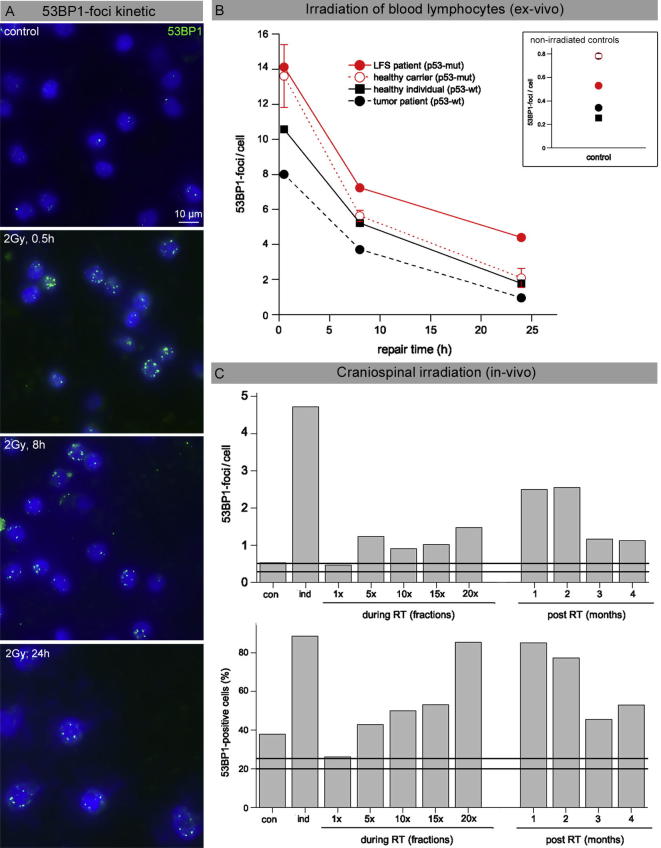
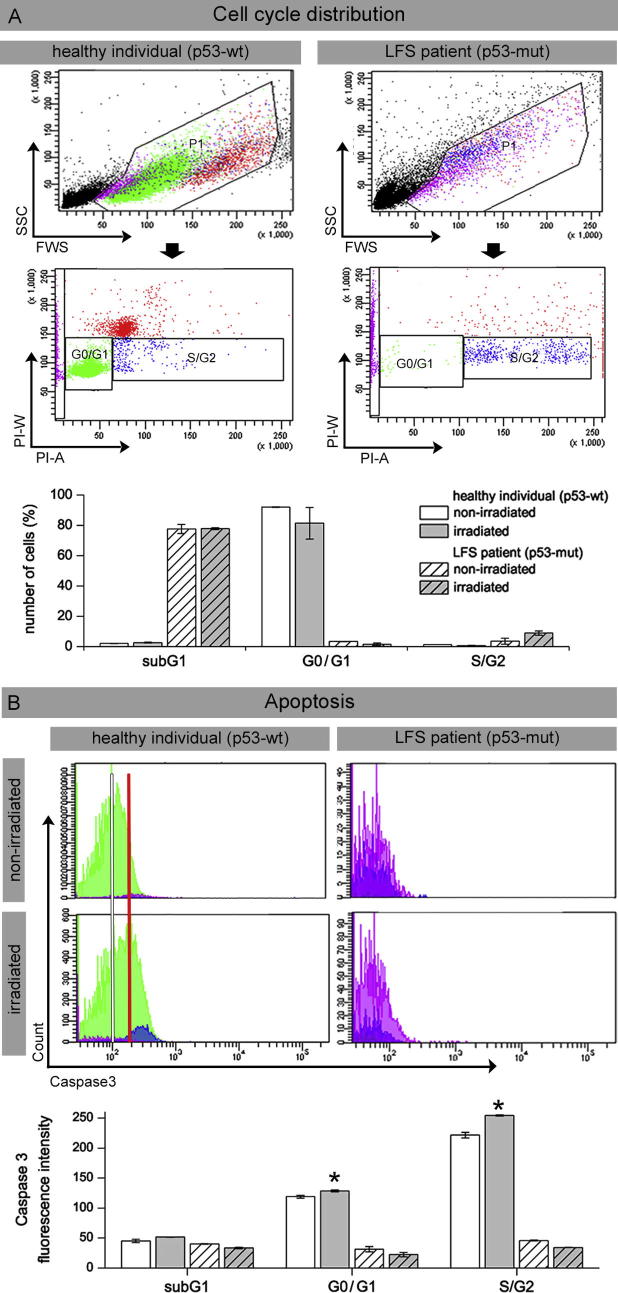
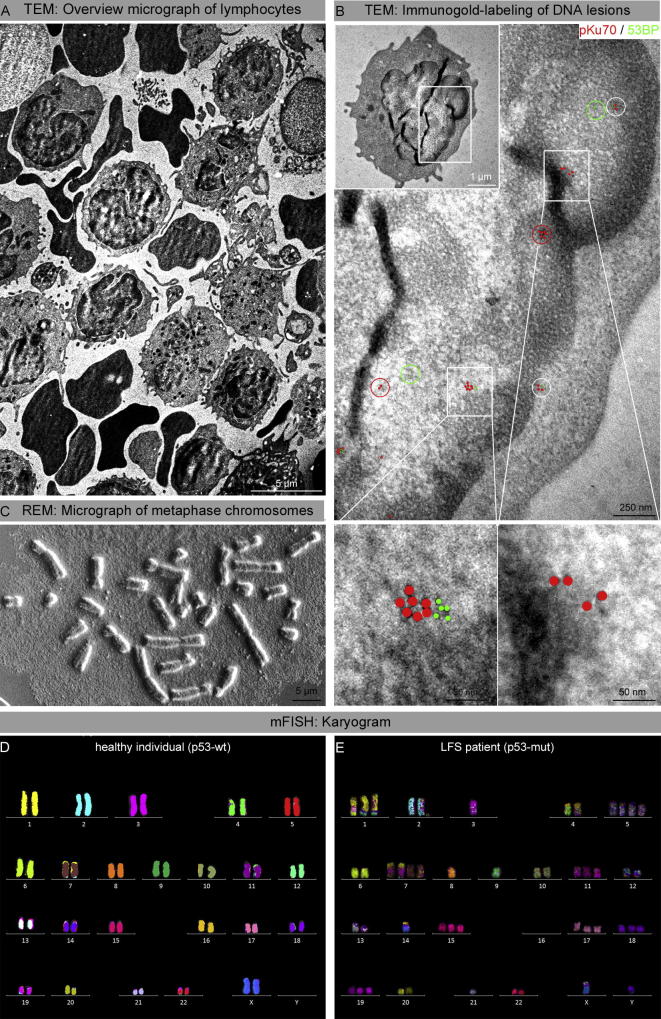
This previously healthy 4-year-old boy presented with parieto-temporal brain tumor, diagnosed as CPC grade-3. Screening for cancer-predisposing syndrome revealed heterozygous p53 germline mutation, leading to LFS diagnosis. After tumour resection and systemic chemotherapy, entire craniospinal axis was irradiated due to leptomeningeal seeding, resulting in disease stabilization for nearly 12 months. Blood lymphocytes of LFS patient (p53-deficient) and age-matched tumor-children (p53-proficient) were collected before, during and after craniospinal irradiation and compared with asymptomatic carriers for identical p53 mutation, not exposed to DNA-damaging treatment. In p53-deficient lymphocytes of LFS patient radiation-induced DNA damage failed to induce cell-cycle arrest or apoptosis. Although DNA repair capacity was not impaired, p53-deficient blood lymphocytes of LFS patient showed significant accumulation of 53BP1-foci during and even several months after irradiation, reflecting persistent DNA damage. Electron microscopy revealed DNA abnormalities ranging from simple unrepaired lesions to chromosomal abnormalities. Metaphase spreads of p53-deficient lymphocytes explored by mFISH revealed high amounts of complex chromosomal aberrations after craniospinal irradiation.
Tumor suppressor p53 plays a central role in maintaining genomic stability by promoting cell-cycle checkpoints and apoptosis. Here, we demonstrate that a patient with LFS receiving craniospinal irradiation including large volumes of bone marrow developed progressive genomic instability of the hematopoietic system. During DNA-damaging radiotherapy, genome-stabilizing mechanisms in proliferating stem/progenitor cells are perturbed by p53 deficiency, increasing the risk of cancer initiation and progression.
李-佛美尼综合征(LFS)是一种癌症易感疾病,其特征是p53肿瘤抑制基因的种系突变。响应DNA损伤时,p53会刺激包括细胞周期停滞和凋亡在内的保护性细胞过程,以防止异常细胞增殖。当前的癌症治疗涉及损害DNA的药物,这些药物也会影响非癌性造血干细胞/祖细胞。在此,我们报告一名患有LFS的儿童,其在接受转移性脉络丛癌(CPC)的颅脊髓照射期间出现了基因组不稳定。
这名此前健康的4岁男孩出现颞顶叶脑肿瘤,诊断为3级CPC。对癌症易感综合征的筛查发现了杂合性p53种系突变,从而确诊为LFS。在肿瘤切除和全身化疗后,由于软脑膜播散,对整个颅脊髓轴进行了照射,使疾病稳定了近12个月。在颅脊髓照射前、照射期间和照射后,收集了LFS患者(p53缺陷)和年龄匹配的肿瘤患儿(p53功能正常)的血液淋巴细胞,并与未接受DNA损伤治疗的相同p53突变的无症状携带者进行比较。在LFS患者的p53缺陷淋巴细胞中,辐射诱导的DNA损伤未能诱导细胞周期停滞或凋亡。尽管DNA修复能力未受损,但LFS患者的p53缺陷血液淋巴细胞在照射期间甚至照射后数月显示53BP1病灶显著积累,反映出持续的DNA损伤。电子显微镜检查发现DNA异常范围从简单的未修复损伤到染色体异常。通过多色荧光原位杂交(mFISH)检测p53缺陷淋巴细胞的中期铺片发现,颅脊髓照射后出现大量复杂的染色体畸变。
肿瘤抑制因子p53通过促进细胞周期检查点和凋亡在维持基因组稳定性方面发挥核心作用。在此,我们证明一名接受包括大量骨髓在内的颅脊髓照射的LFS患者出现了造血系统渐进性基因组不稳定。在DNA损伤放疗期间,增殖的干细胞/祖细胞中的基因组稳定机制因p53缺陷而受到干扰,增加了癌症发生和进展的风险。