Jiang Ruixuan, Law Ernest, Zhou Zhou, Yang Hongbo, Wu Eric Q, Seifeldin Raafat
Department of Pharmacy Systems, Outcomes, and Policy, College of Pharmacy, University of Illinois at Chicago, Chicago, IL, USA.
Analysis Group, Inc., Boston, MA, USA.
Diabetes Ther. 2018 Jun;9(3):1021-1036. doi: 10.1007/s13300-018-0410-8. Epub 2018 Mar 29.
Patients with type 2 diabetes mellitus (T2DM) are clinically heterogeneous in terms of disease severity, treatment, and comorbidities, potentially resulting in differential diabetic nephropathy (DN) progression courses. In this exploratory study we used latent class analysis (LCA) to identify patient groups with distinct clinical profiles of T2DM severity and explored the association between disease severity, DN progression or reversal, and healthcare resource use (HRU) and costs.
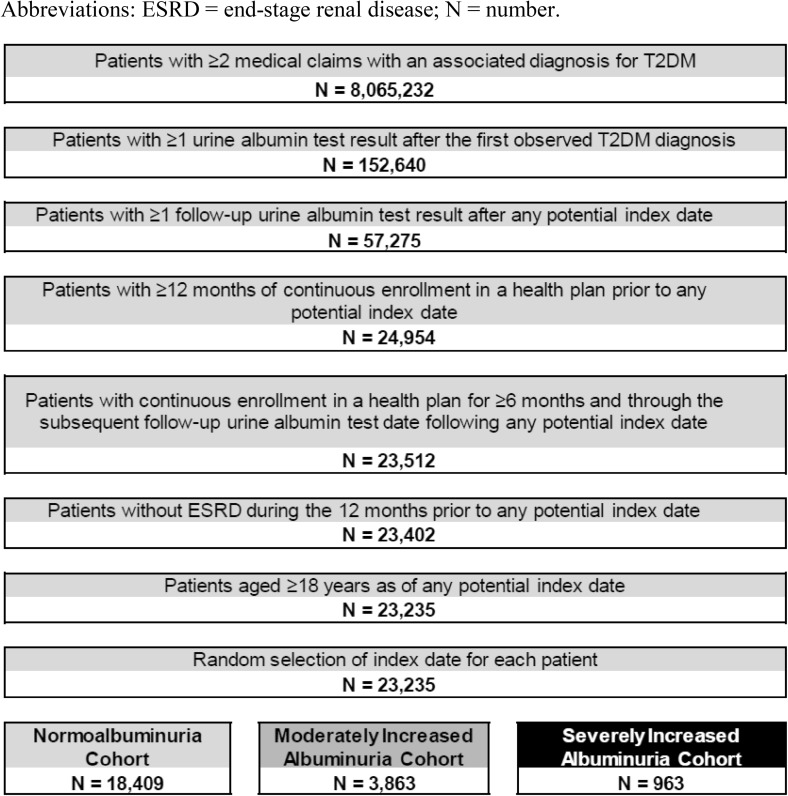
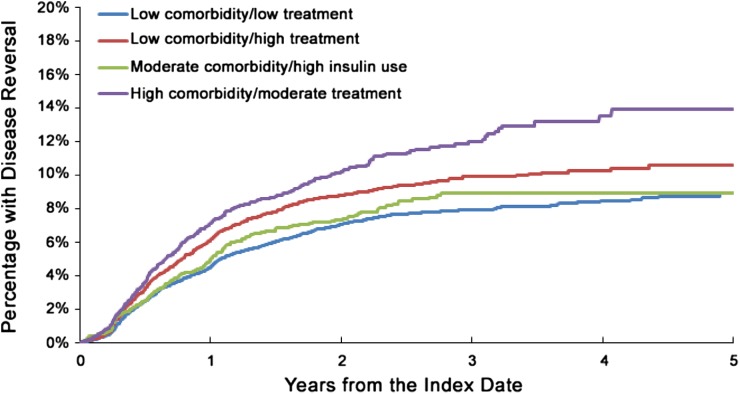
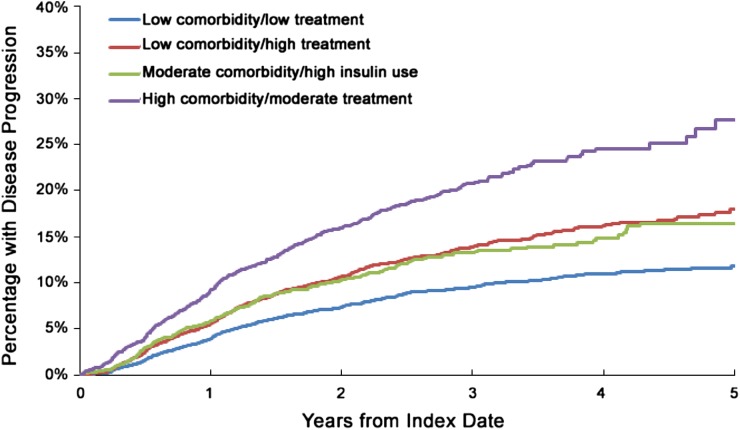
Latent class analysis was used to group adults with ≥ 2 medical claims with a diagnosis of T2DM and ≥ 2 urine albumin tests within the Truven MarketScan database (2004-2014), based on T2DM-related complications, comorbidities, and therapies. DN severity categories (normoalbuminuria, moderately increased albuminuria, and severely increased albuminuria) were determined based on urine albumin measure. The risks of DN progression and reversal (change to a more/less severe DN category) were compared among all identified latent classes using Kaplan-Meier analyses and log-rank tests. All-cause and DN-related costs and HRU were assessed and compared during the study period among the identified latent classes.
Four clinically distinct profiles were identified among the 23,235 eligible patients: low comorbidity/low treatment (46.5%), low comorbidity/high treatment (29.0%), moderate comorbidity/high insulin use (9.7%), and high comorbidity/moderate treatment (14.8%). The 5-year DN progression rates for these clinically distinct profiles were 11.8, 18, 16.5, and 27.7%, respectively. Compared with the low comorbidity/low treatment group, all other groups were associated with an increased risk of DN progression (all p < 0.001). Increasing comorbidity was significantly associated with higher all-cause and DN-related HRU and costs, primarily driven by higher pharmacy and inpatient costs.
Patients with T2DM who have more comorbidities experienced higher rates of DN progression and HRU and incurred higher healthcare costs compared with patients with low comorbidity profiles. Future prospective studies are needed to confirm the significance of these groups on DN progression, HRU, and costs.
Takeda Development Center Americas, Inc.
2型糖尿病(T2DM)患者在疾病严重程度、治疗方法和合并症方面存在临床异质性,这可能导致糖尿病肾病(DN)的进展过程有所不同。在这项探索性研究中,我们使用潜在类别分析(LCA)来识别具有不同T2DM严重程度临床特征的患者群体,并探讨疾病严重程度、DN进展或逆转与医疗资源使用(HRU)及成本之间的关联。
在Truven MarketScan数据库(2004 - 2014年)中,基于与T2DM相关的并发症、合并症和治疗方法,使用潜在类别分析对患有≥2次T2DM诊断医疗索赔且≥2次尿白蛋白检测的成年人进行分组。根据尿白蛋白测量结果确定DN严重程度类别(正常白蛋白尿、中度白蛋白尿增加和重度白蛋白尿增加)。使用Kaplan - Meier分析和对数秩检验比较所有识别出的潜在类别中DN进展和逆转(转变为更严重/较不严重的DN类别)的风险。在研究期间,对识别出的潜在类别中的全因和DN相关成本及HRU进行评估和比较。
在23235名符合条件的患者中识别出四种临床特征不同的类型:低合并症/低治疗(46.5%)、低合并症/高治疗(29.0%)、中度合并症/高胰岛素使用(9.7%)和高合并症/中度治疗(14.8%)。这些临床特征不同的类型的5年DN进展率分别为11.8%、18%、16.5%和27.7%。与低合并症/低治疗组相比,所有其他组的DN进展风险均增加(所有p < 0.001)。合并症增加与全因和DN相关的HRU及成本显著相关,主要由较高的药房和住院成本驱动。
与合并症较少的患者相比,合并症较多的T2DM患者DN进展率和HRU更高,医疗成本也更高。未来需要进行前瞻性研究以确认这些群体对DN进展、HRU和成本的重要性。
武田美洲开发中心公司