School of optics and photonics, Beijing Institute of Technology, Key Laboratory of Biomimetic Robots and Systems, Ministry of Education, Beijing 100081, China.
NUS Suzhou Research Institute (NUSRI), Suzhou Industrial Park, Suzhou 215123, China.
Sensors (Basel). 2018 Mar 30;18(4):1042. doi: 10.3390/s18041042.
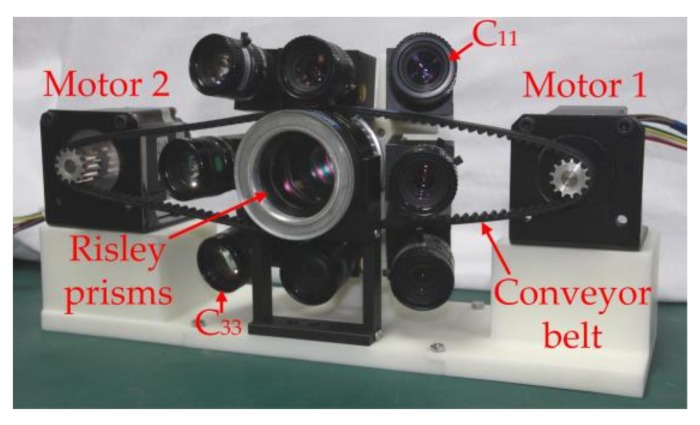
Based on bionic compound eye and human foveated imaging mechanisms, a hybrid bionic image sensor (HBIS) is proposed in this paper to extend the field of view (FOV) with high resolution. First, the hybrid bionic imaging model was developed and the structure parameters of the HBIS were deduced. Second, the properties of the HBIS were simulated, including FOV extension, super-resolution imaging, foveal ratio and so on. Third, a prototype of the HBIS was developed to validate the theory. Imaging experiments were carried out, and the results are in accordance with the simulations, proving the potential of the HBIS for large FOV and high-resolution imaging with low cost.
基于仿生复眼和人类注重视觉成像机制,本文提出了一种混合仿生图像传感器(HBIS),以高分辨率扩展视野(FOV)。首先,开发了混合仿生成像模型,并推导了 HBIS 的结构参数。其次,模拟了 HBIS 的特性,包括视野扩展、超分辨率成像、中央凹比等。第三,开发了 HBIS 的原型以验证理论。进行了成像实验,结果与模拟相符,证明了 HBIS 具有低成本实现大视野和高分辨率成像的潜力。