Centre for Infectious Disease Control, National Institute for Public Health and the Environment, Bilthoven, The Netherlands.
Regional Laboratory of Public Health, Haarlem, The Netherlands.
PLoS One. 2018 Mar 30;13(3):e0194823. doi: 10.1371/journal.pone.0194823. eCollection 2018.
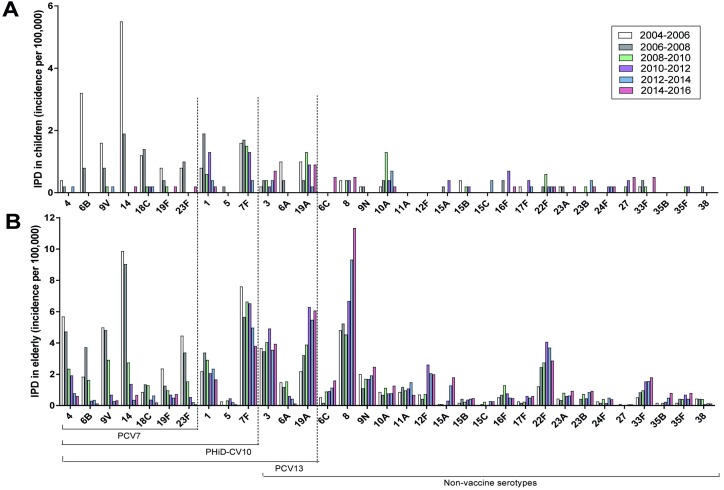
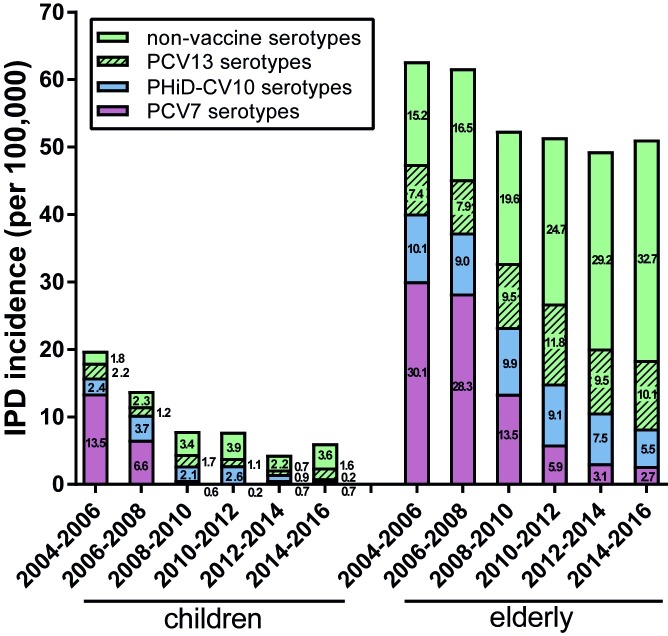
The 7-valent pneumococcal conjugate vaccine (PCV7) was introduced in The Netherlands in 2006 and was replaced by PHiD-CV10 in 2011. Data on carriage prevalence of S. pneumoniae serotypes in children and invasive pneumococcal disease (IPD) in children and older adults were collected to examine the impact of PCVs on carriage and IPD in The Netherlands. Pneumococcal carriage prevalence was determined by conventional culture of nasopharyngeal swabs in 24-month-old children in 2015/2016. Data were compared to similar carriage studies in 2005 (pre-PCV7 introduction), 2009, 2010/2011 and 2012/2013. Invasive pneumococcal disease isolates from hospitalized children <5 years and adults >65 years (2004-2016) were obtained by sentinel surveillance. All isolates were serotyped by Quellung. Serotype invasive disease potential was calculated using carriage and nationwide IPD data in children. The overall pneumococcal carriage rate was 48% in 2015/2016, lower than in 2010/2011 (64%) and pre-vaccination in 2005 (66%). Carriage of the previously dominant non-vaccine serotypes 19A and 11A has declined since 2010/2011, from 14.2% to 4.6% and 4.2% to 2.7%, respectively, whereas carriage of serotypes 6C and 23B has increased (4.2% to 6.7% and 3.9% to 7.3%), making serotypes 6C and 23B the most prevalent carriage serotypes. IPD incidence declined in children (20/100,000 cases in 2004/2006 to 6/100,000 cases in 2015/2016) as well as in older adults (63/100,000 cases to 51/100,000 cases). Serotypes 6C, 23B and 11A have high carriage prevalence in children, but show low invasive disease potential. Serotype 8 is the main causative agent for IPD in older adults (11.3%). In conclusion, 10 years after the introduction of pneumococcal vaccination in children in The Netherlands shifts in carriage and disease serotypes are still ongoing. Surveillance of both carriage and IPD is important to assess PCV impact and to predict necessary future vaccination strategies in both children and older adults.
7 价肺炎球菌结合疫苗(PCV7)于 2006 年在荷兰推出,并于 2011 年被 PHiD-CV10 取代。收集了儿童中肺炎链球菌血清型的携带流行率和侵袭性肺炎球菌病(IPD)的数据,以检查 PCV 对荷兰儿童和老年人中携带和 IPD 的影响。通过对 2015/2016 年 24 个月大的儿童进行常规鼻咽拭子培养来确定肺炎球菌携带流行率。将数据与 2005 年(PCV7 引入前)、2009 年、2010/2011 年和 2012/2013 年类似的携带研究进行了比较。从 2004-2016 年住院的<5 岁儿童和>65 岁成人的侵袭性肺炎球菌病分离株通过哨点监测获得。所有分离株均通过 Quellung 进行血清分型。使用儿童中的携带和全国性 IPD 数据计算血清型侵袭性疾病的潜在性。2015/2016 年的总体肺炎球菌携带率为 48%,低于 2010/2011 年的 64%和接种前的 2005 年的 66%。自 2010/2011 年以来,以前占主导地位的非疫苗血清型 19A 和 11A 的携带率已下降,分别从 14.2%降至 4.6%和 4.2%降至 2.7%,而血清型 6C 和 23B 的携带率有所增加(分别从 4.2%增加到 6.7%和 3.9%增加到 7.3%),使血清型 6C 和 23B 成为最常见的携带血清型。儿童(2004/2006 年每 10 万人中有 20 例,2015/2016 年降至每 10 万人中有 6 例)和老年人(每 10 万人中有 63 例降至每 10 万人中有 51 例)的 IPD 发病率均下降。血清型 6C、23B 和 11A 在儿童中具有较高的携带流行率,但侵袭性疾病的潜在性较低。血清型 8 是老年人 IPD 的主要病原体(11.3%)。总之,荷兰儿童接种肺炎球菌疫苗 10 年后,携带和疾病血清型的转变仍在继续。对携带和 IPD 的监测对于评估 PCV 的影响以及预测儿童和老年人未来必要的疫苗接种策略非常重要。