Department of Nanomedicine, Houston Methodist Research Institute, Houston, Texas.
Department of Gastroenterology, The Tenth People's Hospital of Shanghai, Tongji University, Shanghai, China.
Clin Cancer Res. 2018 Jul 1;24(13):3176-3185. doi: 10.1158/1078-0432.CCR-17-3435. Epub 2018 Mar 30.
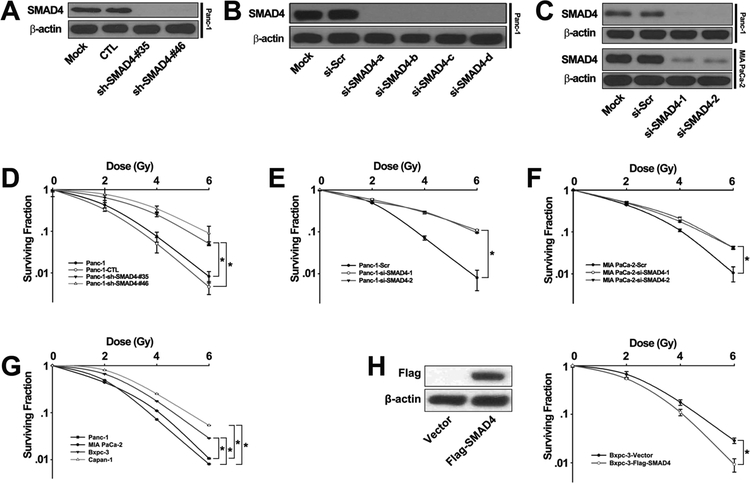
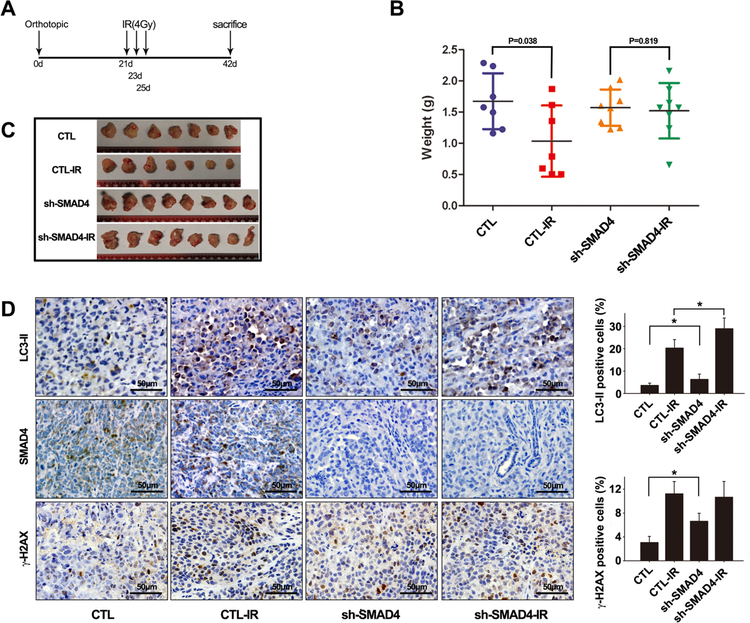
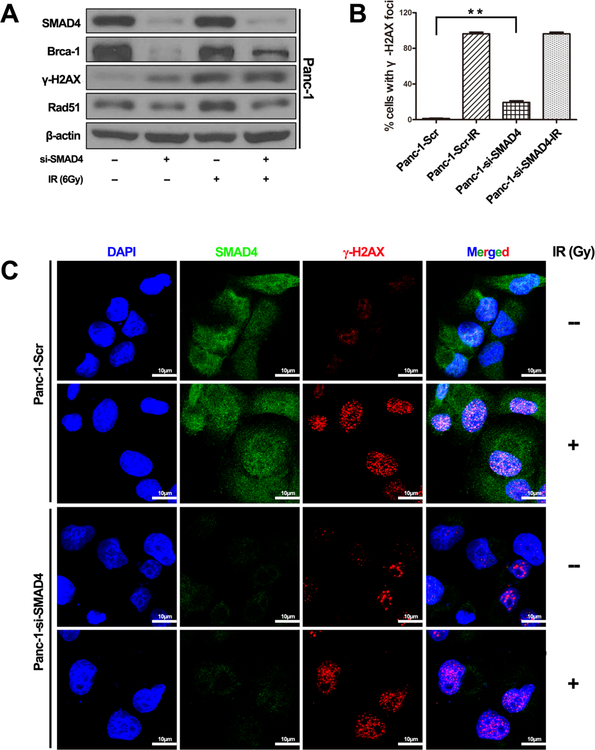
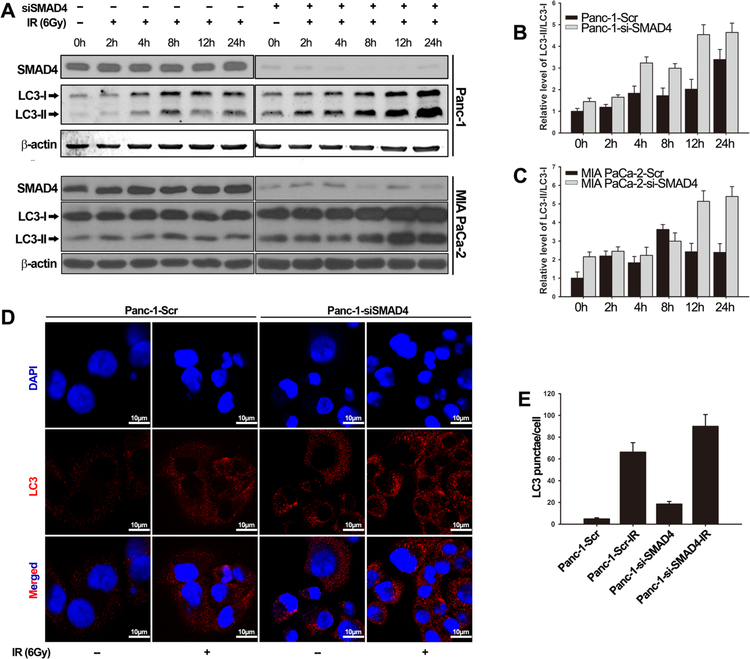
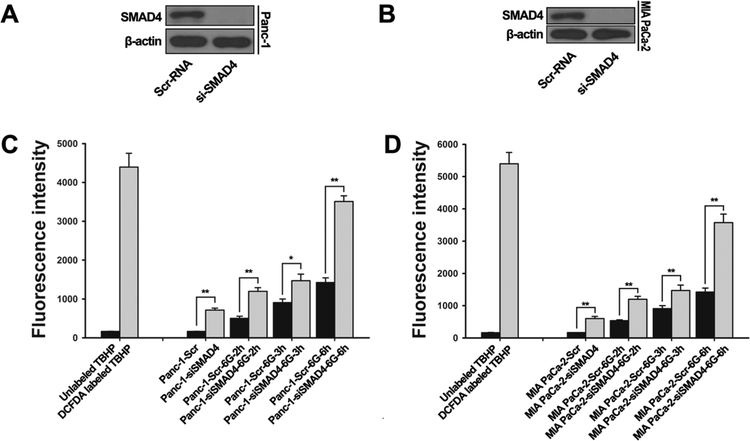
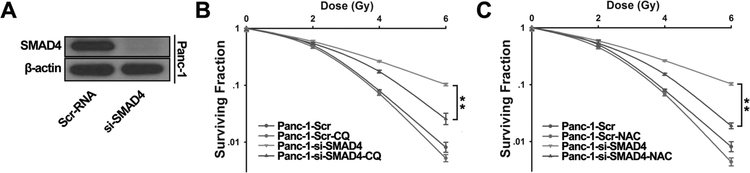
Understanding the mechanism of radioresistance could help develop strategies to improve therapeutic response of patients with PDAC. The gene is frequently mutated in pancreatic cancer. In this study, we investigated the role of deficiency in pancreatic cancer cells' response to radiotherapy. We downregulated SMAD4 expression with siRNA or shRNA and overexpressed SMAD4 in mutant pancreatic cancer cells followed by clonogenic survival assay to evaluate their effects on cell radioresistance. To study the mechanism of radioresistance, the effects of loss on reactive oxygen species (ROS) and autophagy were determined by flow cytometry and immunoblot analysis, respectively. Furthermore, we measured radioresistance by clonogenic survival assay after treatment with autophagy inhibitor (Chloroquine) and ROS inhibitor (N-acetyl-l-cysteine) in -depleted pancreatic cancer cells. Finally, the effects of on radioresistance were also confirmed in an orthotopic tumor model derived from -depleted Panc-1 cells.-depleted pancreatic cancer cells were more resistant to radiotherapy based on clonogenic survival assay. Overexpression of wild-type SMAD4 in -mutant cells rescued their radiosensitivity. Radioresistance mediated by depletion was associated with persistently higher levels of ROS and radiation-induced autophagy. Finally, depletion induced radioresistance in Panc-1-derived orthotopic tumor model ( = 0.038). More interestingly, we observed that the protein level of SMAD4 is inversely correlated with autophagy in orthotopic tumor tissue samples. Our results demonstrate that defective is responsible for radioresistance in pancreatic cancer through induction of ROS and increased level of radiation-induced autophagy. .
了解放射抵抗的机制有助于制定策略来提高胰腺导管腺癌(PDAC)患者的治疗反应。该基因在胰腺癌中经常发生突变。在这项研究中,我们研究了 SMAD4 缺陷在胰腺癌细胞对放疗反应中的作用。我们用 siRNA 或 shRNA 下调 SMAD4 的表达,并在 SMAD4 突变的胰腺癌细胞中转染 SMAD4 过表达载体,然后进行集落存活实验以评估其对细胞放射抵抗的影响。为了研究放射抵抗的机制,我们通过流式细胞术和免疫印迹分析分别确定 SMAD4 缺失对活性氧(ROS)和自噬的影响。此外,我们在用自噬抑制剂(氯喹)和 ROS 抑制剂(N-乙酰-L-半胱氨酸)处理后,通过集落存活实验测量 - 缺陷胰腺癌细胞中的放射抵抗性。最后,在源自 - 缺陷 Panc-1 细胞的原位肿瘤模型中也证实了 SMAD4 对放射抵抗性的影响。基于集落存活实验,- 缺陷的胰腺癌细胞对放疗更具抵抗力。野生型 SMAD4 在 SMAD4 突变细胞中的过表达挽救了它们的放射敏感性。由 SMAD4 耗竭介导的放射抵抗与持续更高水平的 ROS 和辐射诱导的自噬有关。最后,- 缺陷在 Panc-1 衍生的原位肿瘤模型中诱导了 SMAD4 放射抵抗(=0.038)。更有趣的是,我们观察到在原位肿瘤组织样本中,SMAD4 的蛋白水平与自噬呈负相关。我们的结果表明,缺陷的 SMAD4 通过诱导 ROS 和增加辐射诱导的自噬水平,导致胰腺癌细胞放射抵抗。