Wolfe Kate, McQuillin Andrew, Alesi Viola, Boudry Labis Elise, Cutajar Peter, Dallapiccola Bruno, Dentici Maria Lisa, Dieux-Coeslier Anne, Duban-Bedu Benedicte, Duelund Hjortshøj Tina, Goel Himanshu, Loddo Sara, Morrogh Deborah, Mosca-Boidron Anne-Laure, Novelli Antonio, Olivier-Faivre Laurence, Parker Jennifer, Parker Michael J, Patch Christine, Pelling Anna L, Smol Thomas, Tümer Zeynep, Vanakker Olivier, van Haeringen Arie, Vanlerberghe Clémence, Strydom Andre, Skuse David, Bass Nick
Molecular Psychiatry Laboratory, Division of Psychiatry, University College London, London, United Kingdom.
Medical Genetics Unit, Medical Genetics Laboratory, Bambino Gesù Pediatric Hospital, IRCCS, Rome, Italy.
Am J Med Genet B Neuropsychiatr Genet. 2018 Jun;177(4):397-405. doi: 10.1002/ajmg.b.32627. Epub 2018 Mar 31.
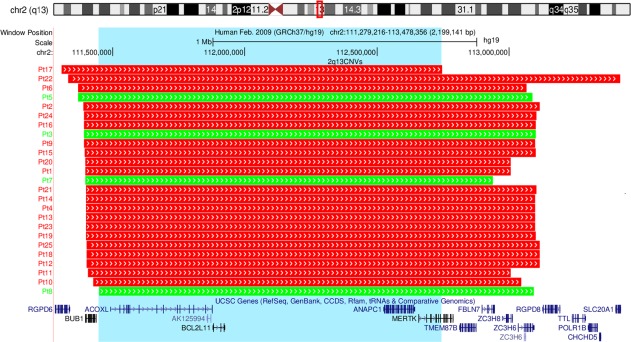
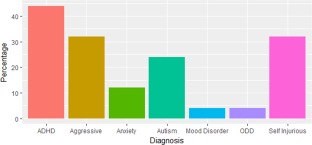
Recurrent deletions and duplications at the 2q13 locus have been associated with developmental delay (DD) and dysmorphisms. We aimed to undertake detailed clinical characterization of individuals with 2q13 copy number variations (CNVs), with a focus on behavioral and psychiatric phenotypes. Participants were recruited via the Unique chromosomal disorder support group, U.K. National Health Service Regional Genetics Centres, and the DatabasE of genomiC varIation and Phenotype in Humans using Ensembl Resources (DECIPHER) database. A review of published 2q13 patient case reports was undertaken to enable combined phenotypic analysis. We present a new case series of 2q13 CNV carriers (21 deletion, 4 duplication) and the largest ever combined analysis with data from published studies, making a total of 54 deletion and 23 duplication carriers. DD/intellectual disabilities was identified in the majority of carriers (79% deletion, 70% duplication), although in the new cases 52% had an IQ in the borderline or normal range. Despite the median age of the new cases being only 9 years, 64% had a clinical psychiatric diagnosis. Combined analysis found attention deficit hyperactivity disorder (ADHD) to be the most frequent diagnosis (48% deletion, 60% duplication), followed by autism spectrum disorders (33% deletion, 17% duplication). Aggressive (33%) and self-injurious behaviors (33%) were also identified in the new cases. CNVs at 2q13 are typically associated with DD with mildly impaired intelligence, and a high rate of childhood psychiatric diagnoses-particularly ADHD. We have further characterized the clinical phenotype related to imbalances of the 2q13 region and identified it as a region of interest for the neurobiological investigation of ADHD.
2q13位点的反复缺失和重复与发育迟缓(DD)及畸形有关。我们旨在对具有2q13拷贝数变异(CNV)的个体进行详细的临床特征分析,重点关注行为和精神表型。通过独特染色体疾病支持小组、英国国家医疗服务体系区域遗传学中心以及利用Ensembl资源的人类基因组变异与表型数据库(DECIPHER)招募参与者。对已发表的2q13患者病例报告进行了回顾,以便进行联合表型分析。我们展示了一个新的2q13 CNV携带者病例系列(21例缺失,4例重复),并与已发表研究的数据进行了有史以来最大规模的联合分析,总计有54例缺失携带者和23例重复携带者。大多数携带者(79%的缺失携带者,70%的重复携带者)被诊断为DD/智力残疾,不过在新病例中,52%的患者智商处于临界或正常范围。尽管新病例的中位年龄仅为9岁,但64%的患者有临床精神疾病诊断。联合分析发现注意力缺陷多动障碍(ADHD)是最常见的诊断(48%的缺失携带者,60%的重复携带者),其次是自闭症谱系障碍(33%的缺失携带者,17%的重复携带者)。新病例中还发现了攻击行为(33%)和自伤行为(33%)。2q13的CNV通常与智力轻度受损的DD以及儿童期精神疾病的高诊断率相关,尤其是ADHD。我们进一步描述了与2q13区域失衡相关的临床表型,并将其确定为ADHD神经生物学研究的一个感兴趣区域。