MRC Social, Genetic and Developmental Psychiatry Centre, Institute of Psychiatry, King's College London, London, UK.
PLoS One. 2013 Apr 18;8(4):e61365. doi: 10.1371/journal.pone.0061365. Print 2013.
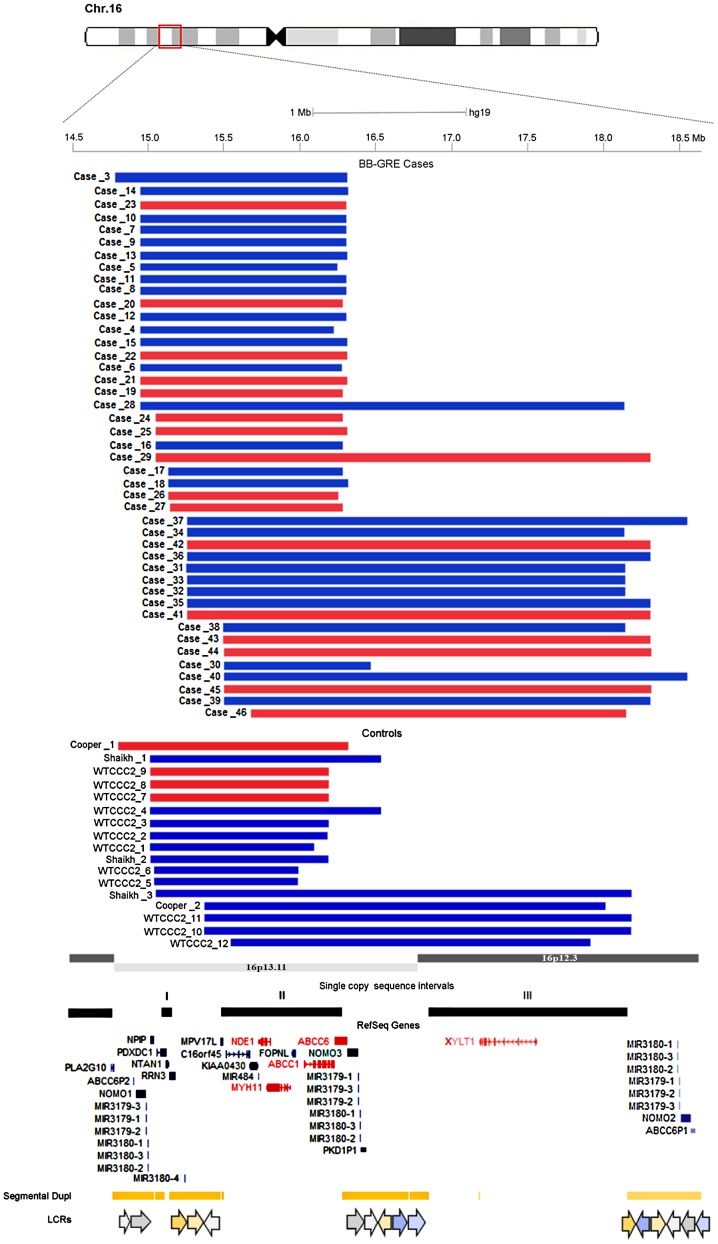
Copy number variants (CNVs) at chromosome 16p13.11 have been associated with a range of neurodevelopmental disorders including autism, ADHD, intellectual disability and schizophrenia. Significant sex differences in prevalence, course and severity have been described for a number of these conditions but the biological and environmental factors underlying such sex-specific features remain unclear. We tested the burden and the possible sex-biased effect of CNVs at 16p13.11 in a sample of 10,397 individuals with a range of neurodevelopmental conditions, clinically referred for array comparative genomic hybridisation (aCGH); cases were compared with 11,277 controls. In order to identify candidate phenotype-associated genes, we performed an interval-based analysis and investigated the presence of ohnologs at 16p13.11; finally, we searched the DECIPHER database for previously identified 16p13.11 copy number variants. In the clinical referral series, we identified 46 cases with CNVs of variable size at 16p13.11, including 28 duplications and 18 deletions. Patients were referred for various phenotypes, including developmental delay, autism, speech delay, learning difficulties, behavioural problems, epilepsy, microcephaly and physical dysmorphisms. CNVs at 16p13.11 were also present in 17 controls. Association analysis revealed an excess of CNVs in cases compared with controls (OR = 2.59; p = 0.0005), and a sex-biased effect, with a significant enrichment of CNVs only in the male subgroup of cases (OR = 5.62; p = 0.0002), but not in females (OR = 1.19, p = 0.673). The same pattern of results was also observed in the DECIPHER sample. Interval-based analysis showed a significant enrichment of case CNVs containing interval II (OR = 2.59; p = 0.0005), located in the 0.83 Mb genomic region between 15.49-16.32 Mb, and encompassing the four ohnologs NDE1, MYH11, ABCC1 and ABCC6. Our data confirm that duplications and deletions at 16p13.11 represent incompletely penetrant pathogenic mutations that predispose to a range of neurodevelopmental disorders, and suggest a sex-limited effect on the penetrance of the pathological phenotypes at the 16p13.11 locus.
16p13.11 号染色体上的拷贝数变异 (CNVs) 与一系列神经发育障碍有关,包括自闭症、ADHD、智力障碍和精神分裂症。许多这些病症都表现出显著的患病率、病程和严重程度的性别差异,但导致这些性别特异性特征的生物学和环境因素仍不清楚。我们在一个包括多种神经发育障碍的临床转诊样本中测试了 16p13.11 号染色体上的 CNVs 的负担和可能的性别偏倚效应;将病例与 11277 名对照进行了比较。为了确定与表型相关的候选基因,我们进行了基于区间的分析,并研究了 16p13.11 号染色体上同源基因的存在;最后,我们在 DECIPHER 数据库中搜索了之前鉴定的 16p13.11 号染色体拷贝数变异。在临床转诊系列中,我们在 16p13.11 号染色体上发现了 46 个大小不一的病例 CNVs,包括 28 个重复和 18 个缺失。患者因各种表型被转诊,包括发育迟缓、自闭症、言语延迟、学习困难、行为问题、癫痫、小头畸形和身体畸形。在 17 名对照中也发现了 16p13.11 号染色体上的 CNVs。关联分析显示,病例中 CNVs 的数量多于对照(OR=2.59;p=0.0005),并且存在性别偏倚效应,仅在病例的男性亚组中存在 CNVs 的显著富集(OR=5.62;p=0.0002),而在女性中没有(OR=1.19,p=0.673)。在 DECIPHER 样本中也观察到了相同的结果模式。基于区间的分析显示,包含区间 II 的病例 CNVs 显著富集(OR=2.59;p=0.0005),位于 15.49-16.32Mb 之间的 0.83Mb 基因组区域,包含四个同源基因 NDE1、MYH11、ABCC1 和 ABCC6。我们的数据证实,16p13.11 号染色体上的重复和缺失代表不完全外显的致病性突变,使一系列神经发育障碍易感性增加,并提示 16p13.11 位点点突变的病理表型的外显率存在性别限制效应。