Liver Care Center of Cincinnati Children's Hospital Medical Center and Department of Pediatrics, University of Cincinnati College of Medicine, Cincinnati, OH.
Perelman School of Medicine, University of Pennsylvania, Philadelphia, PA.
Hepatology. 2018 Sep;68(3):1163-1173. doi: 10.1002/hep.29905.
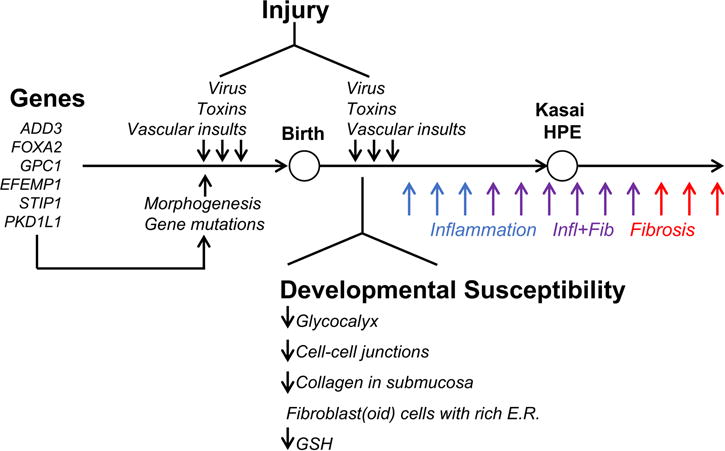
Biliary atresia (BA) is a fibroinflammatory disease of the intrahepatic and extrahepatic biliary tree. Surgical hepatic portoenterostomy (HPE) may restore bile drainage, but progression of the intrahepatic disease results in complications of portal hypertension and advanced cirrhosis in most children. Recognizing that further progress in the field is unlikely without a better understanding of the underlying cause(s) and pathogenesis of the disease, the National Institutes of Diabetes and Digestive and Kidney Diseases (NIDDK) sponsored a research workshop focused on innovative and promising approaches and on identifying future areas of research. Investigators discussed recent advances using gestational ultrasound and results of newborn BA screening with serum direct (conjugated) bilirubin that support a prenatal onset of biliary injury. Experimental and human studies implicate the toxic properties of environmental toxins (e.g., biliatresone) and of viruses (e.g., cytomegalovirus) to the biliary system. Among host factors, sequence variants in genes related to biliary development and ciliopathies, a notable lack of a cholangiocyte glycocalyx and of submucosal collagen bundles in the neonatal extrahepatic bile ducts, and an innate proinflammatory bias of the neonatal immune system contribute to an increased susceptibility to damage and obstruction following epithelial injury. These advances form the foundation for a future research agenda focused on identifying the environmental and host factor(s) that cause BA, the potential use of population screening, studies of the mechanisms of prominent fibrosis in young infants, determinations of clinical surrogates of disease progression, and the design of clinical trials that target subgroups of patients with initial drainage following HPE. (Hepatology 2018; 00:000-000).
先天性胆道闭锁(BA)是一种肝内外胆管的纤维炎性疾病。手术性肝门肠吻合术(HPE)可能恢复胆汁引流,但肝内疾病的进展会导致大多数儿童发生门静脉高压和晚期肝硬化的并发症。鉴于如果不深入了解该疾病的潜在病因和发病机制,该领域的进一步进展是不可能的,因此,国家糖尿病、消化和肾脏疾病研究所(NIDDK)赞助了一个研究研讨会,重点关注创新和有前途的方法,并确定未来的研究领域。研究人员讨论了最近利用产前超声和血清直接(结合)胆红素新生儿 BA 筛查的进展,这些进展支持胆道损伤的产前发病。实验和人体研究表明,环境毒素(例如,胆三醇)和病毒(例如,巨细胞病毒)对胆道系统具有毒性。在宿主因素中,与胆管发育和纤毛病变相关的基因中的序列变异、新生儿肝外胆管中明显缺乏胆细胞糖萼和粘膜下胶原束,以及新生儿免疫系统的固有促炎倾向,导致上皮损伤后易受损伤和阻塞。这些进展为未来的研究议程奠定了基础,该议程侧重于确定导致 BA 的环境和宿主因素、人群筛查的潜在用途、研究婴儿期明显纤维化的机制、确定疾病进展的临床替代标志物,以及针对 HPE 后初始引流的患者亚组设计临床试验。(《肝脏病学》2018 年;00:000-000)。