Departments of Nephrology, Nagoya University Graduate School of Medicine, Nagoya 466-8550, Japan; Departments of Biochemistry, Nagoya University Graduate School of Medicine, Nagoya 466-8550, Japan.
Departments of Nephrology, Nagoya University Graduate School of Medicine, Nagoya 466-8550, Japan.
Metabolism. 2018 Aug;85:161-170. doi: 10.1016/j.metabol.2018.03.020. Epub 2018 Mar 29.
Ketohexokinase (KHK), a primary enzyme in fructose metabolism, has two isoforms, namely, KHK-A and KHK-C. Previously, we reported that renal injury was reduced in streptozotocin-induced diabetic mice which lacked both isoforms. Although both isoforms express in kidney, it has not been elucidated whether each isoform plays distinct roles in the development of diabetic kidney disease (DKD). The aim of the study is to elucidate the role of KHK-A for DKD progression.
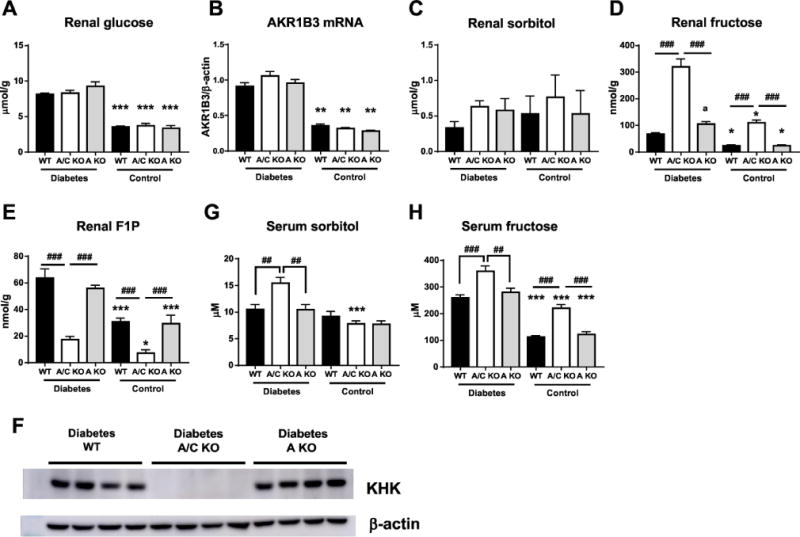
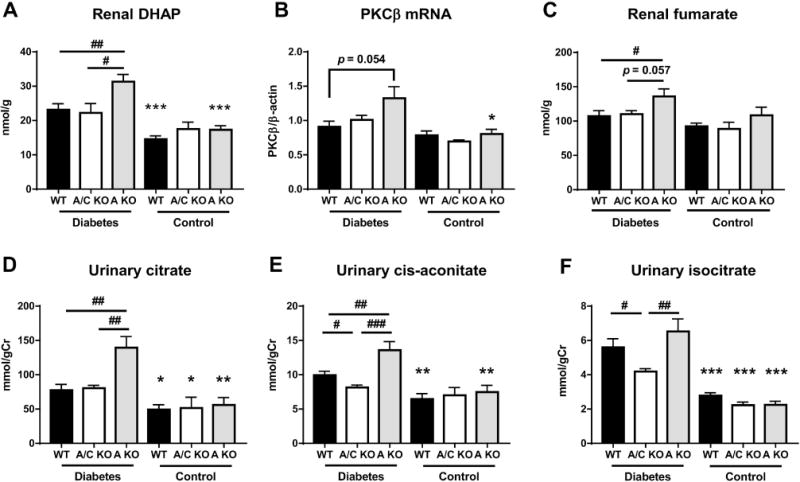
Diabetes was induced by five consecutive daily intraperitoneal injections of streptozotocin (50 mg/kg) in C57BL/6J wild-type mice, mice lacking KHK-A alone (KHK-A KO), and mice lacking both KHK-A and KHK-C (KHK-A/C KO). At 35 weeks, renal injury, inflammation, hypoxia, and oxidative stress were examined. Metabolomic analysis including polyol pathway, fructose metabolism, glycolysis, TCA (tricarboxylic acid) cycle, and NAD (nicotinamide adenine dinucleotide) metabolism in kidney and urine was done.
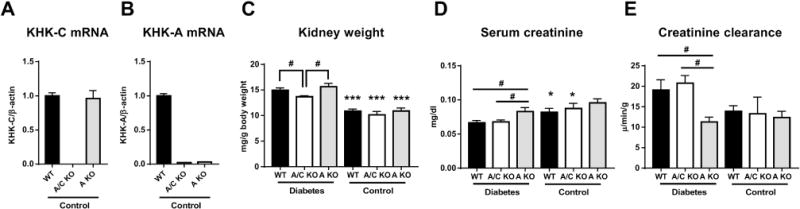
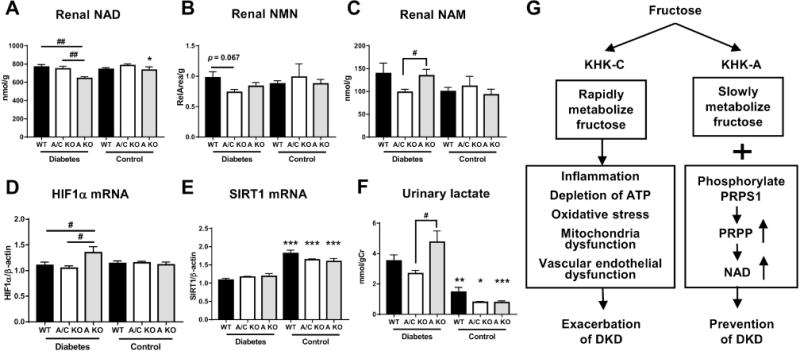
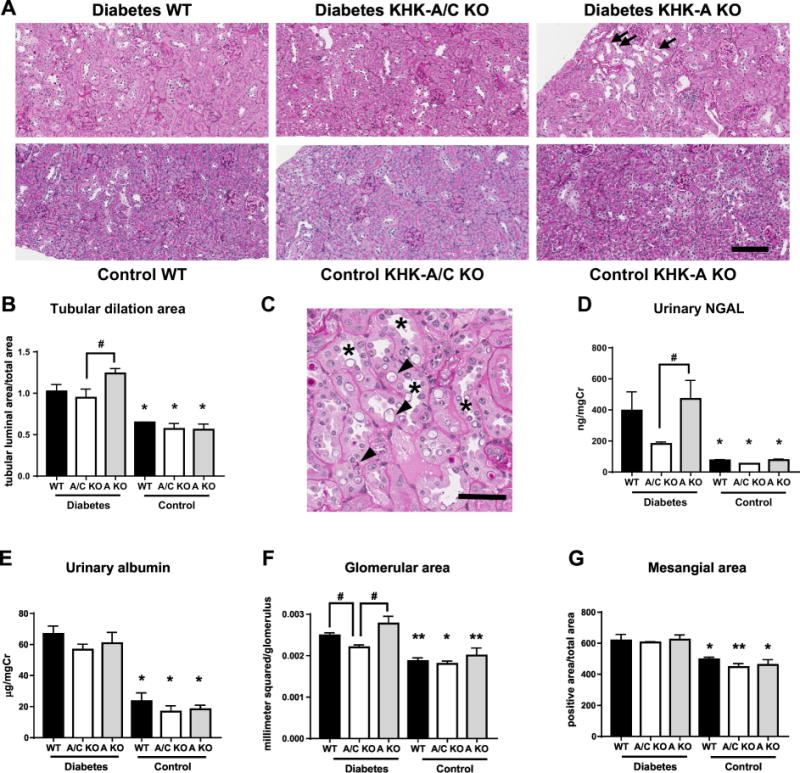
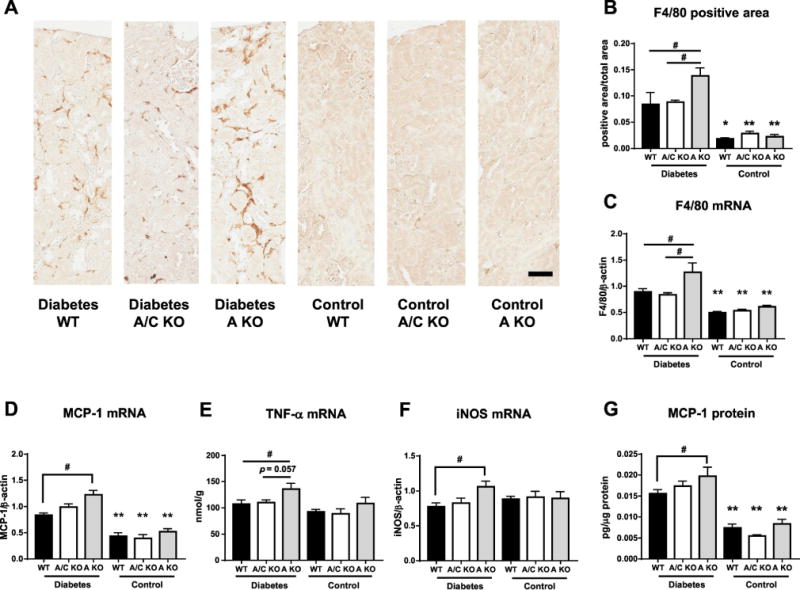
Diabetic KHK-A KO mice developed severe renal injury compared to diabetic wild-type mice, and this was associated with further increases of intrarenal fructose, dihydroxyacetone phosphate (DHAP), TCA cycle intermediate levels, and severe inflammation. In contrast, renal injury was prevented in diabetic KHK-A/C KO mice compared to both wild-type and KHK-A KO diabetic mice. Further, diabetic KHK-A KO mice contained decreased renal NAD level with the increase of renal hypoxia-inducible factor 1-alpha expression despite having increased renal nicotinamide (NAM) level.
These results suggest that KHK-C might play a deleterious role in DKD progression through endogenous fructose metabolism, and that KHK-A plays a unique protective role against the development of DKD.
己酮糖激酶(KHK)是果糖代谢的主要酶,有两种同工酶,即 KHK-A 和 KHK-C。此前,我们报道缺乏这两种同工酶的链脲佐菌素诱导型糖尿病小鼠的肾损伤减少。尽管两种同工酶都在肾脏中表达,但尚未阐明每种同工酶在糖尿病肾病(DKD)的发展中是否发挥独特的作用。本研究旨在阐明 KHK-A 在 DKD 进展中的作用。
通过连续 5 天腹腔注射链脲佐菌素(50mg/kg)在 C57BL/6J 野生型小鼠、仅缺乏 KHK-A 的小鼠(KHK-A KO)和缺乏 KHK-A 和 KHK-C 的小鼠(KHK-A/C KO)中诱导糖尿病。在 35 周时,检查肾脏损伤、炎症、缺氧和氧化应激。对肾脏和尿液中的多元醇途径、果糖代谢、糖酵解、三羧酸(TCA)循环和烟酰胺腺嘌呤二核苷酸(NAD)代谢等进行代谢组学分析。
与糖尿病野生型小鼠相比,糖尿病 KHK-A KO 小鼠的肾脏损伤更为严重,这与肾内果糖、二羟丙酮磷酸(DHAP)、TCA 循环中间产物水平的进一步增加以及严重的炎症有关。相比之下,与野生型和 KHK-A KO 糖尿病小鼠相比,糖尿病 KHK-A/C KO 小鼠的肾脏损伤得到了预防。此外,尽管 KHK-A KO 糖尿病小鼠的肾 NAD 水平降低,但肾缺氧诱导因子 1-α表达增加,提示 KHK-A 可能通过内源性果糖代谢发挥独特的保护作用,防止 DKD 的发生。
这些结果表明,KHK-C 可能通过内源性果糖代谢在 DKD 进展中发挥有害作用,而 KHK-A 在 DKD 的发生中发挥独特的保护作用。