Gunnery Sarah D, Naumova Elena N, Saint-Hilaire Marie, Tickle-Degnen Linda
Department of Occupational Therapy, Tufts University, 574 Boston Ave, Medford, MA 02155, USA.
The Gerald J. and Dorothy H Friedman School of Nutrition Science and Policy, Tufts University, 150 Harrison Ave, Boston, MA 02111, USA.
Cogent Psychol. 2017;4. doi: 10.1080/23311908.2017.1376425. Epub 2017 Sep 8.
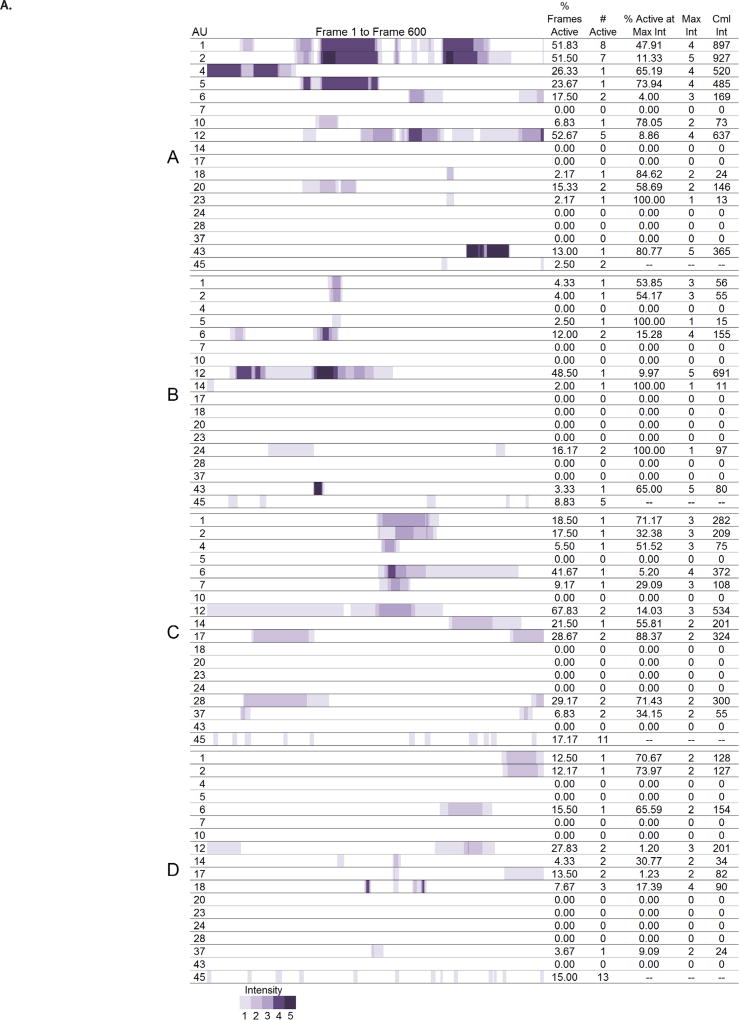
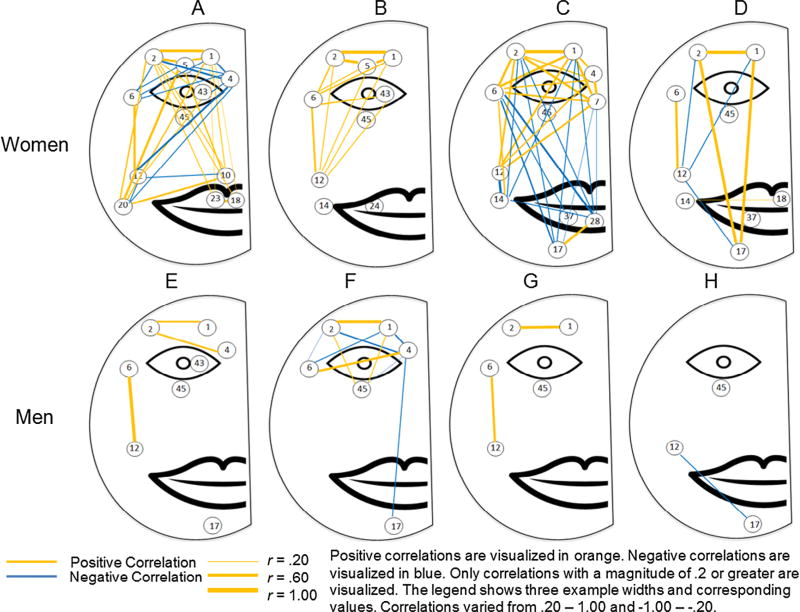
People with Parkinson's disease (PD) often experience a decrease in their facial expressivity, but little is known about how the coordinated movements across regions of the face are impaired in PD. The face has neurologically independent regions that coordinate to articulate distinct social meanings that others perceive as gestalt expressions, and so understanding how different regions of the face are affected is important. Using the Facial Action Coding System, this study comprehensively measured spontaneous facial expression across 600 frames for a multiple case study of people with PD who were rated as having varying degrees of facial expression deficits, and created correlation matrices for frequency and intensity of produced muscle activations across different areas of the face. Data visualization techniques were used to create temporal and correlational mappings of muscle action in the face at different degrees of facial expressivity. Results showed that as severity of facial expression deficit increased, there was a decrease in number, duration, intensity, and coactivation of facial muscle action. This understanding of how regions of the parkinsonian face move independently and in conjunction with other regions will provide a new focus for future research aiming to model how facial expression in PD relates to disease progression, stigma, and quality of life.
帕金森病(PD)患者常常面部表情能力下降,但对于帕金森病患者面部各区域的协调运动是如何受损的,我们却知之甚少。面部在神经学上有独立的区域,这些区域相互协调以表达出他人视为整体表情的不同社会意义,因此了解面部不同区域是如何受到影响至关重要。本研究使用面部动作编码系统,针对600个画面全面测量了被评定为具有不同程度面部表情缺陷的帕金森病患者的多案例自发面部表情,并创建了面部不同区域产生的肌肉激活频率和强度的相关矩阵。数据可视化技术被用于创建不同面部表情程度下脸部肌肉动作的时间和相关映射。结果表明,随着面部表情缺陷严重程度的增加,面部肌肉动作的数量、持续时间、强度和共同激活程度均有所下降。对帕金森病患者面部区域如何独立以及与其他区域协同运动的这种理解,将为未来旨在模拟帕金森病面部表情与疾病进展、污名化及生活质量之间关系的研究提供新的重点。