Mustafa Tehmina, Shahzad Yasir, Kiani Ayyaz
1Centre for International Health, Department of Global Public Health and Primary Care, University of Bergen, Postbox 7804, N-5020 Bergen, Norway.
2Department of Thoracic Medicine, Haukeland University Hospital, Bergen, Norway.
J Pharm Policy Pract. 2018 Mar 28;11:7. doi: 10.1186/s40545-018-0134-1. eCollection 2018.
In order to engage pharmacies in tuberculosis (TB) care, a survey was conducted in the Dera Ismail (DI) Khan City of the Khyber Pakhtoon Khwa province, Pakistan. The objectives were to; 1) characterize the retail pharmacies; 2) determine knowledge of the staff on various aspects of pulmonary TB; 3) determine practices related to the sale of anti-TB drugs, and referrals of presumptive TB patient, and willingness to participate in the National Tuberculosis Control Programme's (NTP) Directly Observed Treatment Short-Course (DOTS) strategy.
A cross-sectional survey was conducted by using a structured questionnaire to collect data from pharmacy staff at all the private retail pharmacies of the DI khan city.
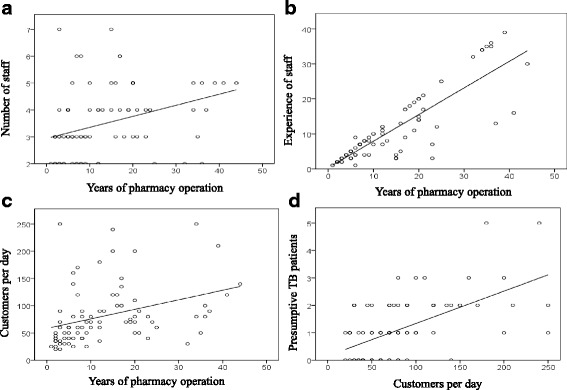
All the interviewed staff ( = 82) were males, only 38% had formal training as pharmacist (5%) or as a pharmacy assistant (33%). Pharmacies established for a longer period were better staffed and had high customer load. About 92% of the interviewed staff knew that persistent cough is a symptom for TB, 82% knew that TB is diagnosed by examination of sputum. Almost 66% of the pharmacy staff did not know multi-drug resistance TB as a consequence of improper treatment. Those with formal training and longer experience in retail pharmacy had better knowledge of various aspects of TB as compared to the staff with no formal pharmacy training and lesser experience ( < 0.01). Only 57% were aware of NTP while only 30% had heard of the DOTS strategy. All reported sale of first-line TB drugs as fixed dose combinations. The majority (80%) referred presumptive TB patients to chest physicians and no patient was referred to the NTP. Nearly 83% of the interviewed staff was willing to be involved in TB control efforts by getting training and referring patients to the DOTS facility.
There was shortage of professionally qualified and female staff in private retail pharmacies. Knowledge of professionally qualified staff about TB seemed sufficient to identify presumptive TB patients; however, their knowledge about NTP and DOTS was poor, and referral practices to NTP and DOTS centers were suboptimal. Majority of staff was willing to be involved in TB control efforts.
为促使药房参与结核病防治工作,在巴基斯坦开伯尔-普赫图赫瓦省德拉伊斯梅尔汗市开展了一项调查。目标如下:1)描述零售药房的特征;2)确定工作人员对肺结核各方面的知识掌握情况;3)确定与抗结核药物销售、疑似结核病患者转诊相关的做法,以及参与国家结核病控制规划(NTP)直接观察短程治疗(DOTS)策略的意愿。
采用结构化问卷进行横断面调查,以收集德拉伊斯梅尔汗市所有私人零售药房工作人员的数据。
所有接受访谈的工作人员(n = 82)均为男性,只有38%接受过药剂师(5%)或药房助理(33%)的正规培训。经营时间较长的药房人员配备更好,顾客流量也大。约92%的受访工作人员知道持续咳嗽是结核病的症状,82%知道结核病通过痰液检查诊断。近66%的药房工作人员不知道不当治疗会导致耐多药结核病。与未接受过正规药房培训且经验较少的工作人员相比,接受过正规培训且在零售药房工作经验较长的人员对结核病各方面的知识掌握得更好(P < 0.01)。只有57%的人知道国家结核病控制规划,只有30%的人听说过DOTS策略。所有药房均报告销售一线抗结核药物的固定剂量组合。大多数(80%)将疑似结核病患者转诊至胸科医生处,没有患者被转诊至国家结核病控制规划机构。近83%的受访工作人员愿意通过接受培训并将患者转诊至DOTS机构参与结核病防治工作。
私人零售药房缺乏专业合格的工作人员和女性工作人员。专业合格工作人员对结核病的了解似乎足以识别疑似结核病患者;然而,他们对国家结核病控制规划和DOTS的了解较差,向国家结核病控制规划和DOTS中心的转诊做法也不理想。大多数工作人员愿意参与结核病防治工作。