College of Horticulture, Sichuan Agricultural University, Chengdu 611130, China.
Institute of Pomology and Olericulture, Sichuan Agricultural University, Chengdu 611130, China.
Molecules. 2018 Apr 3;23(4):820. doi: 10.3390/molecules23040820.
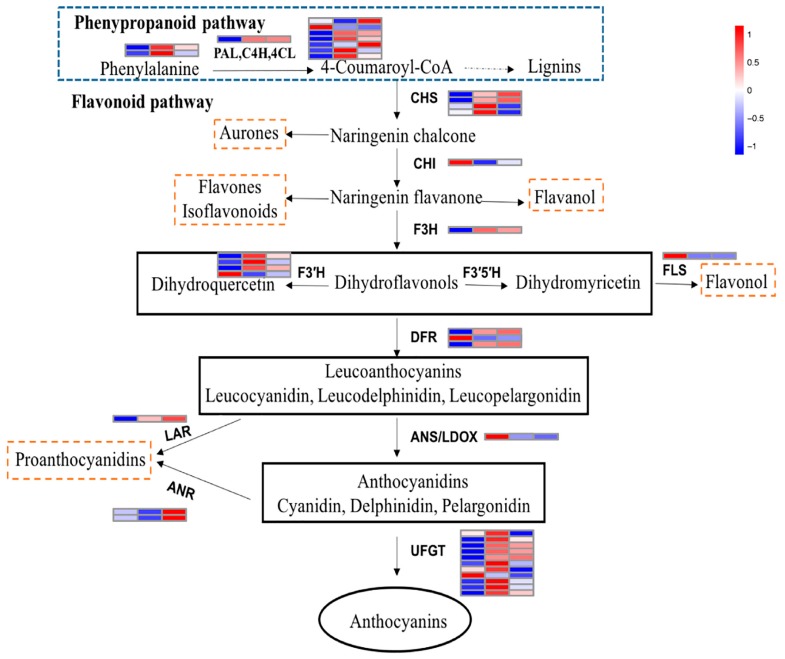
Light conditions can cause quantitative and qualitative changes in anthocyanin. However, little is known about the underlying mechanism of light quality-regulated anthocyanin accumulation in fruits. In this study, light-emitting diodes (LEDs) were applied to explore the effect of red and blue light on strawberry coloration. The results showed contents of total anthocyanins (TA), pelargonidin 3-glucoside (Pg3G) and pelargonidin 3-malonylglucoside (Pg3MG) significantly increased after blue and red light treatment. Pg3G was the major anthocyanin component in strawberry fruits, accounting for more than 80% of TA, whereas Pg3MG accounted for a smaller proportion. Comparative transcriptome analysis was conducted using libraries from the treated strawberries. A total of 1402, 5034, and 3764 differentially-expressed genes (DEGs) were identified in three pairwise comparisons (red light versus white light, RL-VS-WL; blue light versus white light, BL-VS-WL; blue light versus red light, BL-VS-RL), respectively. Photoreceptors and light transduction components remained dynamic to up-regulate the expression of regulatory factors and structural genes related to anthocyanin biosynthesis under red and white light, whereas most genes had low expression levels that were not consistent with the highest total anthocyanin content under blue light. Therefore, the results indicated that light was an essential environmental factor for anthocyanin biosynthesis before the anthocyanin concentration reached saturation in strawberry fruits, and blue light could quickly stimulate the accumulation of anthocyanin in the fruit. In addition, red light might contribute to the synthesis of proanthocyanidins by inducing and .
光照条件会引起花色苷的量变和质变。然而,关于光质调控果实花色苷积累的潜在机制,目前知之甚少。本研究采用发光二极管(LED)探索红蓝对草莓着色的影响。结果表明,蓝光和红光处理后总花色苷(TA)、矢车菊素 3-葡萄糖苷(Pg3G)和矢车菊素 3-丙二酰葡萄糖苷(Pg3MG)含量显著增加。Pg3G 是草莓果实中主要的花色苷成分,占 TA 的 80%以上,而 Pg3MG 占比较小。用处理后的草莓构建文库进行比较转录组分析。在三个两两比较(红光与白光,RL-VS-WL;蓝光与白光,BL-VS-WL;蓝光与红光,BL-VS-RL)中,分别鉴定到 1402、5034 和 3764 个差异表达基因(DEGs)。红光和白光下,光受体和光转导元件持续动态上调与花色苷生物合成相关的调控因子和结构基因的表达,而大多数基因的表达水平较低,与蓝光下总花色苷含量最高时不一致。因此,结果表明,在草莓果实中花色苷浓度达到饱和之前,光是花色苷生物合成的重要环境因素,蓝光可以快速刺激果实中花色苷的积累。此外,红光可能通过诱导和来促进原花青素的合成。