National Crops Resources Research Institute, Namulonge, Kampala, Uganda.
Commonwealth Scientific and Industrial Research Organization, Canberra, Australia.
PLoS One. 2018 Apr 3;13(4):e0194571. doi: 10.1371/journal.pone.0194571. eCollection 2018.
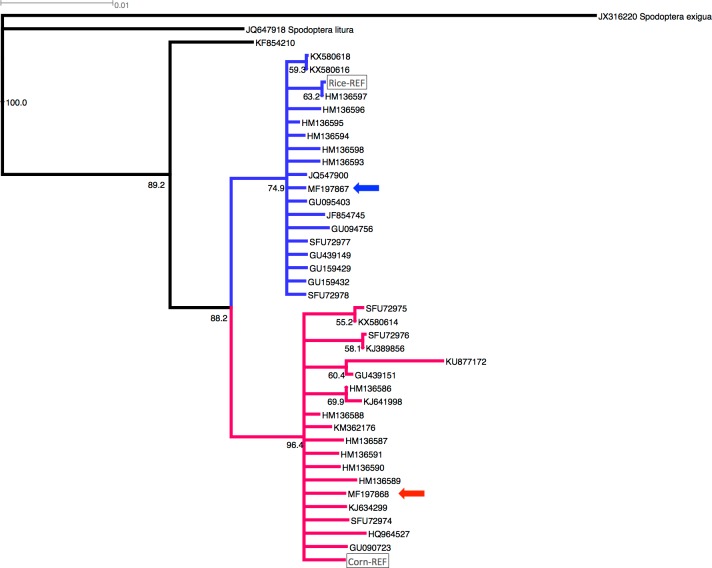
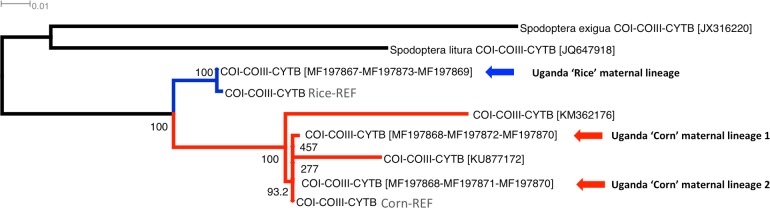
The fall armyworm (FAW) Spodoptera frugiperda (J. E. Smith) is a species native to the Americas. This polyphagous lepidopteran pest was first reported in Nigeria and the Democratic Republic of São Tomé and Principe in 2016, but its presence in eastern Africa has not been confirmed via molecular characterisation. In this study, FAW specimens from western and central Uganda were identified based on the partial mtDNA COI gene sequences, with mtDNA COI haplotypes matching those identified in Nigeria and São Tomé. In this study, we sequence an additional partial mtDNA Cyt b gene and also the partial mtDNA COIII gene in Ugandan FAW samples. We detected identical mitochondrial DNA haplotypes for both the mtDNA Cyt b and COI partial genes, while combining the mtDNA COI/Cyt b haplotypes and mtDNA COIII haplotypes enabled a new maternal lineage in the Ugandan corn-preferred FAW samples to be identified. Our results suggested that the African incursions of S. frugiperda involved at least three maternal lineages. Recent full genome, phylogenetic and microsatellite analyses provided evidence to support S. frugiperda as likely consisted of two sympatric sister species known as the corn-preferred and rice-preferred strains. In our Ugandan FAW populations, we identified the presence of mtDNA haplotypes representative of both sister species. It is not known if both FAW sister species were originally introduced together or separately, and whether they have since spread as a single population. Further analyses of additional specimens originally collected from São Tomé, Nigeria and throughout Africa would be required to clarify this issue. Importantly, our finding showed that the genetic diversity of the African corn-preferred FAW species is higher than previously reported. This potentially contributed to the success of FAW establishment in Africa. Furthermore, with the additional maternal lineages detected, there is likely an increase in paternal lineages, thereby increasing the diversity of the African FAW population. Knowledge of the FAW genetic diversity will be needed to assess the risks of introducing Bt-resistance traits and to understand the FAW incursion pathways into the Old World and its potential onward spread. The agricultural implications of the presence of two evolutionary divergent FAW lineages (the corn and the rice lineage) in the African continent are further considered and discussed.
秋粘虫(FAW)Spodoptera frugiperda(J. E. Smith)原产于美洲。这种多食性鳞翅目害虫于 2016 年首次在尼日利亚和圣多美和普林西比民主共和国报告,但尚未通过分子特征确认其在东非的存在。在这项研究中,根据部分 mtDNA COI 基因序列鉴定了来自乌干达西部和中部的 FAW 标本,mtDNA COI 单倍型与在尼日利亚和圣多美鉴定的单倍型相匹配。在这项研究中,我们还在乌干达 FAW 样本中测序了额外的部分 mtDNA Cyt b 基因和部分 mtDNA COIII 基因。我们检测到 mtDNA Cyt b 和 COI 部分基因的线粒体 DNA 单倍型完全相同,而结合 mtDNA COI/Cyt b 单倍型和 mtDNA COIII 单倍型,可确定乌干达玉米偏好型 FAW 样本中的一个新的母系。我们的结果表明,FAW 对非洲的入侵至少涉及三个母系。最近的全基因组、系统发育和微卫星分析提供的证据支持 S. frugiperda 可能由两个同域姐妹种组成,分别称为玉米偏好型和水稻偏好型。在我们的乌干达 FAW 种群中,我们鉴定出存在代表两个姐妹种的 mtDNA 单倍型。目前尚不清楚两种 FAW 姐妹种是否最初一起引入或分别引入,以及它们是否作为单一种群传播。还需要对最初从圣多美、尼日利亚和整个非洲收集的额外标本进行进一步分析,以澄清这一问题。重要的是,我们的发现表明,非洲玉米偏好型 FAW 物种的遗传多样性高于之前的报告。这可能有助于 FAW 在非洲的建立。此外,随着检测到的额外母系,可能会增加父系,从而增加非洲 FAW 种群的多样性。了解 FAW 的遗传多样性将有助于评估引入 Bt 抗性特性的风险,并了解 FAW 进入旧世界及其潜在传播的途径。进一步考虑和讨论了非洲大陆存在两种进化上不同的 FAW 谱系(玉米谱系和水稻谱系)对农业的影响。