Ye Zhengmeng, Lu Xi, Deng Yi, Wang Xinquan, Zheng Shuo, Ren Hongmei, Zhang Miao, Chen Tingting, Jose Pedro A, Yang Jian, Zeng Chunyu
Department of Cardiology, Daping Hospital, The Third Military Medical University, Chongqing, China.
Chongqing Institute of Cardiology & Chongqing Key Laboratory for Hypertension Research, Chongqing, China.
Cell Physiol Biochem. 2018;46(1):148-159. doi: 10.1159/000488418. Epub 2018 Mar 21.
BACKGROUND/AIMS: Adverse environment in utero can modulate adult phenotypes including blood pressure. Fine particulate matter (PM2.5) exposure in utero causes hypertension in the offspring, but the exact mechanisms are not clear. Renal dopamine D1 receptor (D1R), regulated by G protein-coupled receptor kinase type 4 (GRK4), plays an important role in the regulation of renal sodium transport and blood pressure. In this present study, we determined if renal D1R dysfunction is involved in PM2.5-induced hypertension in the offspring.
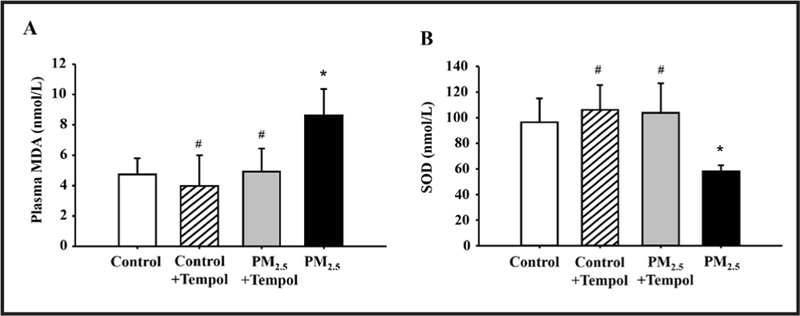
Pregnant Sprague-Dawley rats were given an oropharyngeal drip of PM2.5 (1.0 mg/kg) at gestation day 8, 10, and 12. The blood pressure, 24-hour sodium excretion, and urine volume were measured in the offspring. The expression levels of GRK4 and D1R were determined by immunoblotting. The phosphorylation of D1R was investigated using immunoprecipitation. Plasma malondialdehyde and superoxide dismutase levels were also measured in the offspring.
As compared with saline-treated dams, offspring of PM2.5-treated dams had increased blood pressure, impaired sodium excretion, and reduced D1R-mediated natriuresis and diuresis, accompanied by decreased renal D1R expression and GRK4 expression. The impaired renal D1R function and increased GRK4 expression could be caused by increased reactive oxidative stress (ROS) induced by PM2.5 exposure. Administration of tempol, a redox-cycling nitroxide, for 4 weeks in the offspring of PM2.5-treated dam normalized the decreased renal D1R expression and increased renal D1R phosphorylation and GRK4 expression. Furthermore, tempol normalized the increased renal expression of c-Myc, a transcription factor that regulates GRK4 expression.
In utero exposure to PM2.5 increases ROS and GRK4 expression, impairs D1R-mediated sodium excretion, and increases blood pressure in the offspring. These studies suggest that normalization of D1R function may be a target for the prevention and treatment of the hypertension in offspring of mothers exposed to PM2.5 during pregnancy.
背景/目的:子宫内的不良环境可调节包括血压在内的成年期表型。子宫内暴露于细颗粒物(PM2.5)会导致子代患高血压,但其确切机制尚不清楚。受G蛋白偶联受体激酶4型(GRK4)调控的肾多巴胺D1受体(D1R)在肾钠转运和血压调节中起重要作用。在本研究中,我们确定肾D1R功能障碍是否参与PM2.5诱导的子代高血压。
在妊娠第8、10和12天,给怀孕的Sprague-Dawley大鼠经口滴注PM2.5(1.0mg/kg)。测量子代的血压、24小时钠排泄量和尿量。通过免疫印迹法测定GRK4和D1R的表达水平。使用免疫沉淀法研究D1R的磷酸化。还测量了子代血浆丙二醛和超氧化物歧化酶水平。
与生理盐水处理的母鼠相比,PM2.5处理的母鼠所产后代血压升高、钠排泄受损、D1R介导的利钠和利尿作用减弱,同时肾D1R表达和GRK4表达降低。PM2.5暴露诱导的活性氧化应激(ROS)增加可能导致肾D1R功能受损和GRK4表达增加。在PM2.5处理的母鼠所产后代中给予氧化还原循环氮氧化物tempol 4周,可使降低的肾D1R表达、增加的肾D1R磷酸化和GRK4表达恢复正常。此外,tempol使调节GRK4表达的转录因子c-Myc的肾表达增加恢复正常。
子宫内暴露于PM2.5会增加ROS和GRK4表达,损害D1R介导的钠排泄,并使子代血压升高。这些研究表明,使D1R功能正常化可能是预防和治疗孕期暴露于PM2.5的母亲所产后代高血压的一个靶点。